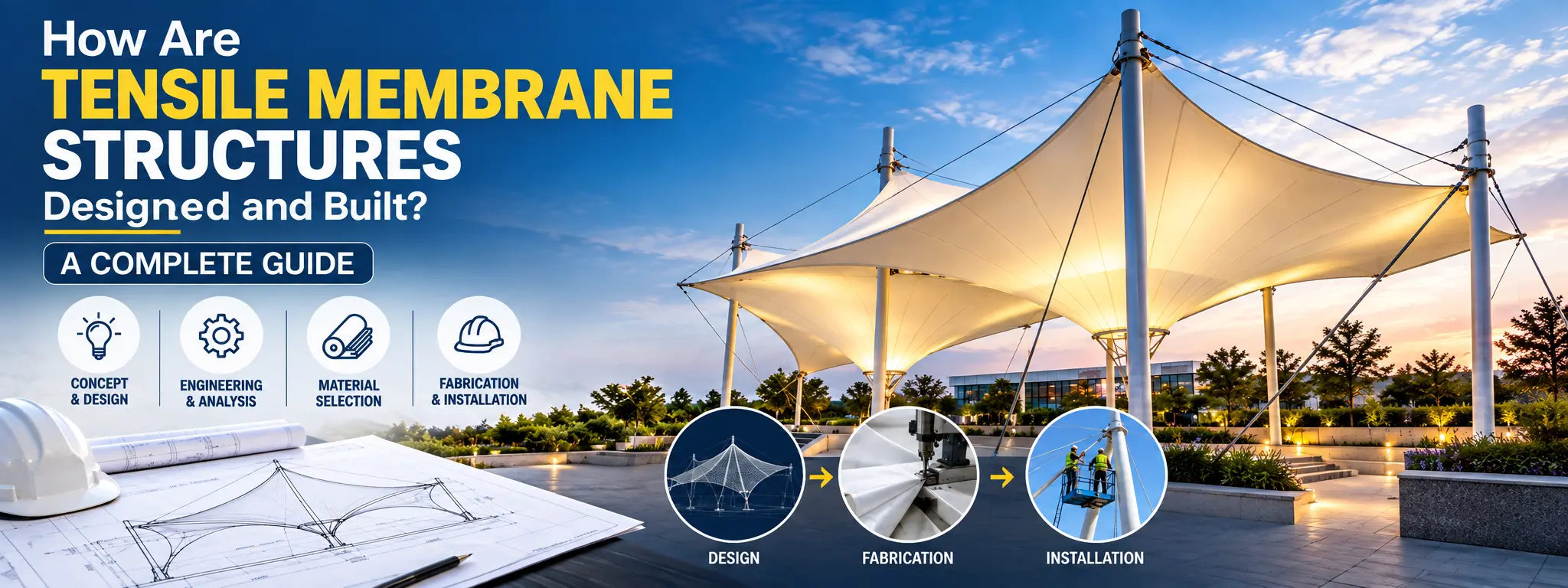
How Are Tensile Membrane Structures Designed and Built? A Complete Guide
A tensile membrane structure is a roofing or shading system built from a high-strength architectural fabric that is stretched and held in tension between steel cables, masts, and anchor points instead of relying on beams or trusses to carry its shape. The tension in the fabric itself is what gives the structure its strength, its curved form, and its ability to shed wind and rain efficiently.
This design approach is why you see it used for stadium roofs, parking canopies, entrance porches, and large industrial sheds — it covers wide spans with far less material and weight than a conventional roof. The rest of this guide walks through exactly how these structures are engineered, what they're made of, how they're built on site, and what to weigh up before choosing one for your own project.
What Is a Tensile Membrane Structure?
A tensile membrane structure is a lightweight structural system where a fabric membrane is pre-stressed into a three-dimensional curved shape and supported by cables, masts, and rigid steel edges. Unlike a flat roof, its double-curved (“anticlastic”) shape keeps the fabric taut, helping prevent water ponding and excessive movement in wind.
The term is commonly used for a fabric membrane structure or membrane tensile structure and, when designed as a roof, is known as a membrane roof structure. Smaller versions providing shade over walkways, entrances, or parking areas are generally called a membrane canopy.
Why Tensile Membrane Structures Are Used So Widely?
Architects and facility planners choose membrane structures for reasons that go beyond appearance:
- Long clear spans without internal columns, useful for stadiums, exhibition halls, and parking areas
- Significantly lower structural weight compared to concrete or conventional steel roofing
- Natural daylighting, since most architectural fabrics transmit some light, reducing daytime lighting costs
- Faster construction timelines once fabrication and engineering are complete
- Design flexibility to create sweeping, sculptural forms that are difficult to achieve with rigid materials
- Good performance in structures needing partial or full weather protection without the enclosed feel of a solid roof
Materials Behind the Structure: PVC-Coated Polyester vs. PTFE Fabric
The fabric is the single most important material decision in the entire project, because it drives cost, lifespan, and light transmission.
| Material | Best For | Main Advantage | Consideration |
|---|---|---|---|
| PVC-coated polyester | Canopies, parking sheds, mid-term architectural fabric structures | Cost-effective, flexible, easier to fabricate into complex shapes | Shorter lifespan than PTFE; surface can degrade faster under intense UV |
| PTFE fabric (PTFE-coated fiberglass) | Stadiums, airports, long-life architectural landmarks | Excellent UV resistance, self-cleaning surface, very long service life | Higher material cost, less flexible during fabrication |
Both are considered structural fabric in engineering terms — meaning they carry load, not just shed water like a tarpaulin. The correct choice depends on budget, expected service life, and the architectural ambition of the project.
Types of Tensile Membrane Structures
- Conical structures — a single central mast supporting a cone-shaped membrane, common for entrance canopies
- Hypar (hyperbolic paraboloid) structures — saddle-shaped forms supported at four points, popular for parking sheds and courtyards
- Barrel vault structures — arched, tunnel-like forms used for walkways and linear coverage
- Cable-net membrane structures — a dense cable grid supporting the fabric, typically used for very large spans like stadiums
- Frame-supported membrane structures — the fabric is stretched over a rigid steel frame rather than relying purely on cable tension
Core Components of a Tensile Structure
Membrane (Fabric)
The pre-stressed fabric skin — either PVC-coated polyester or PTFE — that forms the visible surface and primary load-bearing element.
Cables and Steel Framework
High-strength steel cables define the structure's edges and ridges, transferring load from the fabric to the masts and foundations. Steel edge members and rigid frames may supplement cables depending on the structure type.
Masts and Anchoring System
Vertical or angled masts hold the membrane's high points, while ground anchors and foundations resist the substantial pull-out forces generated by a pre-tensioned fabric roof. Anchoring design is one of the most safety-critical parts of the entire structure.
How Tensile Membrane Structures Are Designed?
Designing a tensile membrane structure is fundamentally different from designing a conventional roof, because the shape itself has to be engineered before anything can be built — the form and the structural performance are inseparable.
How Tensile Membrane Structures Are Designed?
A useful way to think about the design stage is through four sequential questions:
- Form — What double-curved shape will keep the membrane in stable tension across the required span and site conditions?
- Fabric — Which architectural fabric (PVC-coated polyester or PTFE) matches the required lifespan, budget, and light transmission?
- Fixing — How will the membrane connect to cables, edge cables, and masts to distribute stress evenly and avoid tearing at connection points?
- Function — Does the final design meet wind load, snow load (where relevant), drainage, and intended-use requirements for the site?
In practice, this plays out as a technical process:
- Site assessment and load analysis — wind speed, site exposure, soil conditions, and intended span are assessed first.
- Form-finding — specialized structural software determines the equilibrium shape in which the membrane can hold uniform tension. This step cannot be skipped; an incorrectly formed membrane will develop slack areas that flutter or pond water.
- Patterning — the doubly curved 3D surface is unrolled into flat fabric panel shapes ("cutting patterns") that, once seamed and tensioned, recreate the intended 3D form.
- Structural detailing —cable sizes, edge details, mast sections, and foundation loads are finalized based on the form-finding and patterning results.
How Tensile Membrane Structures Are Built (Construction Process)?
Once design is finalized, construction generally follows this sequence:
- Foundation work — footings and anchor points are cast to handle the tension and uplift forces the membrane will exert.
- Steel structure erection — masts, columns, and any supporting steel frame are installed and aligned.
- Cable installation — primary and edge cables are fixed to the steel structure at calculated tension points.
- Fabric fabrication — panels are cut according to the patterning output, then welded (heat or high-frequency welding, depending on the fabric) into the full membrane sheet off-site.
- Membrane lifting and positioning —the fabricated membrane is lifted into place using cranes or manual rigging, depending on scale.
- Tensioning —the membrane is stretched to its designed tension using turnbuckles, winches, or hydraulic jacks, gradually and evenly to avoid localized stress.
- Final fixing and quality checks — edge details, drainage points, and connections are inspected before handover.
Tensioning is typically the most technically sensitive stage — uneven tensioning can leave wrinkles, slack zones, or long-term stress concentrations that shorten the fabric's life.
Common Applications of Tensile Membrane
- Parking sheds and vehicle shading
- Stadium and sports facility roofing
- Entrance canopies and porches for commercial and institutional buildings
- Industrial and warehouse shed roofing
- Food court structure and walkway coverings
- Swimming pool and amphitheater shading
Advantages and Disadvantages of Tensile Membrane
Advantages of Tensile Structure
- Covers large spans with minimal supporting structure
- Reduced dead load compared to conventional roofing
- Good natural light transmission
- Distinctive, modern architectural appearance
- Relatively fast on-site installation once fabrication is complete
Disadvantages of Tensile Structure
- Higher design complexity requires specialized engineering, not standard roofing expertise
- Membrane surface is more vulnerable to punctures, sharp impact, or vandalism than rigid roofing
- Acoustic performance is generally weaker than concrete or metal roofing
- PVC-coated fabrics require replacement sooner than PTFE in high-UV environments
- Not suitable for fully enclosed, insulated, climate-controlled spaces without additional systems
Factors That Affect the Cost of Tensile Membranes
Membrane structure pricing varies significantly project to project, and it's genuinely misleading to quote a flat rate without site-specific detail. Key cost drivers include:
- Span and overall covered area — larger clear spans require heavier cables, masts, and foundations
- Fabric type —PTFE costs more upfront than PVC-coated polyester but can lower lifetime cost through longevity
- Structural complexity — cable-net and multi-mast conical arrangements cost more to engineer and fabricate than a simple hypar canopy
- Site conditions — soil quality, wind exposure, and accessibility for cranes affect foundation and installation costs
- Customization — curved edges, branded color, and architectural detailing add fabrication time
- Site preparation and civil work — foundation depth and reinforcement needed for local soil and wind conditions
Because these variables interact, cost is best assessed through a site-specific consultation rather than a generic price list.
Maintenance and Expected Lifespan of Tensile Membranes
Tensile membrane structures are low-maintenance relative to their scale, but not maintenance-free.
- Routine cleaning — periodic washing removes dust, algae, and pollutants that can degrade coatings over time
- Visual inspection — checking for punctures, seam separation, or slack areas, ideally after major storms
- Cable and connection checks — verifying tension and corrosion status of steel cables and fittings
- Drainage checks — ensuring valleys and drainage points remain clear to prevent water pooling
Typical lifespan depends heavily on fabric choice and environmental exposure: PVC-coated polyester membranes generally offer a shorter functional life than PTFE membranes, which are prized specifically for their long-term UV and weather resistance. Actual figures vary by manufacturer specification, coating quality, and local climate, so it's worth confirming warranty terms directly with your fabricator rather than relying on generic averages.
Common Mistakes to Avoid While Choosing Tensile Membra
- Skipping proper form-finding and assuming a "roughly curved" shape will behave the same as an engineered one
- Choosing fabric purely on upfront price without factoring in UV exposure and expected service life
- Underestimating anchor and foundation loads — tensioned membranes exert much higher uplift forces than static roofing
- Poor tension control during installation — can cause wrinkles, slack areas, and premature fabric fatigue.
- Ignoring drainage design, which can cause ponding and localized fabric stress
- Treating it as a standard roofing project rather than a specialized structural engineering discipline
How to Choose the Right Membrane Structure Supplier?
When evaluating a fabricator or design-build supplier, look for:
- Demonstrated understanding of form-finding and patterning software, not just fabrication
- Clear explanation of fabric specifications (PVC-coated polyester vs. PTFE grade, coating weight, tensile strength)
- Transparent process for structural calculations covering wind and site-specific loads
- A defined maintenance and warranty framework post-installation
- Willingness to walk through design trade-offs rather than pushing a single standard template
If you're planning a project, exploring RS Tensile Private Limited membrane structure services is a reasonable next step to get a site-specific design and material recommendation rather than relying on general guidance alone.
Conclusion
A tensile membrane structure earns its place in modern architecture because it solves a specific problem: covering large, column-free spaces efficiently, using a form that is both structurally sound and visually distinctive. Getting there requires a deliberate sequence — accurate form-finding, the right fabric choice between PVC-coated polyester and PTFE, precise patterning, and careful on-site tensioning — rather than treating it like conventional roofing.
If you're weighing a membrane roof structure, canopy, or larger cable-net installation for an upcoming project, the most useful next step is a site-specific consultation, where span, local wind conditions, and fabric options can be matched to your actual budget and timeline. Reach out to RS Tensile Private Limited to discuss design options suited to your project.
Frequently Asked Questions (FAQs)
How Does Membrane Patterning Turn a 3D Design Into Fabric Panels?
Patterning takes the three-dimensional membrane geometry produced during form-finding and develops it into flat cutting patterns. These panels are then fabricated and joined so they return to the required curved form when installed and tensioned.
Why Can’t a Tensile Membrane Roof Be Designed Like a Conventional Roof?
A conventional roof mainly depends on rigid structural members such as beams and trusses, whereas a tensile membrane depends on pre-stress and curved geometry. The membrane shape, cable arrangement, mast positions, and anchoring system therefore have to be engineered together.
When Should PVC-Coated Polyester Be Chosen Over PTFE Fabric?
PVC-coated polyester can be appropriate for canopies, parking sheds, and projects where flexibility and initial cost are important. PTFE-coated fiberglass is generally considered when longer service life and stronger UV and weather resistance are priorities.
What Makes a Tensile Membrane Structure Suitable for Large Clear Spans?
The membrane works primarily through tension rather than depending on heavy beams across the entire covered area. Combined with cables, masts, and appropriate anchoring, this allows large areas to be covered while keeping the supporting structure relatively lightweight.
What Should Be Checked After a Tensile Membrane Structure Is Installed?
Final checks should include membrane tension, edge connections, cable connections, drainage points, steel alignment, and visible fabric condition. These checks confirm that the installed structure matches the engineered design before handover.
Which Site Conditions Can Change the Design of a Tensile Membrane Structure?
Wind exposure, soil conditions, available installation access, required span, and the intended use of the covered space can all influence the design. These factors affect membrane geometry, cable and mast sizing, foundations, and installation requirements.
