Tensile Roof Structure in India – Manufacturer & Supplier
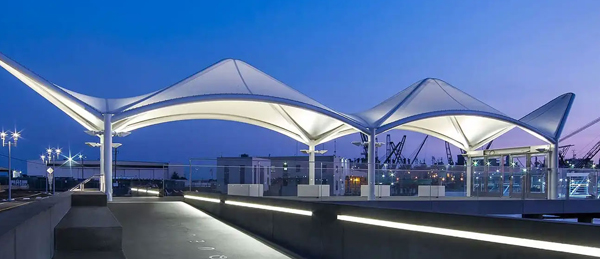
| Product Description | Upgrade your outdoor spaces with our Tensile Roof Structure, a perfect blend of style, durability, and functionality. Order now to protect your assets while adding a touch of modern elegance! |
| Membrane Material | PVC / PTFE / HDPE |
| Fabric Color | White or Customized |
| Shape & Size | Customized |
| Certification | ISO 45001:2018(OHSAS), ISO 45001:2015, ISO 9001:2015 |
| Place of Origin | India |
Order Now
ENQUIRE NOW
When a project needs large-span coverage without a heavy structural framework, a tensile roof structure in India is one of the most practical and visually appealing options available. RS Tensile Pvt. Ltd., led by CEO Radhey Shayam, manufactures and supplies tensile roof structures to clients across the country — from metro cities to smaller towns and industrial zones.
These structures use high-strength fabric membranes stretched over steel frameworks to create weather-resistant, lightweight roofing systems. They work well across commercial, industrial, hospitality, educational, and public infrastructure projects. In a country with climatic extremes ranging from coastal humidity to dry desert heat and Himalayan cold, tensile roofing offers a durable, adaptable solution.
RS Tensile Pvt. Ltd. serves clients in Delhi, Gurgaon, Noida, Greater Noida, Faridabad, Mumbai, Pune, Nagpur, Nashik, Jaipur, Jodhpur, Udaipur, Bikaner, Ajmer, Lucknow, Kanpur, Agra, Mathura, Varanasi, Prayagraj, Meerut, Ghaziabad, Saharanpur, Moradabad, Bareilly, Aligarh, Jhansi, Dehradun, Haridwar, Rishikesh, Mussoorie, Nainital, Haldwani, Rudrapur, Roorkee, and many other locations.
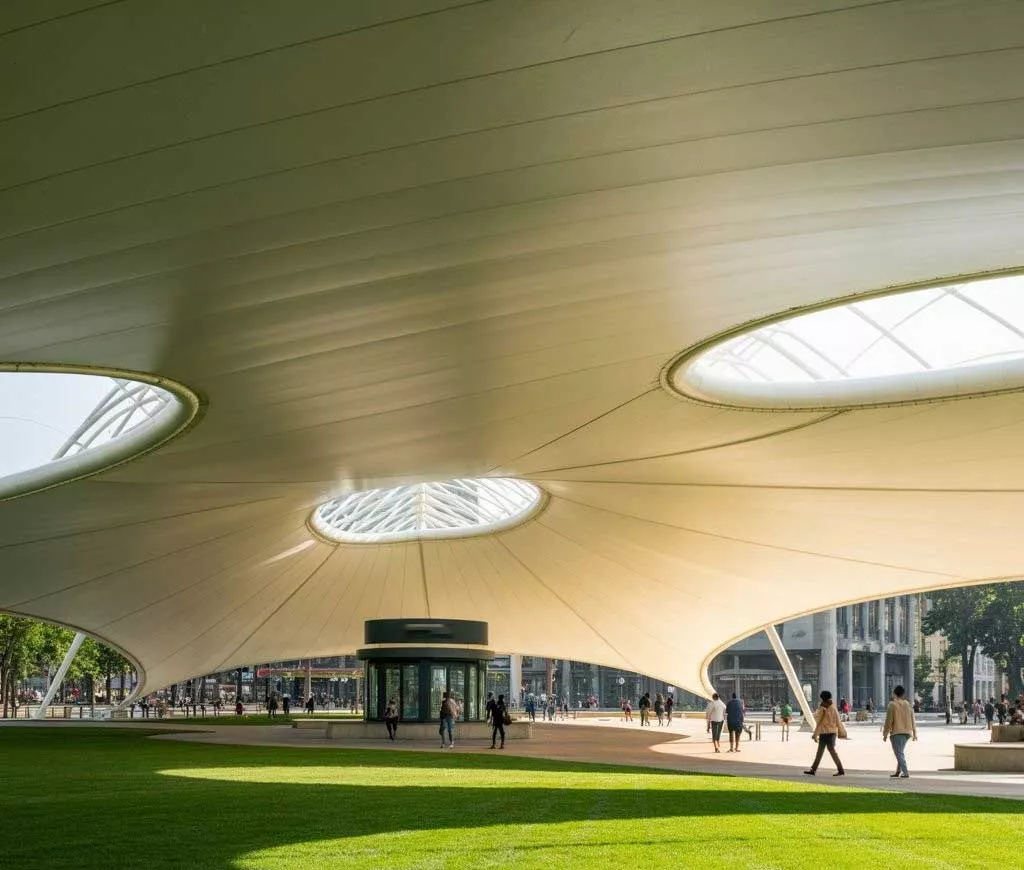
What Is a Tensile Roof Structure?
A tensile roof structure is an architectural roofing system in which a fabric membrane bears load through tension rather than compression. Unlike conventional RCC or metal sheet roofs, these structures do not rely on rigid overhead slabs. Instead, the membrane is anchored to steel masts, cables, or frames — and the geometry of the structure itself provides stability.
The core components of a tensile roof system include:
- High-tensile fabric membrane (HDPE, PVC-coated polyester, or PTFE/glass fibre)
- Steel masts and columns that carry vertical loads
- Structural cables that distribute tension evenly across the fabric
- Anchor points and ground fixings for stability
- Connecting hardware including clamps, turnbuckles, and fittings
Types of Tensile Roof Structures
Different project requirements call for different structural forms. Common types include:
Hypar (Hyperbolic Paraboloid) Structures
Saddle-shaped membranes often used in entry canopies, walkways, and open pavilions. Projects in Shimla, Kasauli, Lansdowne, and Mussoorie often use these forms for aesthetic appeal in hill-station hospitality settings.
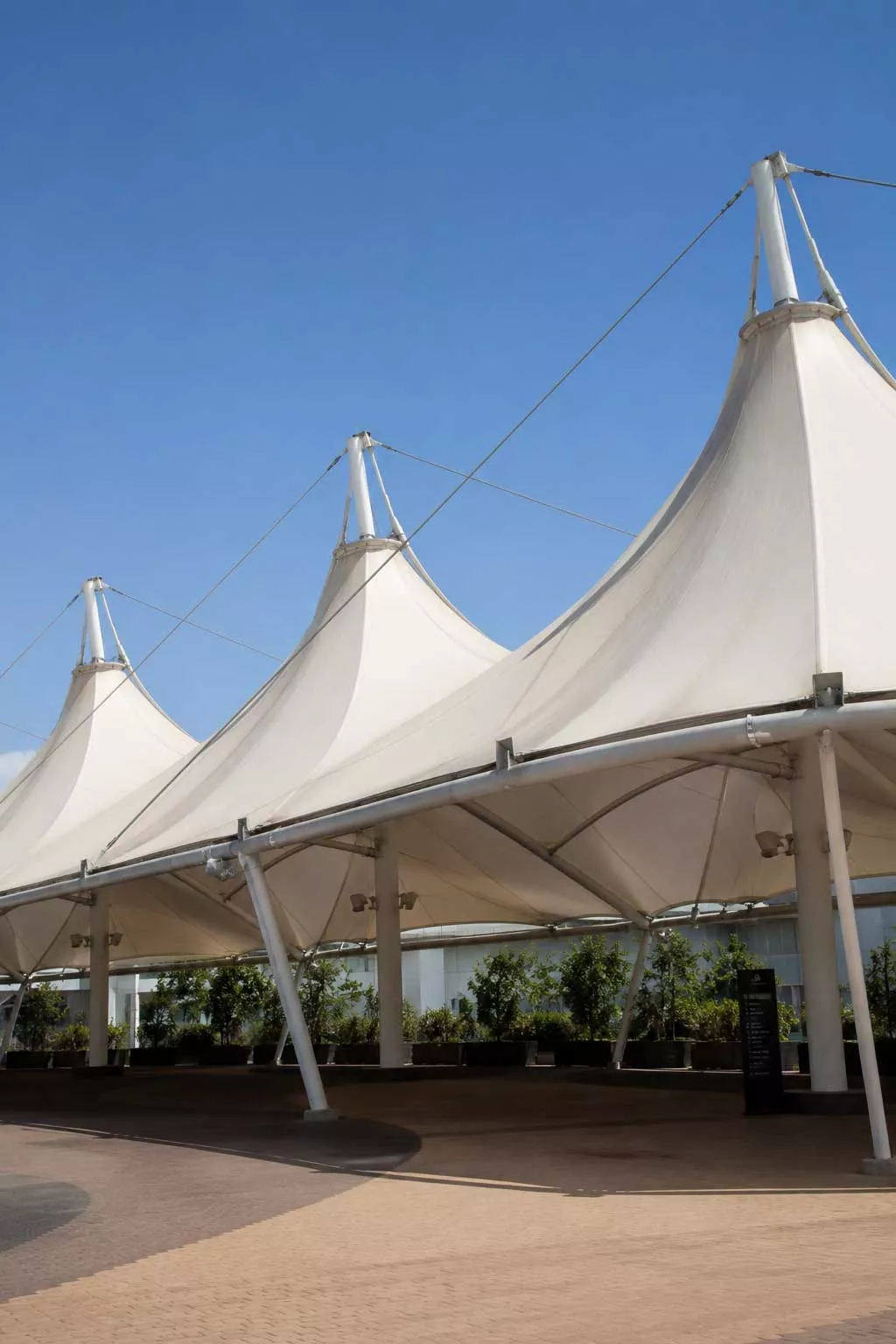
Conical or Mast-Supported Structures
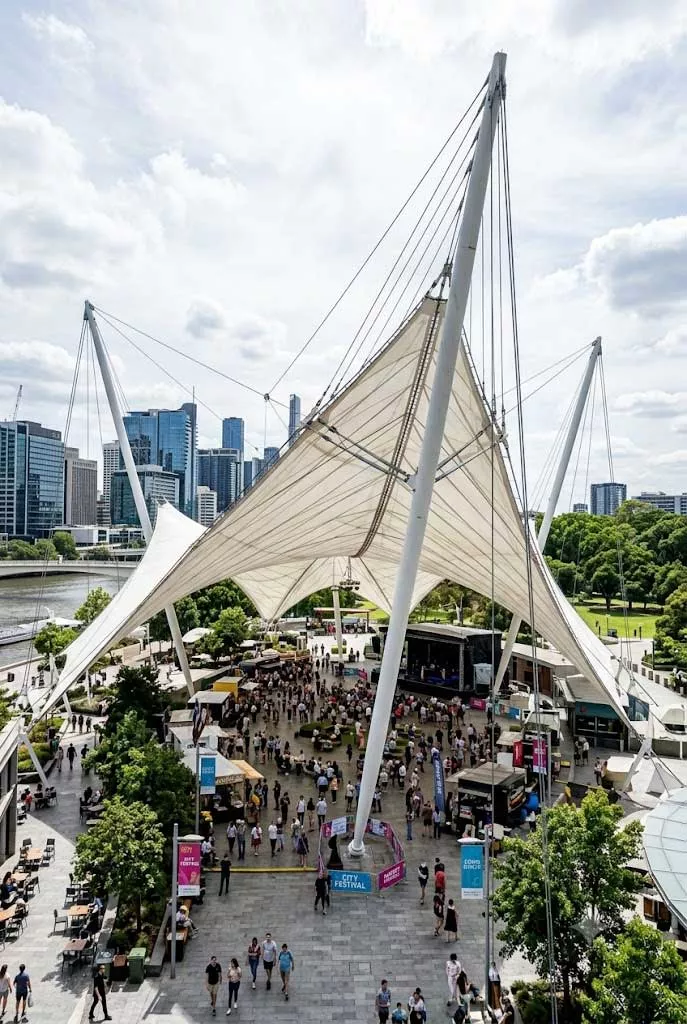
Single or multi-mast designs that create distinctive cone-shaped rooflines. Popular for parking areas, amphitheatres, and resort courtyards in locations like Manali, Kullu, Dalhousie, Pahalgam, and Nainital.
Barrel Vault Tensile Structures
Arched membrane systems suitable for long corridors, petrol stations, or industrial shed roofing. Used frequently in Panipat, Rohtak, Sonipat, Karnal, and Yamuna Nagar industrial estates.
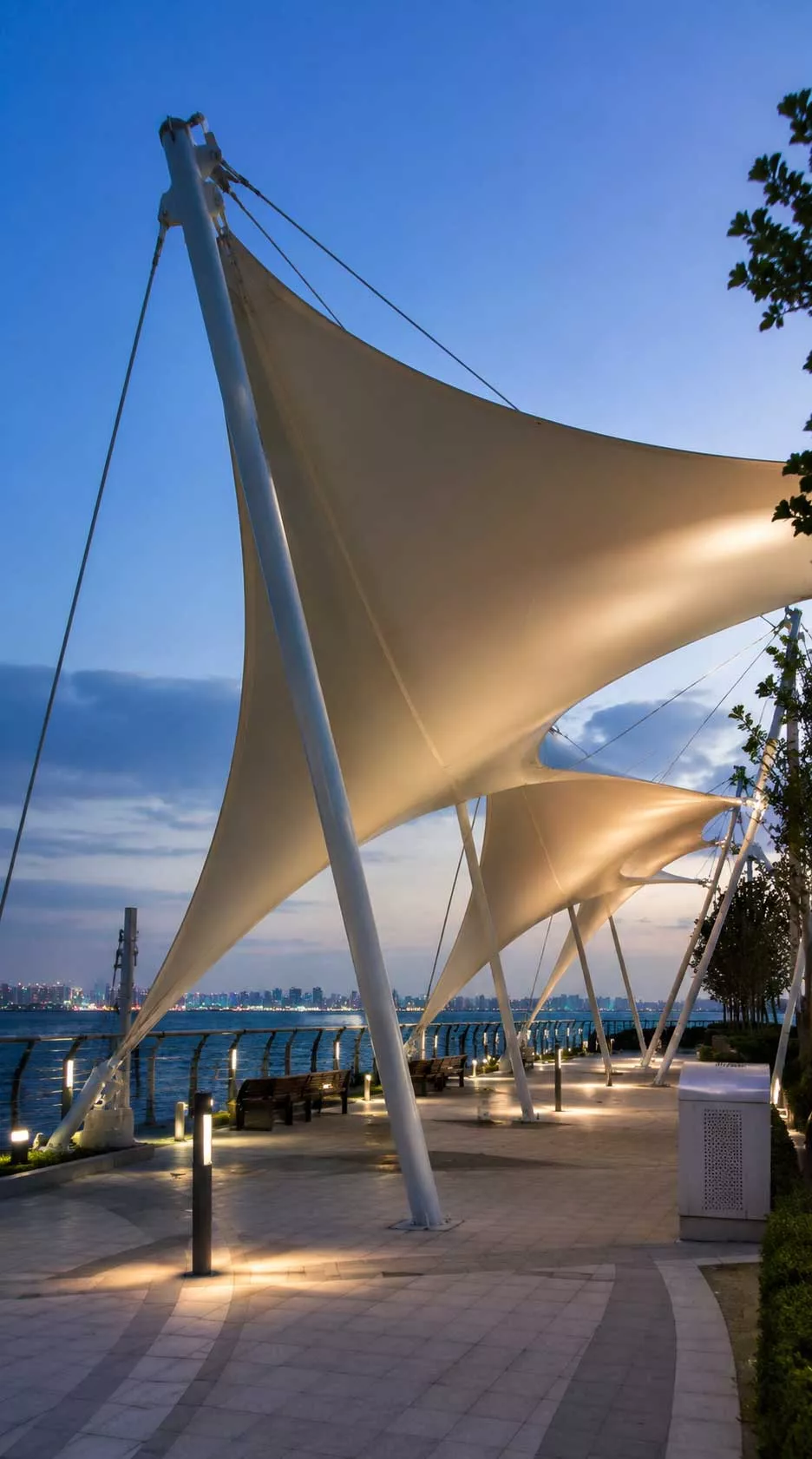
Sail Shade Structures
Flat or angled membrane panels used over outdoor seating, poolside areas, or playgrounds. Common in residential and hospitality projects in Gurgaon, Noida, Dwarka, Rohini, Saket, Greater Noida, and Mahipalpur.
Frame-Supported Tensile Structures
Where membrane is stretched over a rigid steel frame, useful for permanent installations in high wind-load zones such as Jammu, Srinagar, Jammu & Kashmir regions, and coastal Andhra Pradesh.
Key Features of Tensile Roof Structures
High-performance tensile roof structures offer a combination of durability, aesthetics, and functionality, making them suitable for a wide range of commercial, industrial, and hospitality applications.
- Weather Resistance: Quality membranes resist UV radiation, rain, snow loads, and wind pressure, making them suitable for Rajasthan deserts (Jaisalmer, Barmer, Bikaner), Himalayan hill stations, and coastal towns in Andhra Pradesh and Odisha.
- UV Protection: PVC and HDPE membranes block a significant percentage of UV rays, keeping shaded spaces cooler during peak summer in cities like Nellore, Guntur, Vijayawada, and Visakhapatnam.
- Lightweight Construction: The fabric-and-cable system weighs substantially less than conventional roofing, reducing structural loads on foundations and columns.
- Long Service Life: High-quality tensile membranes, when correctly installed and maintained, typically last 15 to 25 years depending on membrane grade and environment.
- Low Maintenance Requirement: Regular cleaning and periodic cable tension checks are usually sufficient. There are no tiles to crack or sheet joints to seal repeatedly.
- Modern Visual Appeal: Clean geometric forms and translucent fabric options give tensile structures a contemporary look that complements both modern commercial buildings and heritage architecture.
- Custom Design Flexibility: Structures can be designed in a wide range of shapes, sizes, and colours to match project branding, site context, or client preference.
Benefits of Choosing a Tensile Roof Structure in India
The practical advantages of tensile roofing are particularly relevant in the Indian context:
- Cost-effective for large spans — Covering a large open area with conventional roofing requires expensive structural steel or concrete. Tensile membranes can span the same area at significantly lower material cost.
- Fast installation — Fabrication happens off-site; on-site work is primarily erection and membrane fixing. This reduces project timelines considerably, a major advantage in commercial and hospitality projects.
- Minimal disruption to existing structures — Anchor points can often be fixed to existing columns or walls, making tensile structures useful for retrofitting shade solutions over existing car parks, courtyards, or walkways.
- Translucency options — Semi-translucent membranes allow diffused natural light through, reducing the need for artificial lighting during daytime and lowering energy consumption in covered spaces.
- Good wind performance when engineered correctly — Pre-stressed membranes with properly calculated cable geometry perform well even in high-wind environments like coastal Odisha, hill stations in Himachal Pradesh, and open plains in Haryana.
- Aesthetic differentiation — A well-designed tensile structure distinguishes a property from conventional buildings, which matters for hospitality, retail, and institutional clients.
Applications of Tensile Roof Structures Across Industries
RS Tensile Pvt. Ltd. has supplied and installed tensile roof structures across a wide range of sectors throughout India:
- Commercial complexes — Entry canopies, walkway covers, and atrium roofing in shopping centres, office parks, and retail hubs in Mumbai, Thane, Pune, Nagpur, Nashik, Aurangabad, Ulhasnagar, Panvel, Vasai, Virar, Bhiwandi, Solapur, Kolhapur, Amravati, and Satara.
- Industrial facilities — Outdoor storage shade, loading bay covers, and factory yard roofing in Baddi, Nalagarh, Paonta Sahib, Rudrapur, Haridwar, Panipat, Sonipat, Rohtak, Bhiwadi, Rewari, Palwal, Samalkha, Bahadurgarh, and Jhajjar.
- Educational institutions — Canteen shades, sports ground covers, and corridor roofing in schools and colleges in Lucknow, Kanpur, Agra, Mathura, Varanasi, Prayagraj, Gorakhpur, Jaunpur, Faizabad, Ayodhya, and Amethi.
- Hotels and resorts — Poolside canopies, outdoor dining shades, and entrance structures in resorts across Shimla, Manali, Kullu, Dalhousie, Dharamsala, Chamba, Kasauli, Mussoorie, Nainital, Rishikesh, Haridwar, Pahalgam, Katra, and Srinagar.
- Hospitals and healthcare — Covered patient waiting areas, ambulance bays, and entry canopies in Gwalior, Jabalpur, Bhopal, Indore, Ujjain, Ratlam, Dewas, Satna, Morena, Bhind, Chhatarpur, Shivpuri, and Itarsi.
- Shopping centres — Large entrance shade structures, food court canopies, and event pavilions in Jaipur, Jodhpur, Ajmer, Udaipur, Kota, Bikaner, Alwar, Bharatpur, Sikar, Dausa, Hanumangarh, Sri Ganganagar, Chittorgarh, Kishangarh, Barmer, Jhunjhunu, Pratapgarh, Dholpur, Hindaun, Pushkar, and Bhilwara.
- Public infrastructure — Bus shelters, metro station canopies, pilgrim rest areas, and public park shading in Varanasi, Mathura, Ayodhya, Sarnath, Fatehpur Sikri, Pushkar, and Tirupati.
- Sports facilities — Spectator stand covers, court shading, and outdoor training facility roofing in Chandigarh, Panchkula, Ambala, Hisar, Sirsa, Fatehabad, Kaithal, Kurukshetra, Jind, Narwana, Hansi, Bhiwani, Una, and Nuh.
- Residential projects — Villa entrance canopies, terrace covers, rooftop shade structures, and poolside pergolas in Gurgaon, Noida, Faridabad, Ghaziabad, Dwarka, Rohini, Saket, Alipur, and Mahipalpur.
Design and Customization Options for Tensile Roof Structures
No two tensile structure projects are identical. RS Tensile Pvt. Ltd. offers customization across every aspect of design and materials:
- Sizes — Structures range from small canopies of 10–20 sq. metres to large span covers exceeding 1,000 sq. metres. Multi-bay configurations allow coverage of even larger areas.
- Shapes — Hypar, conical, barrel vault, flat sail, and combined forms. The structural engineer calculates optimal geometry based on span, wind load, and snow load (relevant for projects in Jammu & Kashmir, Himachal Pradesh, and Uttarakhand hill stations).
- Fabric materials — HDPE knitted shade fabric (cost-effective, 70–95% shade factor), PVC-coated polyester (fully waterproof, durable, wide colour range), and PTFE-coated glass fibre (for permanent high-specification installations).
- Colour options — Available in a full range of colours. White, beige, grey, and sand tones are popular for commercial use; brighter colours suit recreational and branded installations.
- Steel finish — Hot-dip galvanized, powder-coated, or stainless steel hardware options depending on environment (coastal locations like Visakhapatnam, Kakinada, and Brahmapur need corrosion-resistant finishes).
- Lighting integration — Fabric panels can be designed to accommodate integrated LED lighting for night-time visibility and ambience.
- Drainage — Sloped membrane geometry and integrated drainage channels can be designed for locations with heavy monsoon rainfall, including Bhubaneswar, Cuttack, Sambalpur, Rourkela, Dhenkanal, Sundargarh, Balasore, Bargarh, Nabarangpur, Bhawanipatna, Khordha, Puri, and Rajamahendravaram.
Installation Process for Tensile Roof Structures
The installation follows a structured sequence to ensure structural integrity and membrane longevity:
- Site Assessment — A technical team visits the site to assess soil conditions, existing structures, wind exposure, and usage requirements. This is critical for projects in areas with specific load conditions, such as snow-load zones in Pithoragarh, Rudraprayag, Devprayag, Almora, and Chakrata.
- Design Planning — Structural engineers use software to calculate membrane stress, cable pre-tension, mast loads, and anchor forces. Load calculations account for local wind speed, rain intensity, and seismic zone (relevant for Jammu & Kashmir, Himachal Pradesh, and Uttarakhand).
- Fabrication — Steel masts, connecting hardware, and fabric panels are fabricated at the facility. Fabric panels are cut and welded using high-frequency welding or heat-bonding to precise dimensions.
- Structural Assembly — Masts, columns, and base plates are installed on site. Foundation and anchor bolt systems are embedded in concrete as per the structural drawing.
- Fabric Installation — The membrane is unfolded and connected to the structural boundary cables or edge beams. Pre-tensioning is applied systematically to achieve the designed membrane geometry.
- Final Inspection — Cable tensions are checked with calibrated instruments, all hardware connections are verified, and the completed structure is inspected for form accuracy and weatherproofing before handover.
How to Choose a Reliable Tensile Roof Structure Manufacturer in India?
India has a growing number of tensile structure suppliers, but the quality of engineering, materials, and installation varies considerably. Here are practical factors to check:
- Engineering capability — Does the manufacturer employ structural engineers who produce load calculations specific to your site location? This matters especially for high-wind zones like coastal Andhra Pradesh, cyclone-prone Odisha, and snow-load areas in the Himalayas.
- Material specifications — Ask for the fabric grade, weight (gsm), UV stabilisation rating, and tensile strength data. A reliable supplier will share these without hesitation.
- Fabrication facility — A manufacturer with in-house fabrication can control quality and lead times better than a trader who outsources production.
- Installation experience — Tensile structures are not self-correcting. Poor installation leads to membrane wrinkles, fabric damage under wind, and premature failure. Check the team's track record across different structural types.
- After-sales support — Who handles re-tensioning, repairs, or replacement panels if needed after two or three monsoon seasons? This is a question worth asking before signing a contract.
- Project references — A supplier serving projects in diverse locations — from Vizianagaram and Kurnool in Andhra Pradesh to Achalpur and Latur in Maharashtra, from Kathua and Udhampur in Jammu & Kashmir to Jagatsinghpur in Odisha — demonstrates genuine operational breadth.
Why Choose RS Tensile Pvt. Ltd. for Tensile Roof Structure in India?
RS Tensile Pvt. Ltd. operates as a manufacturer — not a trader or agent. This means projects receive factory-direct pricing, direct engineering support, and consistent material quality.
Manufacturer-Direct Supply
Structures are fabricated in-house under controlled quality conditions. Clients deal directly with the production facility.
Engineering-Led Approach
Every project begins with structural design and load analysis. The team accounts for local wind speed data, rainfall intensity, and soil conditions relevant to each city or region.
Pan-India Service Capability
The company supplies and installs tensile roof structures in Haryana, Delhi, Uttar Pradesh, Uttarakhand, Himachal Pradesh, Jammu & Kashmir, Rajasthan, Madhya Pradesh, Maharashtra, Andhra Pradesh, and Odisha, among other states. Whether the site is in a metro like Mumbai or a smaller town like Yanam, Kokernag, Handwara, or Nuh, the team is equipped to deliver.
Custom Project Solutions
From a small 30-square-metre canopy for a residential villa in Sohna to a multi-bay industrial shade covering thousands of square metres in an Udhampur or Bilaspur industrial estate, projects are engineered to specific site requirements.
Quality Material Sourcing
Fabric membranes, steel sections, and connecting hardware are sourced from verified suppliers. Material certificates can be provided on request.
Timely Execution
Project timelines are discussed at the planning stage and monitored through fabrication and installation. The company maintains its own installation crew for direct control over field work.
Conclusion
A tensile roof structure in India is a technically sound and visually distinctive roofing solution for a wide range of applications — from car parks and hotel courtyards to industrial shade and public infrastructure canopies. The combination of lightweight construction, weather resistance, large-span capability, and design flexibility makes these structures a practical choice for projects across different climatic zones and sectors.
RS Tensile Pvt. Ltd., under the leadership of Radhey Shayam, manufactures and supplies tensile roof structures across India — serving commercial, industrial, hospitality, educational, government, and residential clients from the northern plains to the southern coasts, from Himalayan hill stations to arid Rajasthan towns. With in-house engineering, fabrication, and installation capability, the company manages projects from initial site assessment to final handover.
Whether your project is in a major metro or a smaller location like Yanam, Kokernag, Nalagarh, Lansdowne, or Jagatsinghpur — contact RS Tensile Pvt. Ltd. to discuss your requirements and receive a project-specific design proposal.
FAQs About Tensile Roof Structures
1. What is the typical lifespan of a tensile roof structure?
The lifespan depends on fabric grade and environment. HDPE shade fabric typically lasts 8–12 years; PVC-coated polyester 15–20 years; PTFE glass fibre 25–30 years. In coastal locations like Visakhapatnam, Brahmapur, or Kakinada, marine-grade hardware extends the structural life.
2. Can a tensile roof structure handle heavy monsoon rainfall?
Yes, if designed correctly. PVC-coated polyester membranes are fully waterproof. The structure's geometry — particularly the slope and drainage routing — must be engineered for the rainfall intensity of the project location. Cities in Odisha like Cuttack, Puri, and Sambalpur receive very heavy monsoon rainfall, and structures in these areas are designed with steeper slopes and integrated drainage.
3. Are tensile roof structures suitable for high-wind zones?
A properly engineered tensile structure handles wind well because the pre-stressed membrane has no flat surface to catch wind uniformly. Coastal Andhra Pradesh (Vizianagaram, Rajamahendravaram, Guntur, Ongole, Nellore, Chittoor), Odisha, and Himalayan hill station zones all have higher wind exposure, and structures for these areas are designed to higher wind load standards.
4. Can a tensile roof structure be installed over an existing building or car park?
Yes. Many clients retrofit tensile structures over existing concrete car parks, courtyards, or walkways. Anchor points are designed to connect to existing columns or new footings added within the space. This is a common requirement in commercial complexes in Panvel, Bhiwandi, Vasai, Virar, and Thane in Maharashtra.
5. What maintenance does a tensile roof structure require?
Periodic cleaning of the membrane surface with mild detergent and water removes dust and biological growth. Cable tensions should be checked every 12–18 months and adjusted if needed. Hardware connections, including clamps and turnbuckles, should be inspected for corrosion annually, especially in coastal or high-humidity zones.
6. Do you provide customised tensile roof structure designs?
Yes. All projects at RS Tensile Pvt. Ltd. are custom-engineered. The structural form, membrane colour, fabric grade, and hardware finish are specified to match the project's functional requirements and visual context. Clients provide site drawings and usage details; the team prepares a design proposal accordingly.
7. How long does installation of a tensile roof structure take?
A small to medium structure (50–200 sq. metres) typically takes 3–7 days of on-site work after fabrication is complete. Larger or more complex installations in commercial complexes or public infrastructure projects take longer depending on site access and structural configuration. Fabrication lead time is usually 2–4 weeks.
8. Is a tensile roof structure suitable for cold and snowy locations in India?
Yes, for locations in Himachal Pradesh (Shimla, Manali, Mandi, Chamba, Dalhousie, Kasauli), Uttarakhand (Mussoorie, Nainital, Almora, Pithoragarh, Chakrata, Devprayag, Rudraprayag), and Jammu & Kashmir (Pahalgam, Srinagar, Anantnag, Kokernag, Handwara, Katra, Kathua, Udhampur), snow load is incorporated into the structural design. Steeper membrane geometry helps snow shed naturally rather than accumulate.
9. Do you serve smaller towns and tier-2 or tier-3 cities in India?
Yes. RS Tensile Pvt. Ltd. supplies tensile roof structures to projects across India, including smaller towns such as Bargarh, Nabarangpur, Bhawanipatna, Khordha, Dhenkanal, Sundargarh, Jagatsinghpur in Odisha; Achalpur, Latur, Jalgaon in Maharashtra; Hindaun, Dausa, Bhind, Morena, Satna in Rajasthan and Madhya Pradesh; and Amethi, Faizabad, Jaunpur, Chhatarpur in Uttar Pradesh.
10. What information is needed to get a quotation for a tensile roof structure?
To prepare an accurate estimate, the team needs: approximate dimensions of the area to be covered, the intended use (car parking, entrance canopy, outdoor seating, etc.), the city or region (for wind and snow load data), any specific fabric or colour preferences, and site photographs or drawings if available.
