Tensile Walkway Structure in India

| Product Description | Tensile Walkway Structure is a Durable, weather-resistant, and stylish shading solution for walkways. Made from premium materials with customizable sizes and colors. Enhance your space today! |
| Membrane Material | PVC / PTFE / HDPE |
| Fabric Color | White or Customized |
| Shape & Size | Customized |
| Certification | ISO 45001:2018(OHSAS), ISO 45001:2015, ISO 9001:2015 |
| Place of Origin | India |
Order Now
ENQUIRE NOW
A tensile walkway structure in India has become one of the most practical solutions for covered pedestrian pathways in both urban and semi-urban settings. Whether it is a factory corridor, a hospital passage, a resort pathway, or a public walkway near a heritage site, these structures offer reliable overhead protection without the bulk of conventional construction.
RS Tensile Pvt. Ltd. manufactures and supplies tensile walkway structures across India — from small towns to major cities — serving clients in industries that demand functional, weather-resistant, and visually clean infrastructure.
India's climate varies enormously by region. The coastal humidity in Odisha, the intense summer heat of Rajasthan, the heavy monsoons in Maharashtra, the cold winters of Himachal Pradesh — all of these conditions demand structures that are designed with local weather in mind. A well-built tensile walkway structure holds up through all of this without needing frequent repair or replacement.
What Is a Tensile Walkway Structure?
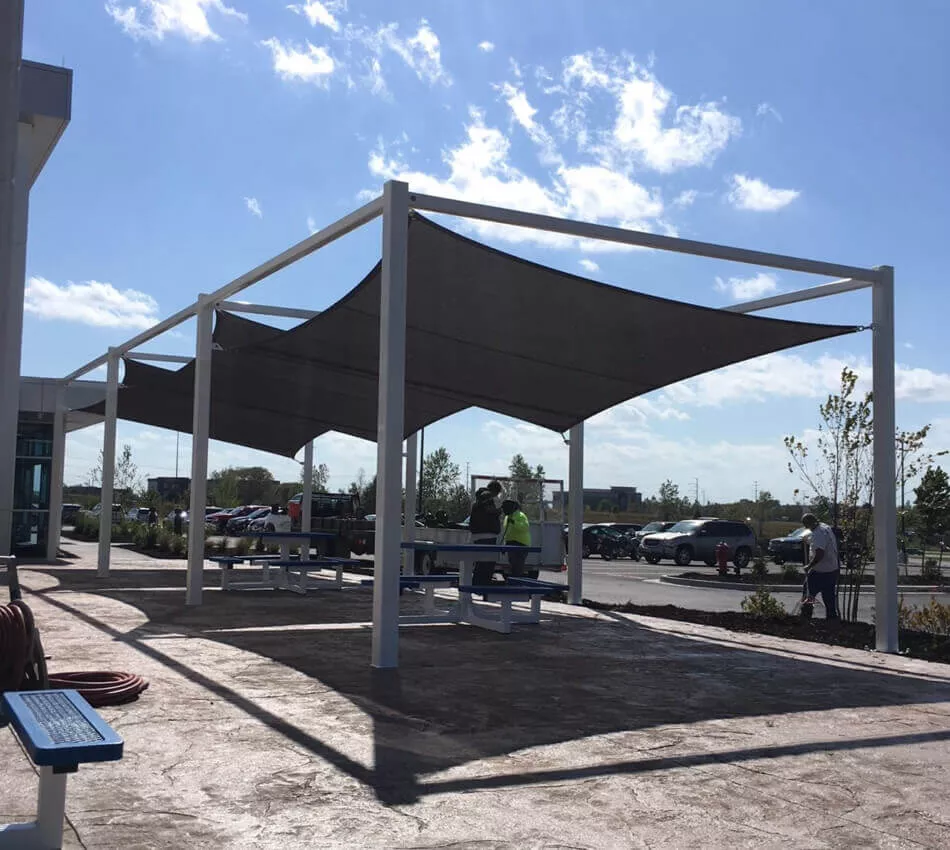
A tensile walkway structure is a covered pathway system that uses high-strength fabric membranes stretched over a steel or aluminium framework. The tension in the fabric gives the structure its rigidity and shape — no solid roof panel or heavy truss is required.
The primary components include structural steel columns or posts, horizontal and diagonal bracing members, anchor and connection fittings, and a tensioned architectural fabric membrane. The fabric is typically made of PVC-coated polyester or PTFE-coated fibreglass, both of which are UV-resistant and weatherproof.
These structures work on the principle of pretension — the fabric is stretched tight between fixed points so it distributes loads efficiently without sagging or buckling. This makes them suitable for spanning large open widths without intermediate supports.
Key Features of Tensile Walkway Structures
Durability
The steel framework and tensioned membrane together provide a structure that withstands wind, rain, and thermal cycling. Properly fabricated structures last 15 to 25 years with routine upkeep.
Weather Resistance
The fabric membrane is waterproof and does not allow moisture penetration. Drainage is typically built into the design through sloped profiles that direct rainwater away from the walkway.
UV Protection
PVC and PTFE fabrics used in these structures include UV-inhibiting compounds. This prevents colour fading and degradation from prolonged sun exposure, which is especially important in cities like Varanasi, Agra, and Jaisalmer where solar radiation is high.
Low Maintenance
Once installed, tensile walkway structures require minimal ongoing attention. Periodic cleaning of the membrane and inspection of tension fittings are usually sufficient to maintain performance.
Modern Visual Appeal
The clean lines, fabric curves, and minimal visible structure give tensile walkways a contemporary look. They integrate well into commercial, institutional, and public environments.
Custom Design Options
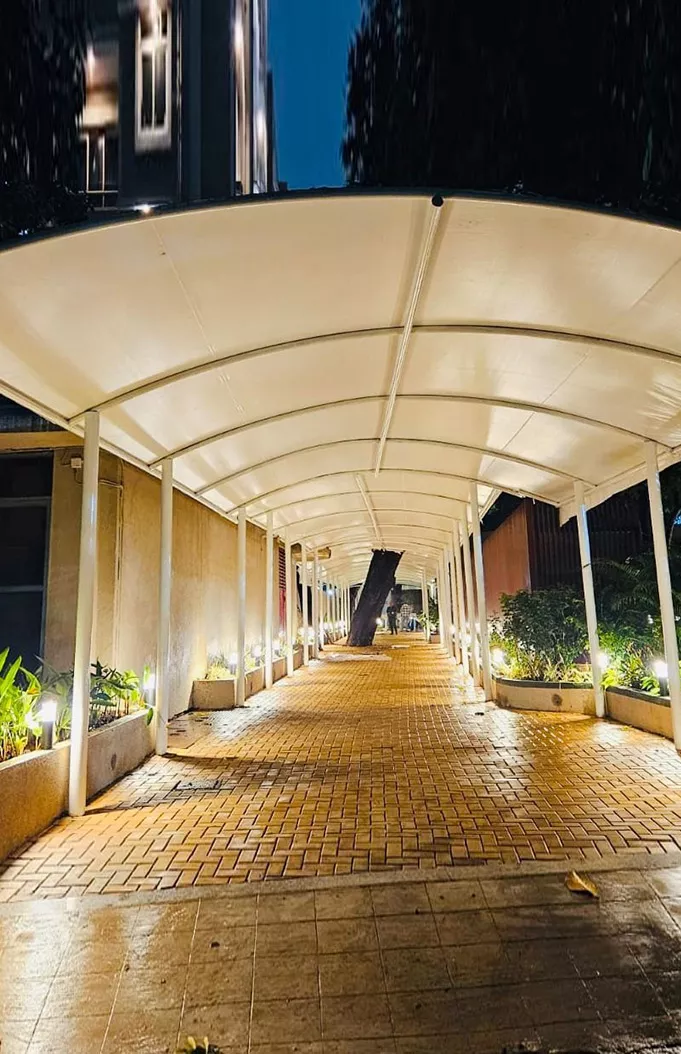
Tensile walkway structures can be configured in various shapes — flat, arched, barrel-vaulted, or wave-form. Width, height, column spacing, and fabric colour can all be adapted to project requirements.
Long Service Life
With quality materials and correct installation, these structures function reliably for many years even in demanding environments like those near the coast in Visakhapatnam or Balasore, or in the high humidity of regions like Puri and Brahmapur.

Benefits of Choosing a Tensile Walkway Structure in India
There are several practical reasons why builders, facility managers, and project developers across India choose tensile walkway structures over conventional alternatives.
- Cost Effectiveness: Tensile structures typically cost less than RCC or steel-sheet roofed walkways of comparable span. The savings come from lighter foundations, faster fabrication, and reduced labour during installation.
- Fast Installation: Most tensile walkway projects can be completed in days or weeks rather than months. This is valuable in commercial and industrial settings where downtime must be minimised.
- Structural Flexibility: The system can be configured to navigate curves, slopes, and irregular site geometries. This makes it suitable for heritage areas like Fatehpur Sikri and Sarnath where site constraints are significant.
- Large Span Coverage: Tensile membranes can cover wide walkways — often 4 to 12 metres or more — without requiring columns in the middle of the path. This keeps the walkway clear and safe for pedestrian movement.
- Aesthetic Value: In locations like Rishikesh, Pushkar, or Mussoorie, visual appearance matters to property owners and local authorities. Tensile structures blend form and function in a way that conventional canopy materials often cannot.
- Light Transmission: Semi-translucent fabric options allow diffused natural light into the walkway. This reduces the need for daytime artificial lighting and creates a pleasant environment for users.
Applications of Tensile Walkway Structures Across Industries
Tensile walkway structures are used across a wide range of sectors throughout India. Below are the key application areas where these structures serve a practical purpose.
- Commercial Complexes: Shopping centres in cities like Noida, Gurgaon, Pune, and Mumbai install tensile walkways to connect buildings, parking areas, and entrance zones while keeping shoppers protected from the elements.
- Industrial Facilities: Manufacturing units and warehouses in places like Baddi, Bhiwadi, Dewas, and Panipat use covered walkways to ensure safe pedestrian movement between production areas, offices, and loading docks.
- Educational Institutions: Schools and colleges across Haryana, Uttar Pradesh, and Madhya Pradesh install covered walkways between classrooms, hostels, libraries, and administrative blocks to keep students and staff protected during rain.
- Hotels and Resorts: Properties in tourist destinations such as Manali, Kasauli, Dalhousie, Pahalgam, and Kokernag use tensile walkways to create sheltered outdoor pathways that complement the resort's design language.
- Hospitals and Healthcare Centres: Medical campuses in cities like Lucknow, Bhopal, Nagpur, and Hyderabad use covered walkways to connect OPD blocks, wards, diagnostic centres, and car parks, ensuring patients and visitors stay dry during rain.
- Shopping Centres: Large retail formats in Thane, Rohini, Greater Noida, and Faridabad rely on tensile walkways to improve customer circulation and reduce congestion near entrances.
- Public Infrastructure: Government projects in cities including Ayodhya, Katra, Tirupati, and Puri are increasingly incorporating tensile walkway structures near pilgrimage sites, bus terminals, and public parks.
- Sports Facilities: Stadiums, sports academies, and multi-purpose courts in places like Kanpur, Vijayawada, and Indore benefit from covered pathways that link spectator areas, change rooms, and parking zones.
- Residential Projects: Gated communities and apartment complexes in areas like Mahipalpur, Saket, Panvel, and Vasai install tensile walkways as covered paths from car parks to lobbies, and between amenity blocks.
- Government and Institutional Projects: Civic bodies and state government departments in Rajasthan, Andhra Pradesh, Jammu & Kashmir, and Uttarakhand have procured tensile walkway structures for public installations at heritage sites, railway stations, and administrative campuses.
Design and Customization Options for Tensile Walkway Structures
No two project sites are exactly alike. RS Tensile Pvt. Ltd. works with clients to develop tensile walkway structures that meet their specific functional and aesthetic requirements.
- Sizes and Spans: Walkway widths typically range from 2 metres to 12 metres or more. Custom widths, heights, and lengths are available depending on site requirements.
- Shapes and Profiles: Options include flat canopy, single-arch, double-arch, barrel vault, wave form, and hypar (hyperbolic paraboloid) configurations. Each shape suits different structural and visual needs.
- Structural Materials: Mild steel with hot-dip galvanisation or powder coating is the standard choice. Stainless steel components are available for coastal or high-humidity installations, such as projects in Balasore, Kakinada, or Brahmapur.
- Fabric Choices: PVC-coated polyester is the most common choice — it is durable, available in many colours, and cost-effective. PTFE-coated fibreglass offers greater longevity and is used for long-term or premium installations. Fire-retardant fabric grades are available for regulated environments.
- Colour Options: Fabric membranes are available in white, grey, cream, blue, and custom RAL colours. The powder coating on steel can also be colour-matched to project branding or surroundings.
- Project-Specific Customization: Sites in pilgrimage towns like Haridwar, Mathura, or Rishikesh may require culturally appropriate finishes. Industrial parks in Rudrapur, Sonipat, or Itarsi may prioritise functional load ratings. RS Tensile accommodates these specific requirements during the design phase.
Installation Process for Tensile Walkway Structures
Installation of a tensile walkway structure follows a structured process to ensure accuracy, safety, and long-term performance. Here is an outline of the typical workflow.
Site Assessment
A technical team visits the project location to evaluate ground conditions, available space, existing structures, drainage requirements, and wind load considerations. This step is done whether the project is in Dehradun, Vizianagaram, Kolhapur, or Amravati.
Design Planning
Based on site data, engineers prepare structural drawings, load calculations, and fabric layout plans. The design is reviewed against local wind and load codes before fabrication begins.
Fabrication
Steel components are fabricated in a controlled workshop environment. Fabric panels are cut to precise dimensions and fitted with edge ropes, sleeves, or plates as required by the connection system.
Structural Assembly
Columns, beams, and bracing members are installed on-site. Anchor bolts are set into concrete footings. All steel-to-steel connections are checked for correct torque and alignment.
Fabric Installation
The tensioned fabric membrane is attached to the steel frame using edge fittings. Pre-tensioning is applied progressively to achieve the correct geometry and surface stress. This step requires trained personnel and proper tensioning equipment.
Final Inspection
After installation, the full structure is inspected for correct tension levels, drainage flow, connection integrity, and fabric surface condition. Any adjustments are made before the walkway is handed over to the client.
How to Choose a Reliable Tensile Walkway Structure Manufacturer in India?
With many suppliers operating across the country, selecting the right manufacturer for your tensile walkway structure project requires careful evaluation. Here are the key factors to consider.
Technical Competence
Verify that the manufacturer has in-house structural engineering capability. A reliable tensile walkway structure supplier in India should be able to provide load calculations, material specifications, and engineering drawings.
Material Transparency
Ask about the grade and source of steel used, the fabric brand, and the type of surface treatment applied. Responsible manufacturers are open about what goes into their products.
Project Portfolio
Review completed projects in conditions similar to yours. A manufacturer supplying tensile walkway structures in Jagatsinghpur, Rourkela, Dhenkanal, and Sambalpur has different exposure than one limited to metro cities.
Installation Capability
Check whether the company handles fabrication and installation through its own workforce or relies entirely on sub-contracting. In-house installation teams tend to maintain more consistent quality standards.
After-Sales Support
Ask about warranty terms, spare parts availability, and response times for post-installation issues. This matters especially if your project is in a location like Yanam, Chakrata, Handwara, or Nabarangpur, which may have longer logistics lead times.
Compliance
The manufacturer should follow relevant Indian standards for steel fabrication and structural safety. Projects near high-wind or seismic zones — such as those in Jammu & Kashmir, Uttarakhand, or coastal Andhra Pradesh — require this especially.
Why Choose RS Tensile Pvt. Ltd. for Tensile Walkway Structures in India?
RS Tensile Pvt. Ltd. has worked on tensile walkway structure projects across multiple Indian states, including Uttar Pradesh, Rajasthan, Haryana, Himachal Pradesh, Odisha, Maharashtra, Andhra Pradesh, Madhya Pradesh, and Uttarakhand.
Industry Experience: The company has accumulated hands-on experience across diverse project types — from small institutional walkways to large-span industrial corridor covers. This breadth helps the team anticipate site-specific challenges before they arise.
Skilled Engineering and Installation Team: RS Tensile employs engineers and trained installation crews who understand both the design and practical aspects of tensile structures. Projects in cities like Gwalior, Bhilwara, Ujjain, Satara, Jalgaon, and Latur are managed with the same attention as metro assignments.
Quality Materials: The company sources steel, fabric, and fittings from reputed suppliers. Material quality is verified at intake and documented as part of project records.
Nationwide Service: RS Tensile has the logistics and installation reach to serve clients in smaller towns such as Hindaun, Dholpur, Barmer, Kaithal, Jind, Palwal, Samalkha, Narwana, and Hansi — not just the major urban centres.
Project Support: From the first site visit through to final handover, clients receive technical guidance and clear communication. This is particularly useful for first-time buyers of tensile structures.
Custom Engineering Solutions: Unusual sites — such as irregularly shaped corridors, sloped grounds, or areas with restricted anchor points — are handled through site-specific engineering rather than off-the-shelf configurations.
Conclusion
A tensile walkway structure in India is a practical, cost-effective, and visually sound solution for covered pedestrian pathways across a wide range of project types. From industrial corridors in Bhiwadi and Noida to resort pathways in Kasauli and Pahalgam, from hospital campuses in Bhopal and Aurangabad to public walkways near pilgrimage sites in Katra and Ayodhya — these structures deliver reliable performance without requiring heavy construction or excessive maintenance.
RS Tensile Pvt. Ltd. manufactures and supplies tensile walkway structures to clients across India. The company handles projects from initial design through to installation and final handover, working across states including Rajasthan, Haryana, Uttar Pradesh, Madhya Pradesh, Maharashtra, Andhra Pradesh, Odisha, Himachal Pradesh, Uttarakhand, Delhi, and Jammu & Kashmir.
If you are planning a tensile walkway structure project — whether in a major city or a smaller location — contact RS Tensile Pvt. Ltd. to discuss your requirements. The team will review your site conditions and provide a solution designed to perform for years to come.
FAQs About Tensile Walkway Structures
What is the typical lifespan of a tensile walkway structure?
A well-constructed tensile walkway structure generally lasts 15 to 25 years. Lifespan depends on the quality of materials used, installation accuracy, and the maintenance regime followed. Structures installed in high-UV or coastal environments — such as in Ongole, Nellore, Kakinada, or Guntur — may require fabric replacement earlier than those in milder climates.
Is a tensile walkway structure suitable for heavy rainfall regions?
Yes. The fabric membrane used in these structures is waterproof and the profiles are designed with drainage in mind. Sloped surfaces or integrated drainage channels direct water away from the walkway. This makes them suitable for high-rainfall areas across Maharashtra, Odisha, and the North-East facing slopes of Uttarakhand.
Can a tensile walkway structure withstand strong winds?
Tensile walkway structures are engineered to meet local wind load requirements. The design is developed based on the wind zone of the installation site. Projects in Jaisalmer, Bikaner, Sri Ganganagar, Barmer, and other high-wind regions of Rajasthan are designed with higher safety margins.
Do you provide customised tensile walkway structure designs?
Yes. RS Tensile Pvt. Ltd. provides project-specific designs based on site dimensions, load requirements, aesthetic preferences, and budget parameters. Custom fabric colours, steel finishes, and structural configurations are all possible.
Do you supply and install tensile walkway structures across India?
RS Tensile Pvt. Ltd. serves clients across India. Past and ongoing projects span locations including cities and towns in Uttar Pradesh, Rajasthan, Haryana, Himachal Pradesh, Madhya Pradesh, Maharashtra, Andhra Pradesh, Odisha, Uttarakhand, and Delhi NCR. Whether the project is in Almora, Bhawanipatna, Achalpur, Kathua, or Udhampur, the company can assess and execute the work.
What maintenance does a tensile walkway structure require?
Maintenance is generally limited to periodic washing of the fabric membrane to remove dust and biological growth, inspection of tension fittings and connection points once or twice a year, and repainting or re-coating of steel components every few years depending on environmental conditions.
What fabric materials are available for tensile walkway structures?
The two main fabric options are PVC-coated polyester, which is the standard for most projects, and PTFE-coated fibreglass, which is used for premium or long-life installations. Both are UV-resistant, waterproof, and fire-retardant grades are available.
How long does it take to install a tensile walkway structure?
Installation time depends on the size and complexity of the project. A standard walkway of 20 to 50 metres can typically be installed in one to two weeks. Larger projects or those in remote locations such as Devprayag, Rudraprayag, Lansdowne, or Pithoragarh may take slightly longer due to logistics.
Can tensile walkway structures be installed on uneven or sloped ground?
Yes. The column heights and base plate positions can be adjusted to accommodate ground level variations. This makes the system practical for hillside resorts in Manali, Dharamsala, Chamba, or Shimla where perfectly flat sites are rare.
What is the cost of a tensile walkway structure in India?
Cost depends on the span, length, fabric type, steel specification, site conditions, and location. Projects in accessible urban locations will differ in cost from those in remote areas. RS Tensile provides detailed quotations after reviewing project requirements.
