Tensile Architecture Design in India

| Product Description | Combine form and function with the Tensile Architecture Design Structure—the ideal solution for practical and aesthetic outdoor protection. Order yours today to elevate your space with innovative design! |
| Membrane Material | PVC / PTFE / HDPE |
| Fabric Color | White or Customized |
| Shape & Size | Customized |
| Certification | ISO 45001:2018(OHSAS), ISO 45001:2015, ISO 9001:2015 |
| Place of Origin | India |
Order Now
ENQUIRE NOW
Tensile architecture design in India has grown from a niche engineering concept into a mainstream structural solution adopted across sectors — from airports and stadiums to resorts, parking facilities, and public plazas. At its core, tensile architecture uses pre-stressed fabric membranes supported by cables, masts, and steel frames to create covered spaces without the need for load-bearing walls or rigid roof panels.
RS Tensile Pvt. Ltd., led by CEO Radhey Shayam, manufactures and supplies tensile structures across India, working with project owners, architects, contractors, and government agencies to design and deliver fabric-based structures tailored to each site's functional and aesthetic requirements.
Whether the project is in a bustling city like Gurgaon or Noida, a heritage town like Pushkar or Mathura, a hillside location like Shimla or Mussoorie, or a coastal setting in Visakhapatnam or Puri — tensile architecture adapts to diverse climatic and site conditions across the country.
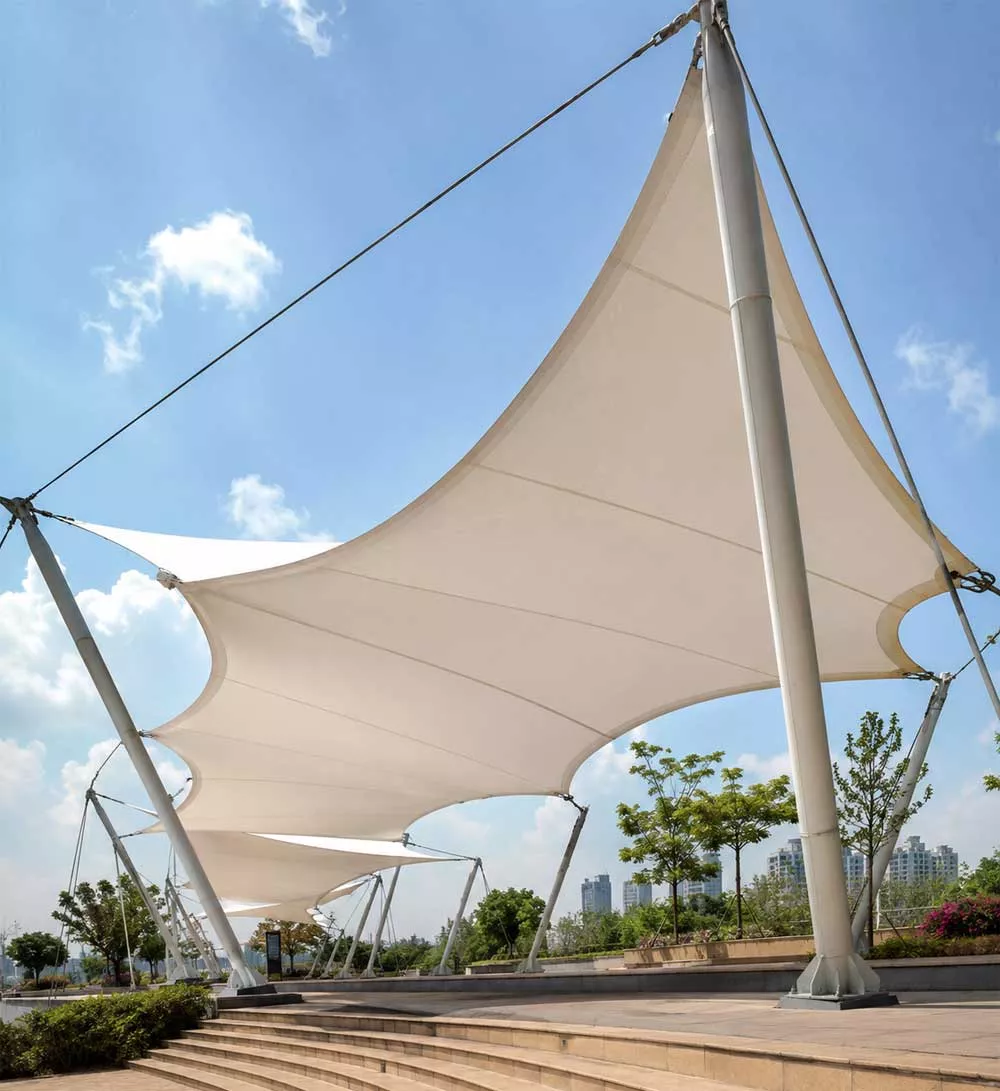
What Is Tensile Architecture Design?
Tensile architecture design refers to the engineering and creative process of developing structures where fabric membranes carry structural loads through tension rather than compression. Unlike conventional construction where roof panels or slabs are rigid, tensile structures work by pulling the membrane taut, which gives it rigidity, strength, and shape.
The key components of a tensile architecture system include:
- High-tensile coated fabric (PVDF, PTFE, HDPE, or PVC-coated polyester)
- Steel or aluminium support frames and masts
- Stainless steel cables and tensioning hardware
- Anchor foundations and connection fittings
- Edge plates, clamps, and perimeter fixing systems
The design process involves computational form-finding, structural load analysis (wind, snow, live loads), fabric stress distribution modelling, and CAD-based 3D design. The result is a structure that is both structurally sound and visually distinctive.
Types of Tensile Structures Used in Architecture
There is no single form for tensile architecture. The design language varies widely depending on the project's span, function, and site conditions. Common structural types include:
Hypar (Hyperbolic Paraboloid) Structures
These saddle-shaped forms are among the most recognisable in tensile architecture. They appear in airports, retail entrances, and pedestrian plazas across cities like Delhi, Mumbai, and Pune.
Conical Structures
Single-point or multi-point conical forms are used for car parks, walkways, and outdoor event spaces — popular in cities like Jaipur, Ahmedabad, and Chandigarh.
Barrel Vault Structures
Curved, tunnel-like forms suited to covered walkways, exhibition halls, and sports facilities. Frequently installed in Lucknow, Kanpur, and Hyderabad.
Sail Structures
Flat or gently curved panels mimicking sail shapes, used for shade in parks, resorts, and swimming pool areas.
ETFE Cushion Structures
Used in high-specification commercial and institutional buildings where transparency and thermal performance are priorities.
Each type is engineered differently, and the appropriate choice depends on the site's wind exposure, span requirements, aesthetic preferences, and structural support conditions.
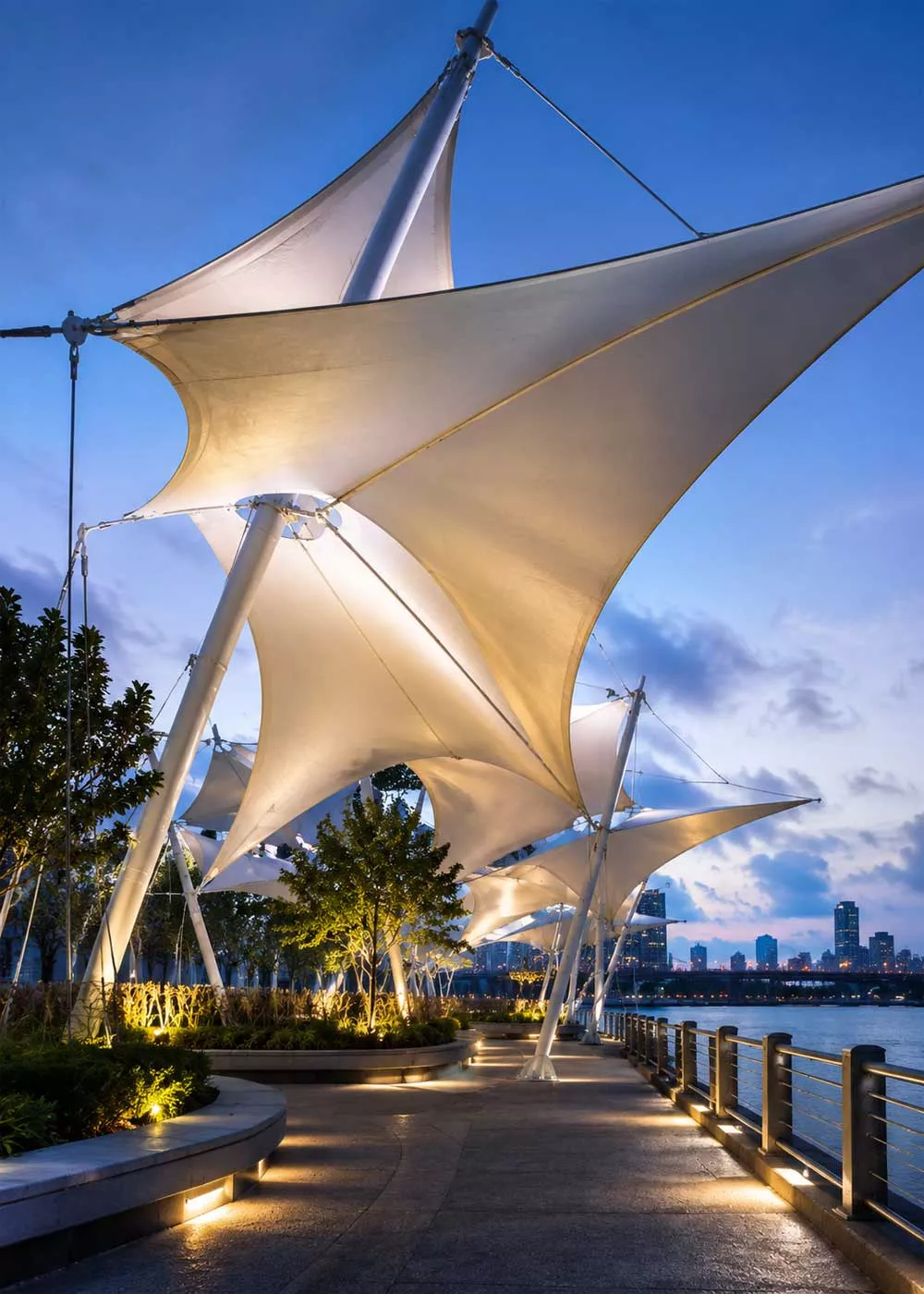
Key Features of Tensile Architecture Design
- Weather Resistance: High-quality coated fabrics resist UV radiation, rain, and temperature extremes — suitable for tropical climates in Andhra Pradesh, Odisha, and Maharashtra as well as cold mountain regions like Himachal and Uttarakhand.
- Long Service Life: Well-designed and properly installed tensile structures typically have a service life of 15–25 years depending on fabric type and maintenance regime.
- Low Self-Weight: Tensile membrane systems weigh significantly less than concrete or metal roofing, reducing foundation load and material cost.
- Large Span Coverage: Tensile structures can cover spans of 5 metres to over 100 metres without intermediate columns, making them useful for large open areas.
- Daylight Transmission: Translucent fabrics allow diffused natural light into covered spaces, reducing artificial lighting requirements during daytime hours.
- Custom Design Options: Every tensile structure is designed to the site's exact dimensions, which means no two installations are identical.
- Fire Safety Compliance: Fabrics can be treated to meet fire-retardant standards applicable under Indian building codes.
- Low Maintenance: Surface coatings repel dust and biological growth; most fabrics require only periodic washing rather than repainting or replacement.
Benefits of Choosing Tensile Architecture Design in India
Choosing tensile architecture for a project in India comes with functional, economic, and aesthetic advantages that conventional roofing and canopy solutions often cannot match.
- Cost-Effective for Large Spans: When spanning large areas, tensile structures often cost less per square metre than steel or concrete alternatives because they use less material overall.
- Fast Installation: Prefabricated components are manufactured in the factory and assembled on-site, reducing construction time compared to traditional roofing projects.
- Design Flexibility: Tensile architecture is not constrained by rectangular grids or standard module sizes. Curved, angular, and compound shapes are all achievable through engineering.
- Energy Efficiency: Reflective and translucent membranes reduce solar heat gain and allow daylight penetration — both factors that can lower energy consumption in buildings below.
- Aesthetic Appeal Without Heavy Ornamentation: The natural elegance of a tensile form adds architectural character to a space without additional decorative work.
- Suitable for Heritage and Sensitive Sites: Because tensile structures are reversible and non-intrusive at the foundation level, they are often appropriate for use near heritage structures — such as projects in Fatehpur Sikri, Sarnath, or Ayodhya — where permanent construction is restricted.
- Wind Performance: When designed correctly, tensile structures perform well under wind loads, which is important for exposed sites in coastal Andhra Pradesh, cyclone-prone Odisha, and high-altitude Himachal regions.
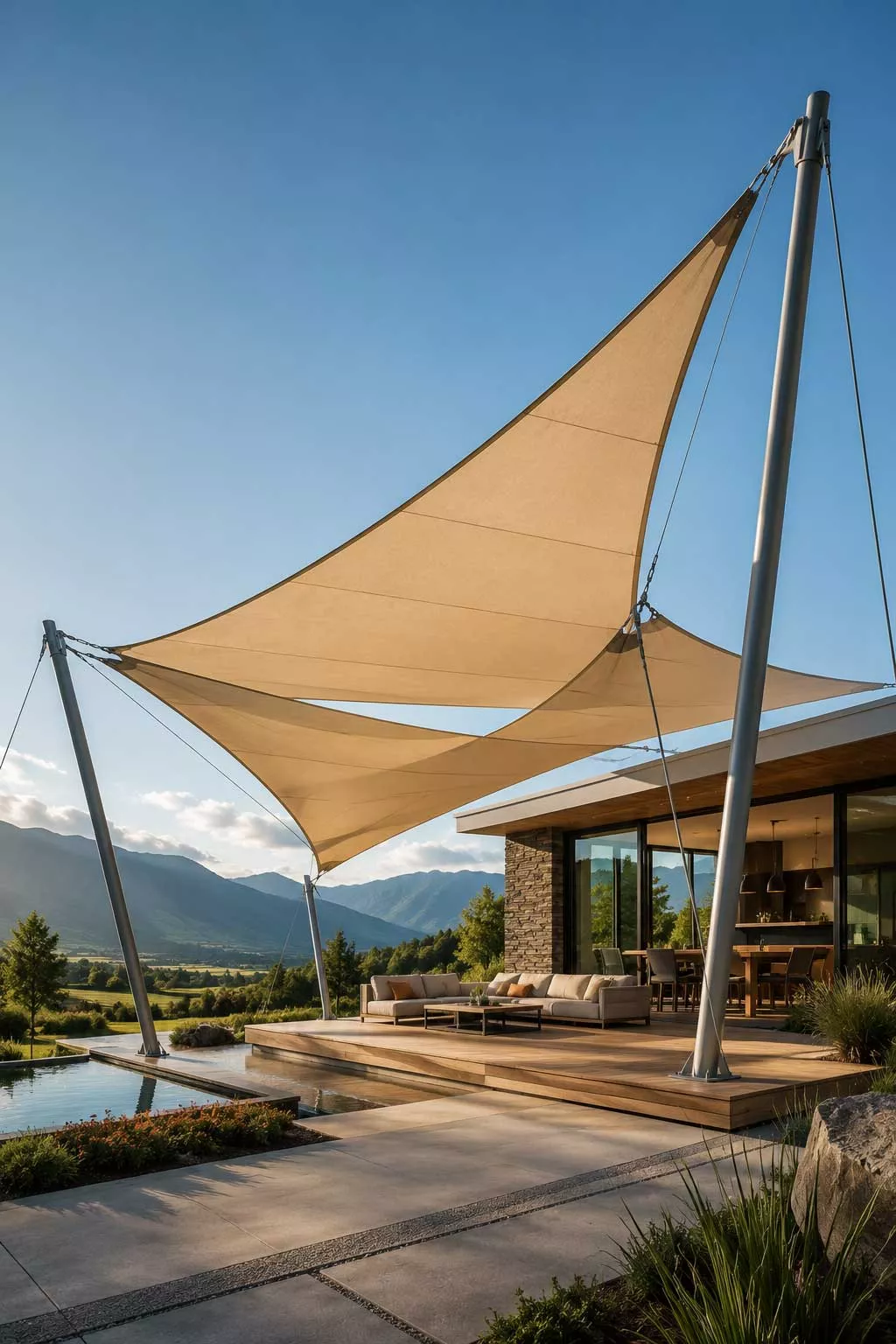
Applications of Tensile Architecture Design Across Different Industries
Tensile architecture design is not limited to any single sector. The technology serves a wide range of project types across India.
- Commercial Complexes: Entry canopies, atrium covers, and outdoor seating shade structures in malls and retail parks in cities like Noida, Gurgaon, Faridabad, and Thane.
- Industrial Facilities: Storage yards, loading docks, and outdoor work areas require weather protection across industrial zones in Baddi, Bhiwadi, Dewas, Ratlam, and Panipat.
- Educational Institutions: Schools and colleges in Rohtak, Karnal, Aligarh, and Varanasi use tensile walkway covers and outdoor assembly canopies.
- Hotels and Resorts: Pool-side shade sails, terrace covers, and entrance canopies are common at resorts in Manali, Kasauli, Dalhousie, Pahalgam, and Udaipur.
- Hospitals: External covered walkways connecting buildings, vehicle drop-off canopies, and rooftop gardens with membrane shading in cities like Lucknow, Bhubaneswar, and Nagpur.
- Shopping Centres: Overhead fabric shading for open-to-sky retail corridors and parking areas in Indore, Bhopal, Jaipur, and Nashik.
- Public Infrastructure: Bus shelters, pedestrian underpasses, public plazas, and metro feeder areas in Ghaziabad, Rohini, Dwarka, and Greater Noida.
- Sports Facilities: Spectator shade structures at stadiums, roofing for open sports courts, and swimming pool covers in Vijayawada, Rourkela, and Guntur.
- Residential Projects: Terrace canopies, carport shade structures, and building entrance covers in residential developments across Panchkula, Sonipat, Saket, and Panvel.
- Government Projects: Public event canopies, cultural centre covers, and civic infrastructure shade projects from Jammu & Kashmir to Andhra Pradesh and across Rajasthan, Haryana, Uttar Pradesh, and Madhya Pradesh.
Design and Customization Options for Tensile Architecture Design
One of the defining qualities of tensile architecture is the degree to which each project can be customised. RS Tensile Pvt. Ltd. approaches each enquiry as a unique design problem, not a catalogue selection exercise.
- Size and Span: Structures can range from compact 4-metre pergola canopies to large-span airport-style covers exceeding 80 metres. Span is determined by structural analysis, not arbitrary limits.
- Shape and Form: Flat, curved, conical, hypar, and compound-form structures are all achievable. The structural form is also determined in part by the cable and mast configuration chosen.
Fabric Selection:
- PVC-coated polyester: Cost-effective, widely used, available in many colours. Good for general commercial and industrial applications.
- HDPE shade fabric: Open-weave, permeable, used for shade without full weather protection. Common in agricultural and resort settings.
- PVDF-coated fabric: Higher UV resistance and longer lifespan, suited to long-term installations in exposed locations.
- PTFE fibreglass: Premium, self-cleaning, very long service life. Used in high-specification architectural projects.
- ETFE film: Transparent or printed, used for skylights and feature canopies in institutional buildings.
- Structural Frame: Steel, stainless steel, and aluminium frames are all available. Frame profiles, finish (powder coating, galvanising, or natural), and connection details are designed per project.
- Colour and Finish: Fabric membranes are available in dozens of standard colours, with custom colour-matching on request for brand or design purposes.
- Fixings and Accessories: Gutter systems, lighting integration, drainage, and perimeter detailing are all considered in the design phase.
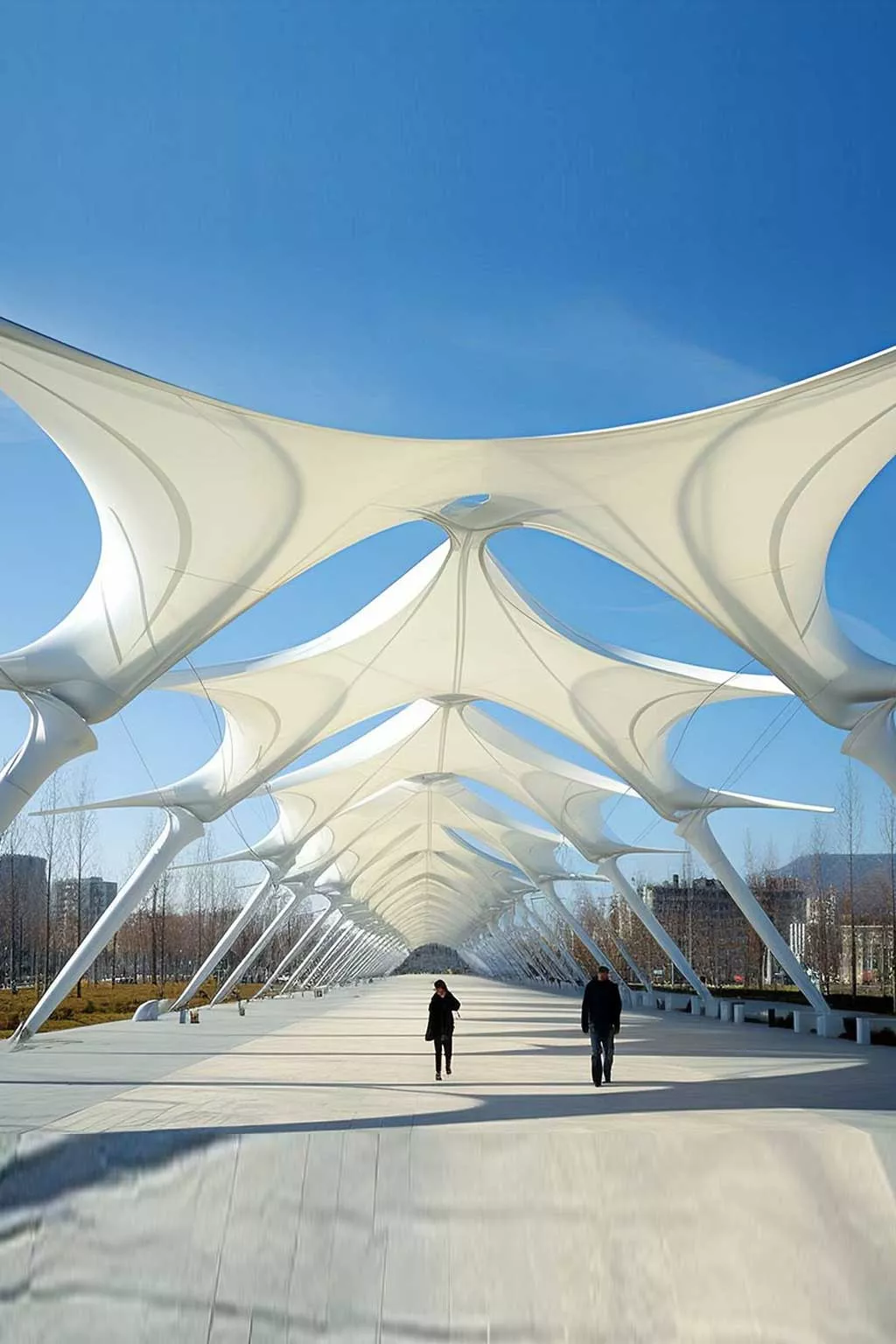
Installation Process for Tensile Architecture Design
A tensile architecture installation follows a structured sequence of activities from initial enquiry through to project handover.
- Site Assessment: The project team visits the site to measure dimensions, assess substructure conditions, evaluate wind exposure, and review access constraints. For remote locations such as Chakrata, Lansdowne, Kokernag, or Handwara, site visits are scheduled with appropriate lead time.
- Design and Engineering: Structural engineers carry out load analysis, form-finding, and detailed design. CAD drawings and structural calculations are prepared and reviewed before fabrication begins.
- Fabrication: Steel frames, masts, and cable systems are fabricated in the workshop. Fabric panels are cut, welded, and fitted with edge hardware according to the approved design. Quality checks are carried out at this stage.
- Foundation and Structural Assembly: On-site, foundation anchors are installed first. Steel columns, masts, and connection frames are erected and checked for alignment before any tension is applied to the fabric.
- Fabric Installation: Membrane panels are lifted, attached to perimeter fixings, and tensioned progressively using calibrated hardware to achieve the correct pre-stress level throughout the structure.
- Final Inspection and Handover: A completed structure is inspected for fabric tension uniformity, connection integrity, drainage performance, and overall appearance before being handed over to the client.
How to Choose a Reliable Tensile Architecture Design Manufacturer in India?
With tensile structures appearing on more project briefs, the number of vendors has grown significantly — and so has the variation in quality. Here are the practical factors to evaluate when selecting a manufacturer:
- Engineering Capability: Can the manufacturer provide structural calculations and load analysis reports? A vendor that only fabricates from standard templates cannot reliably serve complex or exposed sites.
- Fabric and Material Sourcing: Ask about the fabric brands and specifications used. Quality differences between fabrics are significant in terms of UV resistance, colourfastness, and service life.
- Portfolio and References: Look for completed projects in comparable site conditions — similar spans, climates, or building types. References from clients in Haryana, Rajasthan, Uttar Pradesh, or Uttarakhand will indicate experience with conditions relevant to those regions.
- Project Management: Timely delivery matters. A reliable manufacturer will provide a project schedule and communicate clearly about fabrication and installation milestones.
- After-Installation Support: A good supplier will provide documentation on maintenance requirements and be accessible for post-installation queries or adjustments.
- Nationwide Service Capability: If your project is in a smaller town such as Yanam, Nalagarh, Bargarh, Nabarangpur, or Bhawanipatna, confirm the manufacturer can actually reach and service those locations.
Why Choose RS Tensile Pvt. Ltd. for Tensile Architecture Design in India?
RS Tensile Pvt. Ltd. is a manufacturer of tensile structures based in India, with project delivery capability across states and territories including Rajasthan, Haryana, Himachal Pradesh, Jammu & Kashmir, Uttar Pradesh, Uttarakhand, Madhya Pradesh, Maharashtra, Andhra Pradesh, Odisha, and more.
Under the leadership of CEO Radhey Shayam, the company focuses on engineering-led design rather than catalogue-based sales. Each project is assessed individually, and the structure is designed to meet the specific load conditions, functional needs, and site constraints of that location.
Projects have been completed in a wide range of locations — from urban commercial developments in Delhi, Mumbai, and Pune to institutional projects in Dehradun, Roorkee, and Shimla; from resort developments in Manali, Nainital, and Rishikesh to industrial installations in Morena, Itarsi, Bhiwandi, and Sambalpur. The company also serves smaller and growing cities including Narwana, Hansi, Hindaun, Dholpur, Dausa, Kaithal, Palwal, and Jhajjar.
Key aspects of the RS Tensile service:
- Engineering and design team with experience across multiple structure types
- In-house fabrication of steel frames and membrane systems
- Use of tested and certified fabric materials
- Project documentation including structural drawings and load calculations
- Installation teams deployed to project sites across India
- Support for projects in tier-2 and tier-3 cities as well as major metros
- Willingness to work with architects, contractors, and direct clients
Conclusion
Tensile architecture design in India offers a practical, adaptable, and architecturally considered approach to covered structures across a wide range of project types. The technology is mature, the materials are well-tested, and the engineering methods are well-established — yet each project remains a custom exercise in structural design.
RS Tensile Pvt. Ltd. manufactures and delivers tensile structures to project sites across India, from large cities to smaller towns and from coastal lowlands to mountain locations. The company's engineering-led approach ensures that each tensile architecture design is appropriate for its site conditions, durable under local climatic stresses, and functional for the intended use.
Whether the project is a resort in Katra or Pahalgam, a commercial complex in Aurangabad or Kolhapur, a government facility in Sundargarh or Khordha, or an institutional installation in Kurukshetra or Roorkee — the process begins with understanding the site, the use, and the structural requirements.
To discuss your tensile architecture design requirement and receive a project-specific response from the RS Tensile team, submit your enquiry with project details, location, and span dimensions.
FAQs About Tensile Architecture Design
1. What is the typical lifespan of a tensile architecture design structure?
The service life of a tensile structure depends on the fabric type and maintenance routine. PVC-coated polyester typically lasts 10–15 years. PVDF fabrics extend this to 15–20 years, while PTFE fibreglass can perform for 25 years or more. Regular cleaning and periodic tension checks extend the service life significantly.
2. Is tensile architecture design suitable for heavy rainfall conditions in India?
Yes. Tensile structures used for weather protection are designed with appropriate pitch and drainage to shed rainwater efficiently. Structures installed in high-rainfall areas such as coastal Andhra Pradesh, parts of Maharashtra, and Northeast India are specifically engineered for higher hydraulic loads.
3. Can tensile architecture design structures withstand strong winds?
Structural design for wind is a standard part of the engineering process. Wind load analysis is carried out based on the site's location and exposure category as per Indian Standards (IS 875). Sites in coastal Andhra Pradesh, exposed hilltop locations in Himachal, or open plains in Rajasthan and Haryana all require specific wind load design.
4. Are tensile architecture designs fully customisable?
Yes. Every project is custom-designed. The shape, size, fabric colour, structural material, and connection details are all specific to the project brief. Standard catalogue structures are not offered because every site has unique dimensions and requirements.
5. Does RS Tensile Pvt. Ltd. provide tensile architecture design services across all of India?
Yes. Projects are delivered across India — including states such as Rajasthan, Uttar Pradesh, Madhya Pradesh, Maharashtra, Haryana, Himachal Pradesh, Uttarakhand, Andhra Pradesh, Odisha, Jammu & Kashmir, and cities ranging from major metros to smaller towns. Enquiries from locations like Satna, Barmer, Jaunpur, Ongole, Dhenkanal, Vizianagaram, and Achalpur are all considered.
6. What maintenance does a tensile architecture design structure require?
Maintenance requirements are low compared to most conventional roofing systems. Fabric surfaces should be washed periodically (typically once or twice a year) to remove dust and biological growth. Cable tensions should be checked every few years. Structural connections should be inspected after severe weather events. A maintenance guide is provided at project handover.
7. How long does the tensile architecture design and installation process take?
Timeline depends on the scale of the project. For a straightforward structure up to 50 square metres, design, fabrication, and installation can be completed in 4–8 weeks. Larger or more complex projects — such as multi-span covers for a stadium in Rourkela or a multi-level structure in Prayagraj — may take 3–6 months from design to completion.
8. What fabric options are available for tensile architecture design projects?
Available fabrics include PVC-coated polyester (standard and high-performance grades), HDPE shade mesh, PVDF-coated fabric, PTFE fibreglass, and ETFE film. The appropriate choice depends on the project's functional requirements, desired service life, transparency preference, and budget.
9. Can a tensile architecture design structure be installed on an existing building?
In many cases, yes. Tensile structures can be anchored to existing walls, parapet structures, or independent foundations. A structural assessment of the existing building is carried out before design to ensure the anchor points can safely carry the required loads.
10. Is tensile architecture design structurally safe for public spaces?
Yes, when properly engineered and installed. Tensile structures for public use are designed to comply with applicable Indian Standards for structural loads, wind, and material safety. A qualified structural engineer is involved in every project to ensure the design meets the required safety standards.
