Tensile Entrance Structure in India

| Product Description | Served in various sizes and colors, our Tensile Entrance Structures add elegance and functionality to any location. Transform your area right now! Get the best shade solution by ordering now. |
| Membrane Material | PVC / PTFE / HDPE |
| Fabric Color | White or Customized |
| Shape & Size | Customized |
| Certification | ISO 45001:2018(OHSAS), ISO 45001:2015, ISO 9001:2015 |
| Place of Origin | India |
Order Now
ENQUIRE NOW
A tensile entrance structure is one of the most practical and visually distinct ways to mark the entry point of any building, campus, or facility. Across India, these structures have become a common choice for commercial complexes, industrial parks, educational campuses, healthcare facilities, and public spaces. RS Tensile Pvt. Ltd. designs, fabricates, and installs tensile entrance structures tailored to the specific requirements of each project — from small gated entries to large gateway canopies.
Unlike conventional masonry or metal entrance gates, tensile structures use high-tension fabric membranes stretched over engineered steel frames. The result is a lightweight yet strong overhead covering that is both functional and architectural. In Indian conditions — where structures must handle heavy monsoon rainfall, strong UV radiation, and wide temperature swings — tensile entrance structures offer a reliable, low-maintenance solution.
Whether your project is in a metro city like Delhi, Mumbai, or Pune, or in a smaller town like Katra, Nalagarh, or Pithoragarh, a well-designed tensile entrance makes an immediate visual impact while serving a real functional purpose.
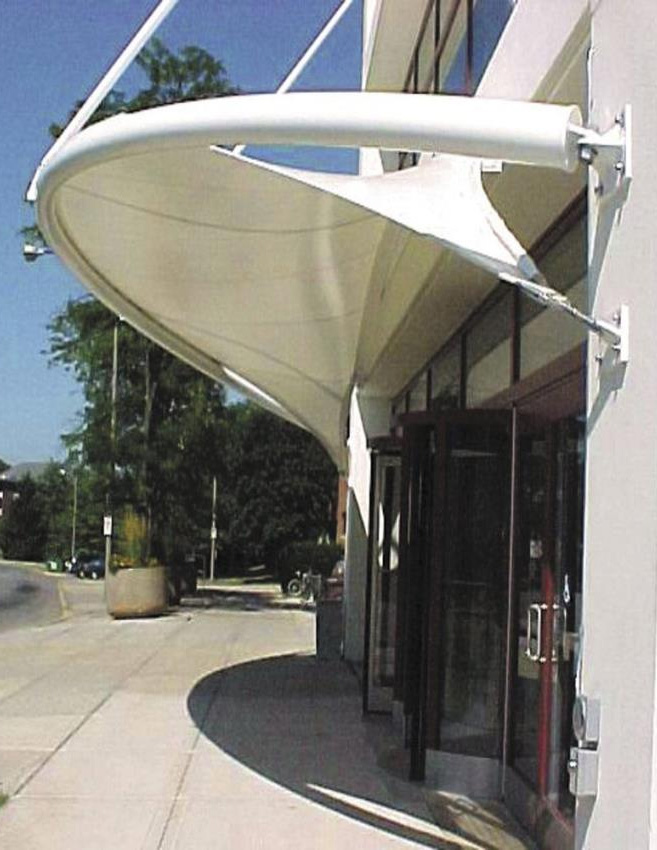
What Is a Tensile Entrance Structure?
A tensile entrance structure is an architectural canopy or gateway built using a tensioned fabric membrane supported by a steel framework. The fabric is pulled taut from anchoring points to create a defined shape — typically a cone, saddle, arch, or wave form — that hovers over the entry area.
The core components of a typical tensile entrance structure include:
- Steel support columns or mast poles, which carry the vertical loads
- Steel cables or edge beams that transmit tension through the structure
- A high-strength fabric membrane, usually made from PTFE-coated fiberglass, PVC-coated polyester, or HDPE
- Fixing brackets, clamps, and anchor plates that connect fabric to frame
- Optional lighting fixtures and branding elements integrated into the design
The structural principle relies on the balance of tensile forces. When fabric is stretched between fixed points at the right geometry and pretension, it becomes rigid enough to handle wind, rain, and snow loads without sagging or deforming. This is the same principle used in large-scale stadium roofs and airport canopies, applied here at the entrance scale.
Key Features of Tensile Entrance Structures
Tensile entrance structures offer a combination of structural and aesthetic characteristics that traditional entrance solutions cannot match.
Durability
Quality tensile structures, when installed with proper anchorage and the right fabric grade, last 15 to 25 years with standard maintenance.
Weather Resistance
The fabric membranes used are waterproof and tested against heavy rainfall conditions common in cities like Rishikesh, Haridwar, Gorakhpur, Varanasi, and Prayagraj during monsoon season.
UV Protection
High-quality PTFE and PVC fabrics are UV-stabilised, protecting the entry area from direct sunlight — particularly valuable in locations like Bikaner, Barmer, Jaisalmer, and other high-radiation zones.
Low Maintenance
The smooth fabric surface repels dust and grime. Periodic washing and occasional cable tension checks are typically sufficient.
Lightweight Structure
Tensile frames impose far less load on foundations compared to equivalent masonry or metal roof structures.
Design Flexibility
Curved, angular, wave, or cone shapes can all be achieved within the tensile format.
Long Service Life
With correct installation and periodic inspection, the structure and fabric have long service cycles, making them a cost-effective investment over time.
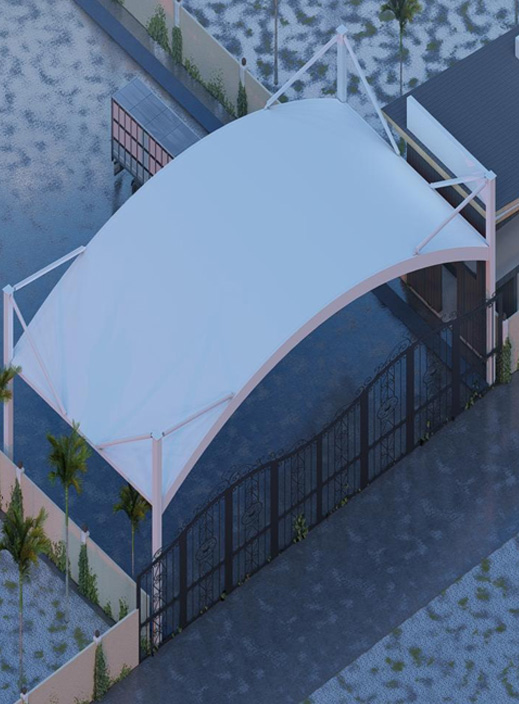
Benefits of Choosing a Tensile Entrance Structure in India
There are practical reasons why tensile entrance structures are specified across different project types throughout India.
- Cost Effectiveness Compared to RCC canopies or elaborate metal fabrications, tensile entrance structures are generally more economical in terms of material cost, foundation requirements, and installation time. Projects in tier-two and tier-three cities — such as Mathura, Bharatpur, Sikar, Jhansi, or Bhiwani — benefit from this cost advantage without compromising on visual quality.
- Speed of Installation The steel framework can be erected and fabric installed within days for most entrance-scale projects. This minimises disruption, which is especially relevant for operational facilities.
- Large Span Coverage Tensile structures can cover wide entry roads, vehicle drive-throughs, and pedestrian plazas without needing intermediate columns, keeping the entry unobstructed.
- Aesthetic Value The clean, architectural appearance of a tensile entrance gives a professional visual identity to any facility. Cities like Jaipur, Udaipur, Ajmer, Pushkar, and Shimla have seen tensile structures used effectively at resort entries, temple approach gates, and institutional campuses where a quality appearance matters.
- Structural Flexibility Tensile structures adapt to irregular site shapes. Whether the entry is narrow and tall in a location like Mussoorie or Manali, or wide and flat in Meerut or Lucknow, the fabric can be configured accordingly.
Applications Across Different Industries for Tensile Entrance Structure
RS Tensile Pvt. Ltd. has supplied and installed tensile entrance structures for a wide range of sectors. Here is how different industries use them.
- Commercial Complexes : Shopping malls, retail plazas, and business parks in Noida, Greater Noida, Ghaziabad, Rohini, Saket, and Dwarka use tensile entrance canopies to enhance visual branding and provide weather protection at entry points.
- Industrial Facilities : Manufacturing plants, logistics parks, and warehouses in Baddi, Bhiwadi, Panipat, Sonipat, Rohtak, and Samalkha use tensile entrance gates to define access points and project a professional appearance to visitors.
- Educational Institutions : Universities, colleges, and schools in Aligarh, Agra, Kanpur, and Moradabad use tensile entrance structures at main gates and internal entry plazas. The structures handle daily foot traffic while requiring minimal upkeep.
- Hotels and Resorts : Hospitality properties in Pahalgam, Kokernag, Kasauli, Lansdowne, Chakrata, Dalhousie, and Chamba depend on entrance architecture that matches their natural and architectural setting. Tensile fabric offers warmth and elegance without heavy construction.
- Hospitals and Healthcare Facilities : Tensile entrance canopies are widely used at hospital emergency entry points and OPD access areas in cities like Nagpur, Aurangabad, Nashik, Kolhapur, Solapur, and Amravati to provide shelter during patient drop-offs.
- Public Infrastructure and Government Projects : Government buildings, state secretariats, district courts, and public parks in Bhubaneswar, Cuttack, Rourkela, Sambalpur, and Dhenkanal have used tensile entrance structures to improve the civic appearance of public spaces. Projects in Odisha, Andhra Pradesh, and Haryana have seen growing adoption of these structures.
- Sports Facilities : Stadiums, sports academies, and recreational complexes in Visakhapatnam, Vijayawada, Guntur, Nellore, and Kakinada use tensile entrance canopies at player and spectator entry points.
- Residential Projects : Gated communities and housing societies in Faridabad, Gurgaon, Panchkula, Yamunanagar, Panipat, Ambala, and Karnal use tensile entrance gates as part of the overall community identity.
- Religious and Heritage Sites : Entry canopies near temples, ghats, and heritage corridors in Varanasi, Mathura, Ayodhya, Sarnath, Fatehpur Sikri, Tirupati, and Puri provide shelter to pilgrims and visitors while maintaining a visual respect for the setting.
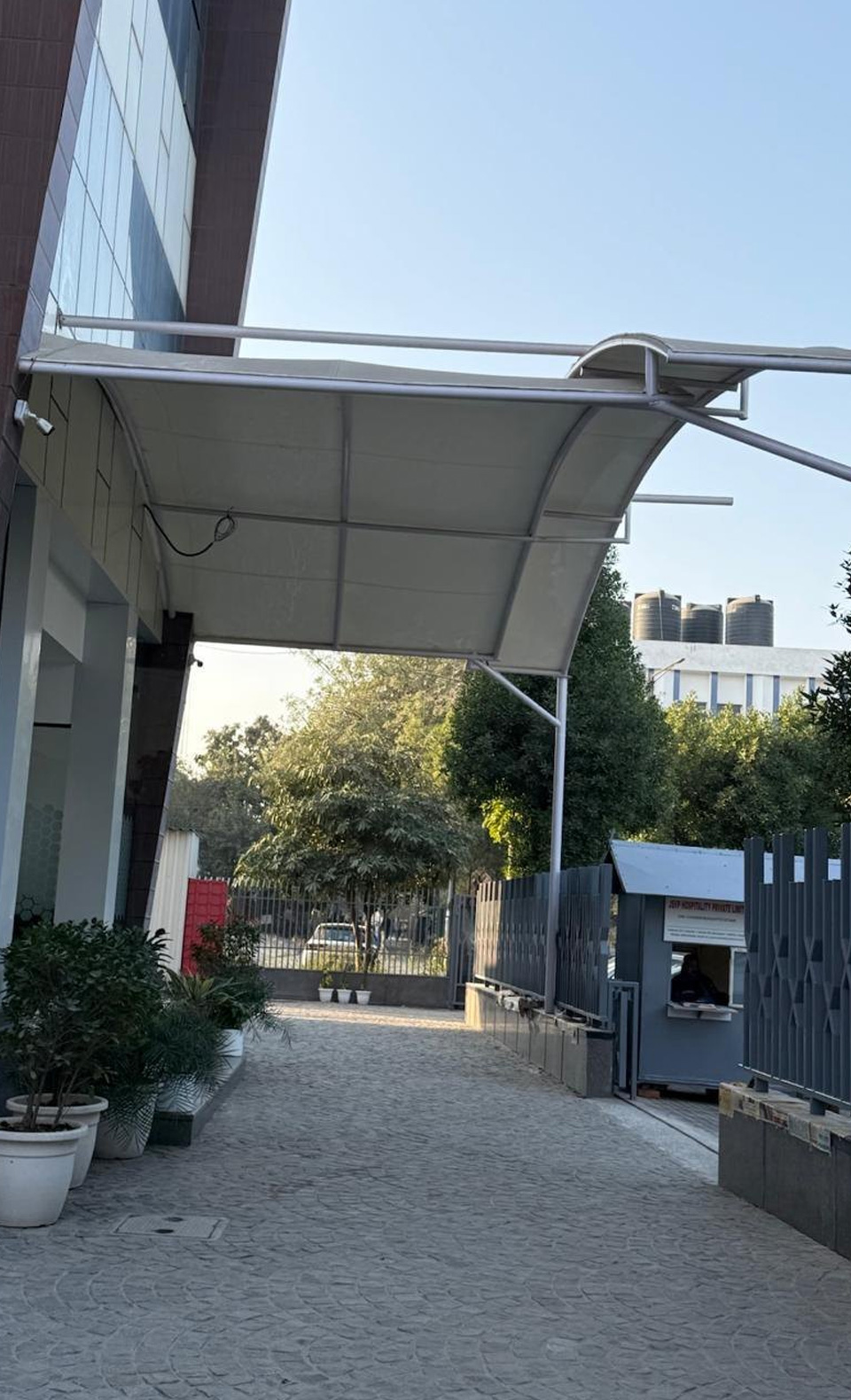
Design and Customization Options of Entrance Tensiles
Every tensile entrance structure that RS Tensile Pvt. Ltd. delivers is designed to suit the specific site, function, and visual brief of the client. There is no single standard size or shape.
- Shape Options: Common entrance structure shapes include conic (pyramid-like peaks), wave or sail forms, arch spans, hypar (hyperbolic paraboloid) forms, and flat-tensioned canopies. The geometry depends on the structural span, wind exposure, and desired visual effect.:
- Fabric Material Selection: The primary choices are PVC-coated polyester fabric for cost-efficient installations, PTFE-coated fiberglass for longer life and better fire resistance, and HDPE knitted fabric for ventilated or shaded entry zones. The right material is selected based on location, climate, and project budget.:
- Frame and Structural Configuration: Mast poles, arches, ring beams, and cable arrays can all be configured differently. For high-wind areas in Jammu, Srinagar, Anantnag, Handwara, or Udhampur, structures are designed with appropriate wind load calculations. For coastal areas in Vizianagaram, Brahmapur, Balasore, and Nabarangpur, corrosion-resistant steel and fittings are specified.:
- Sizes: Entry spans can range from a compact 3-metre single-lane gate to a 20-metre or wider multi-lane vehicle entry. Height profiles are adjusted based on vehicle clearance requirements and aesthetic intent.:
- Colour and Branding: Fabric membranes are available in a wide range of colours. Corporate colour schemes, institutional identities, and local design preferences can all be accommodated. Custom printing on fabric is also possible for branding-intensive projects.:
- Lighting and Accessories: LED strip lighting, spotlights, and decorative lighting elements can be integrated into the frame or anchoring structure. Security cameras and signage mounts can also be incorporated at the design stage.:
Installation Process of Tensile Entrance Structure
RS Tensile Pvt. Ltd. follows a structured installation process to ensure structural integrity and a quality finish on every project.
- Site Assessment: Our technical team visits the site to assess soil conditions, access constraints, span dimensions, wind exposure, and existing infrastructure before any design is finalised.
- Design Planning: Based on site data, our engineers create structural drawings and fabric patterning plans. Load calculations are done for wind, snow (where applicable), and dead loads.
- Fabrication: Steel structures are fabricated at our facility with quality checks on weld quality, galvanisation, and dimensional accuracy. Fabric panels are cut and assembled with precision to match the design geometry.
- Structural Assembly: Steel columns, masts, cables, and beams are installed at site and anchored per the structural design. Column bases are concreted into the ground or bolted to existing foundations.
- Fabric Installation: Fabric panels are stretched and attached to the steel structure using clamping profiles, edge ropes, or lacing cables. Proper pretension is applied at this stage.
- Final Inspection: Once installation is complete, the structure is inspected for tension uniformity, joint quality, drainage pathways, and visual alignment. The client is handed over the completed structure with a maintenance guide.
Why Choose RS Tensile Pvt. Ltd. for Tensile Entrance Structure in India?
RS Tensile Pvt. Ltd. has built a track record of delivering tensile entrance structures across a wide range of Indian cities and states. Here is what we bring to each project.
Industry Experience
Our team has worked on tensile structure projects across Uttar Pradesh, Rajasthan, Himachal Pradesh, Uttarakhand, Haryana, Maharashtra, Andhra Pradesh, Telangana, Odisha, Jammu & Kashmir, and Madhya Pradesh.
Skilled Engineering Team
Our structural engineers, fabric technicians, and site supervisors work together from the design stage through to final handover.
Quality Materials:
We source steel, fabric, and hardware from reliable suppliers and carry out quality checks before fabrication and installation.
Nationwide Project Reach
We serve clients in major cities including Delhi, Mumbai, Pune, Bengaluru, Jaipur, Lucknow, Bhopal, Indore, Jabalpur, Nashik, Vijayawada, Hyderabad, and hundreds of smaller cities and towns across India.
Custom Engineering Solutions
We do not offer cookie-cutter products. Each entrance structure is designed for the specific site conditions, loads, and visual requirements.
Post-Installation Support
We provide maintenance guidance and are available for periodic inspection services after project completion.
Transparent Project Process
From initial enquiry to final delivery, clients receive regular updates on design, fabrication, and installation progress.
Our projects span cities like Satara, Panvel, Vasai, Virar, Thane, Bhiwandi, Ulhasnagar, Jalgaon, Latur, Kolhapur, Solapur, Dewas, Ratlam, Ujjain, Satna, Gwalior, Morena, Bhind, Chhatarpur, Shivpuri, Kota, Dausa, Bharatpur, Dholpur, Alwar, Hindaun, Pratapgarh, Kishangarh, and many more across every region.
Conclusion
A tensile umbrella structure in India offers a practical, cost-effective, and visually clean solution for outdoor shading and shelter across a wide range of project types. From religious sites in Sarnath and Pushkar to industrial zones in Rourkela and Sundargarh, from hill stations in Kasauli and Nainital to coastal towns in Brahmapur and Kakinada — the applications are as diverse as the geography of India itself.
RS Tensile Pvt. Ltd. brings manufacturing capability, engineering depth, and installation experience to every project. The team works with clients from site assessment through to final handover, ensuring the structure is designed and built for the specific demands of the location.
If you are planning a tensile umbrella canopy for a commercial, hospitality, residential, or public project anywhere in India, reach out to RS Tensile Pvt. Ltd. to discuss your requirements and receive a detailed project proposal.
FAQs Related to Tensile Umbrella Structure
1. What is the typical lifespan of a tensile entrance structure?
A tensile entrance structure, when built with quality materials and properly maintained, typically lasts between 15 and 25 years. The steel framework can last even longer with periodic repainting or recoating. Fabric panels have a service life of 10 to 20 years depending on the material grade and local climate conditions.
2. Are tensile entrance structures suitable for heavy monsoon rainfall?
Yes. Tensile fabrics used in these structures are waterproof and designed to manage water runoff through their geometry. The slope and curvature of the fabric ensures that rainwater drains off quickly without pooling. This makes them suitable for high-rainfall areas in Odisha, Uttarakhand, Jammu & Kashmir, and coastal Andhra Pradesh.3. Can tensile entrance structures withstand strong winds?
Properly designed tensile entrance structures are engineered to handle regional wind loads as per Indian standards (IS 875 Part 3). Projects in high-wind zones such as Jaisalmer, Barmer, coastal Andhra Pradesh, or hilly regions in Himachal and Uttarakhand require specific structural detailing, which our engineers account for at the design stage.4. Can the design be customized to match our facility's branding?
Yes. We offer customization in shape, size, fabric colour, frame finish, and optional printed graphics on the fabric. Whether you need a structure that fits a corporate park in Gurgaon, a resort in Manali, or a hospital campus in Bhubaneswar, the design can be tailored accordingly.5. Do you serve tensile entrance projects across India?
Yes. RS Tensile Pvt. Ltd. serves clients across all Indian states, including projects in Himachal Pradesh cities like Shimla, Dharamsala, Mandi, Kullu, Paonta Sahib, Baddi, Nalagarh, Bilaspur, Kasauli, Lansdowne, Dalhousie, and Chamba. We also serve Rajasthan, Haryana, Uttar Pradesh, Uttarakhand, Delhi, Maharashtra, Andhra Pradesh, Odisha, Jammu & Kashmir, and Madhya Pradesh.6. What maintenance is required after installation of entrance tensile structures?
Maintenance is straightforward. Periodic washing of the fabric surface to remove dust and organic matter is recommended. Cable tension should be checked once or twice a year. Structural joints and anchors should be inspected for rust or movement annually. We provide a maintenance checklist on project completion.7. How long does the installation of the tensile entrance membrane take?
Installation time depends on the size and complexity of the entrance structure. A standard single-span gate structure can typically be installed in 3 to 7 days once fabrication is complete. Larger multi-span entry plazas may take 10 to 20 days. Fabrication lead time is typically 3 to 6 weeks from design approval.8. What fabric materials do you offer for entrance tensile?
We offer PVC-coated polyester fabric for standard applications, PTFE-coated fiberglass for long-life and fire-resistant installations, and HDPE shade cloth for ventilated or semi-open entry structures. The choice depends on the project's functional needs, budget, and location-specific climate conditions.9. Are tensile entrance structures suitable for locations in Jammu & Kashmir and Himachal Pradesh?
Yes. Projects in Srinagar, Jammu, Pahalgam, Anantnag, Katra, Udhampur, Kathua, Dharamsala, Chamba, Devprayag, Rudraprayag, Almora, and Pithoragarh require structures designed for snow load, seismic considerations, and low-temperature durability. We engineer our structures for these conditions specifically.10. How do I get a quote for a tensile entrance structure project?
You can contact RS Tensile Pvt. Ltd. directly through our website enquiry form or by phone. Share basic details such as the entry span width, approximate height, site location, and any design references. Our team will review the requirements and provide a preliminary design concept and cost estimate without obligation.