Tensile Gazebo Structure in India - Built for Every Climate and Setting
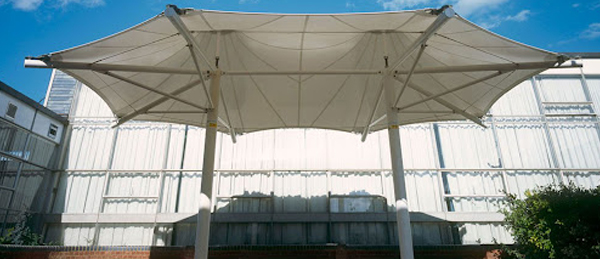
| Product Description | The conventionally styled gazebos that we offer ensure maximum protection against harsh weather conditions as well as act as a stunning focal point, thanks to their size & colors. All of our tensile gazebos are made from high quality membranes like PVC polymer, PTFE or HDPE, and are flexible in terms of style and other requirements added by clients. |
| Membrane Material | PVC / PTFE / HDPE |
| Fabric Color | White or Customized |
| Shape & Size | Customized |
Order Now
ENQUIRE NOW
When you need covered outdoor space that looks good, lasts long, and does not eat into your budget, a tensile gazebo structure is one of the most practical choices available today. RS Tensile Pvt. Ltd. designs and supplies tensile gazebo structures across India for residential gardens, commercial spaces, tourist resorts, institutional campuses, and public infrastructure projects.
Unlike heavy permanent constructions, these structures use high-performance fabric membranes stretched over a steel frame to create shade and shelter. They are lighter, faster to install, and far more flexible in terms of shape and size. Across India — from hill stations like Mussoorie and Shimla to coastal towns like Visakhapatnam and warm plains like Prayagraj — outdoor spaces need protection from sun, rain, and wind. A well-designed tensile gazebo handles all three.
What Is a Tensile Gazebo Structure?
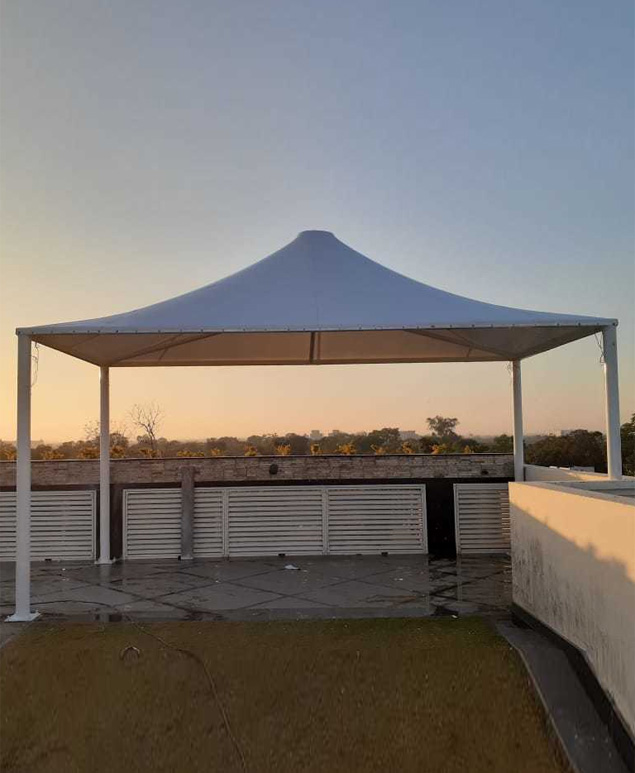
A tensile gazebo structure is a fabric-covered outdoor shelter that uses tensioned membranes instead of solid walls or roofing sheets. The membrane is anchored to a steel or aluminium framework and held in shape by controlled tension. This tension is what gives the structure its rigidity, weather resistance, and that clean, curved appearance you often see at parks, hotels, and public squares.
The main components include:
- Steel or galvanised frame: Hot-dip galvanised or powder-coated mild steel or stainless steel columns and connecting hardware.
- Tensioned fabric membrane: Typically HDPE, PTFE-coated polyester, or PVC-coated polyester, selected based on the project's UV, wind, and rainfall requirements.
- Anchor foundations: Concrete footings or ground anchors that transfer structural loads safely into the ground.
- Connecting hardware: Stainless steel cables, fittings, and tension rods that maintain the membrane's shape over time.
The basic working principle is straightforward: the fabric is cut into precise geometric panels, attached to the frame at specific anchor points, and then tensioned to its designed stress level. Once tensioned, the membrane behaves like a rigid surface — it resists wind uplift, sheds rain, and blocks solar radiation without needing a heavy rigid roof.
Key Features of Tensile Gazebo Structures
Weather Resistance
These structures are engineered to handle India's varied weather — heavy monsoon rainfall in regions like Odisha and Brahmapur, intense summer heat in Rajasthan and Barmer, strong winds in coastal Andhra Pradesh, and snowfall in Himachal Pradesh locations such as Manali and Dalhousie.
UV Protection
PVC and PTFE membranes typically block 90–98% of UV radiation, making them suitable for gardens, waiting areas, and leisure zones where prolonged sun exposure is a concern.
Durability
Quality fabric membranes carry a service life of 10 to 20 years depending on the material grade and exposure conditions. The steel framework, when properly treated, lasts several decades.
Low Maintenance
Tensile structures need periodic cleaning and occasional fabric inspection. There are no gutters to clear, no tiles to replace, and no repainting cycles for the fabric itself.
Modern Visual Appeal
RS Tensile works with clients to specify span, height, shape, colour, and material grade. No two sites are identical, and the design process reflects that.
Custom Design Options
RS Tensile works with clients to specify span, height, shape, colour, and material grade. No two sites are identical, and the design process reflects that.
Long Service Life
With proper installation and routine care, a tensile gazebo structure easily serves 15 to 25 years, even in demanding outdoor environments.
Benefits of Choosing a Tensile Gazebo Structure
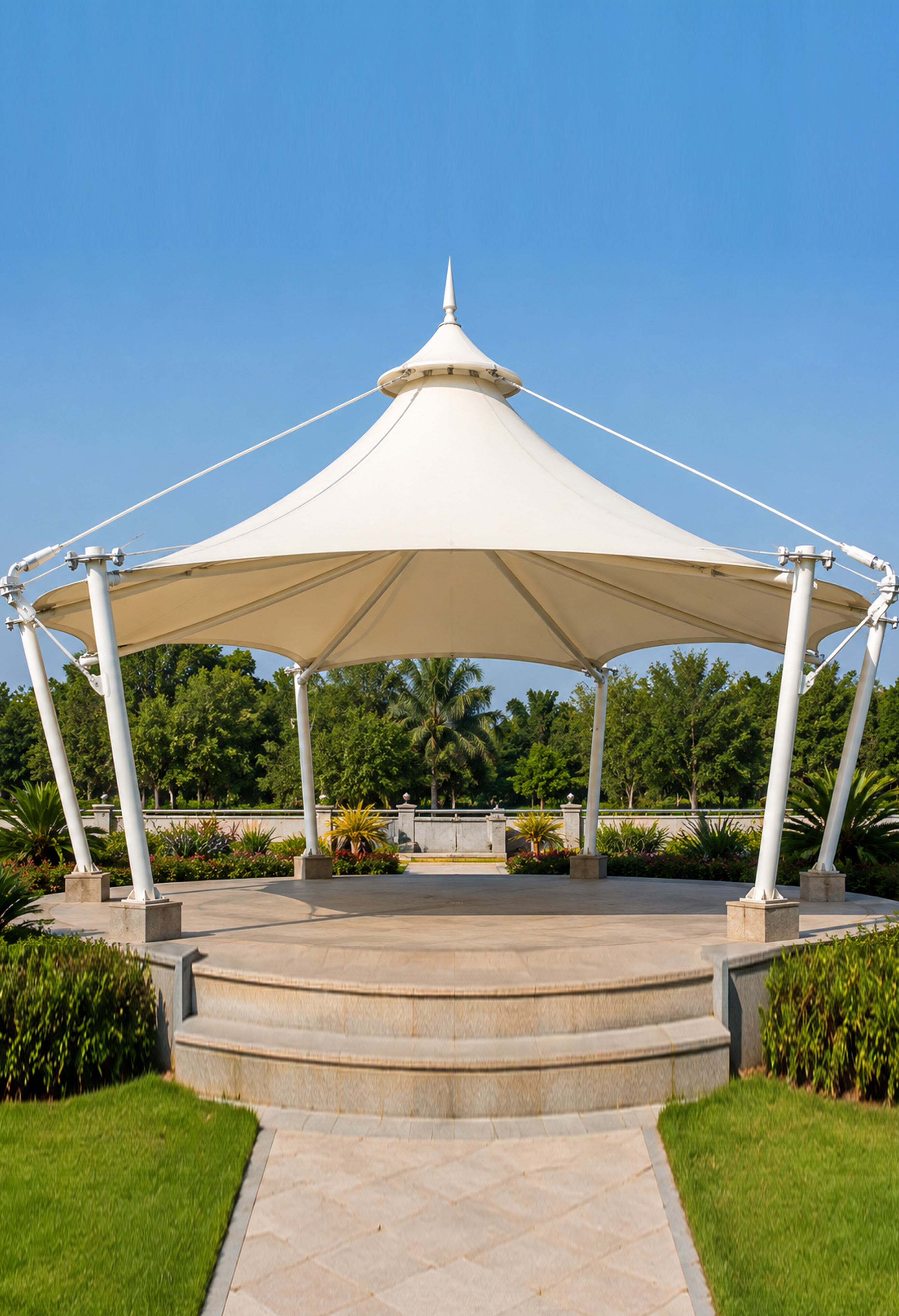
- Cost Effectiveness: Compared to constructing a permanent RCC or brick-and-mortar gazebo, a tensile version typically costs less in materials, labour, and time. For projects with budget constraints — whether a municipal park in Hanumangarh or a resort extension in Rishikesh — this matters.
- Fast Installation: Most mid-sized tensile gazebo installations are completed within a few days once the foundation work is done. Permanent structures of comparable coverage can take weeks or months.
- Structural Flexibility: The design can adapt to irregular plots, sloped terrain, or areas where drilling deep foundations is not feasible. Projects in hilly locations like Lansdowne, Chakrata, or Pahalgam benefit from this flexibility.
- Large Span Coverage :Tensile systems can span several metres without intermediate columns. This makes them ideal for open seating areas, market spaces, and event pavilions where unobstructed floor space is important.
- Aesthetic Value: The visual difference between a corrugated sheet roof and a properly tensioned fabric membrane is significant. For hospitality properties in Nainital, Manali, or Katra — where visual presentation affects guest experience — this matters commercially.
- Energy Efficiency: Translucent membranes allow filtered natural light to enter, reducing the need for artificial lighting during daytime. In warmer cities like Vijayawada, Guntur, and Nagpur, proper shading from these structures also reduces heat load on adjacent built spaces.
Applications Across Different Industries for Tensile Gazebo Structure
Tensile gazebo structures serve a broad range of sectors across India.
- Hospitality and Tourism : Hotels and resorts in Udaipur, Manali, Mussoorie, Pahalgam, and Jaisalmer use tensile gazebo structures for open-air dining areas, poolside lounges, wedding lawns, and outdoor corridors. The aesthetic fits both heritage settings and modern properties.
- Residential Projects : Homeowners in urban areas like Noida, Greater Noida, Pune, Mumbai, and Gurgaon use garden tensile structures for covered patios, terrace shelters, and landscaped garden zones. Smaller towns like Alwar, Mathura, and Bhiwadi are seeing growing demand as well.
- Commercial Complexes and Shopping Centres :Tensile gazebos work well at building entries, outdoor seating courts, and pedestrian walkways in malls and commercial complexes in cities like Indore, Nagpur, Kanpur, Lucknow, and Jaipur.
- Educational Institutions : Schools and colleges in Dehradun, Rohtak, Ambala, Panchkula, and Karnal use these structures for campus shading, outdoor assembly spaces, and sports court covers.
- Healthcare Facilities : Hospitals in Bhopal, Jabalpur, Varanasi, and Gwalior use tensile canopies at entry areas and open waiting corridors where shade and shelter are necessary without blocking airflow.
- Public Infrastructure and Government Projects : City parks, bus terminals, and heritage site visitor zones in places like Fatehpur Sikri, Sarnath, Ajmer Pushkar, and Ayodhya use gazebo tensile structures to provide visitor shelter in a way that does not clash with the surrounding environment.
- Sports Facilities : Outdoor stadiums and sports complexes in Vijayawada, Bhubaneswar, Rourkela, Cuttack, and Visakhapatnam use fabric canopies for spectator seating coverage and player zones.
- Industrial Facilities : Factories and industrial parks in Baddi, Bhiwandi, Panvel, Ulhasnagar, and Rudrapur use tensile gazebos at worker break areas, checkpoint entries, and outdoor storage zones.
Design and Customization Options of Gazebo Tensile Structure
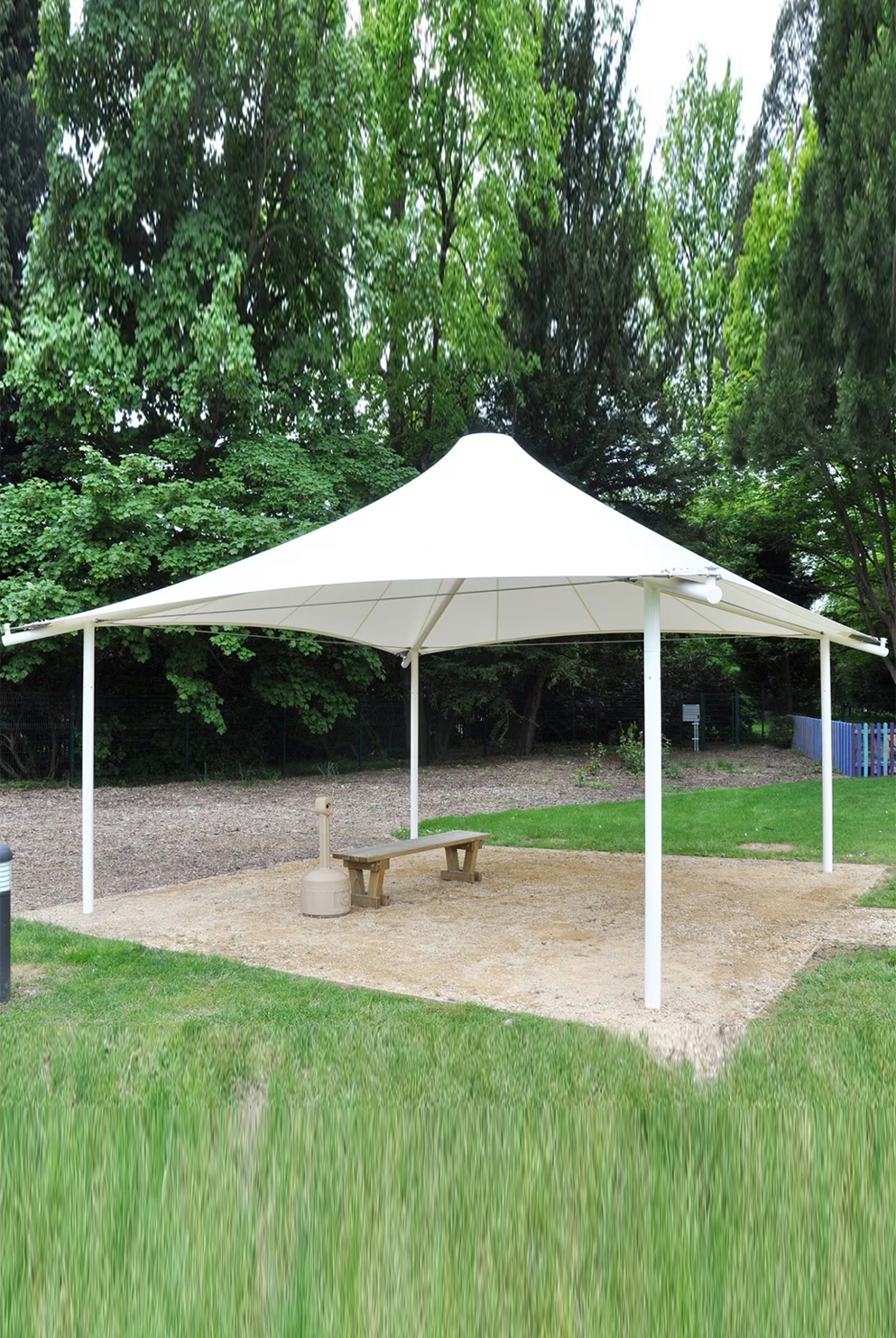
One of the practical advantages of tensile gazebo structures over permanent gazebos is the degree of customization available.
- Size and Span Structures can range from compact 3m x 3m garden gazebos to large 20m+ span public pavilions. For a school in Karnal or a township project in Sonipat, the size gets specified around actual space requirements and footfall.
- Shape and Form Hyperbolic paraboloid (hypar), cone, sail, and barrel-vault shapes are among the most common options. The shape affects not only appearance but also drainage behaviour and structural performance under wind load.
- Fabric Material PVC-coated polyester: Cost-effective, widely used, available in a range of colours and translucency levels.
HDPE shade fabric: Used for open-weave shade applications in gardens and outdoor seating.
PTFE-coated fibreglass: Premium option for long-term projects where dimensional stability and fire resistance are priorities. - Colour Options Membranes are available in a wide range of standard colours. Custom colour matching is possible for projects where the structure needs to match a brand palette or architectural theme.
- Frame Configurations Frame options include single-column umbrella designs, multi-column structures, wall-mounted canopies, and free-standing tension systems — each suited to different site and loading conditions.
- Project-Specific Customization Structural design is adjusted for site wind zones, snow loads (relevant in Shimla, Kullu, and Mandi), seismic zones, and foundation soil conditions.
Installation Process of Tensile Gazebo Structure
- Site Assessment : The process begins with a site visit or detailed drawings review. The RS Tensile team notes ground conditions, existing infrastructure, sun orientation, wind direction, and access constraints. Projects in locations like Dehradun, Haldwani, or Rishikesh often have terrain factors that need early attention.
- Design and Engineering : Structural drawings are prepared based on site data and client requirements. Load calculations, fabric tension values, and foundation specifications are all part of this phase. This is reviewed before fabrication begins.
- Fabrication : The steel frame components are fabricated, treated (galvanised or powder-coated), and checked against the design. Fabric panels are cut and welded using high-frequency welding equipment for clean, strong seams.
- Foundation and Structural Assembly : Concrete footings or anchor bolts are installed on site. Once cured, the steel frame is assembled, aligned, and secured. For projects in remote hill locations like Chakrata or Kokernag, logistics planning is part of this phase.
- Fabric Installation and Tensioning : The fabric membrane is attached to the frame and tensioned in a controlled sequence. Proper tensioning eliminates sag, ensures water runs off cleanly, and gives the structure its designed load-bearing capacity.
- Final Inspection and Handover : The completed structure is inspected for fabric tension uniformity, hardware tightness, drainage performance, and overall finish. Client walkthrough and documentation are part of the handover.
How to Choose a Reliable Tensile Gazebo Structure Manufacturer in India?
The quality of the final structure depends heavily on who designs and installs it. Here are practical points to consider:
Check Design Capability
A manufacturer who provides structural drawings and load calculations is a stronger choice than one who offers only standard catalogue sizes. Site-specific engineering matters, especially in wind-heavy coastal regions or snowfall areas.
Fabric Material Specification
Ask for the fabric grade, GSM rating, UV resistance rating, and manufacturer warranty. Unbranded or low-GSM fabrics may reduce upfront cost but fail within a few years.
Steel Quality and Finish
Confirm whether the frame uses IS-grade steel and whether it is hot-dip galvanised or simply spray-painted. In humid or coastal locations like Brahmapur, Balasore, or Kakinada, galvanisation matters for longevity.
Installation Team
Experienced installation crews handle tensioning correctly. Incorrect tensioning is one of the most common causes of early fabric failure or structural movement.
After-Sales Support
Ask about warranty terms, inspection schedules, and response time for maintenance or repair needs after installation.
Geographic Reach
If your project is in a smaller town like Dhenkanal, Nabarangpur, or Bhawanipatna, confirm the manufacturer can mobilise installation teams to that location without inflating costs disproportionately.
Why Choose RS Tensile Pvt. Ltd. for Tensile Gazebo Structures in India?
RS Tensile Pvt. Ltd. designs, fabricates, and installs tensile gazebo structures for clients across India — from metro cities like Delhi, Mumbai, Pune, Hyderabad, Bengaluru, and Chennai to smaller towns and district headquarters spread across Uttar Pradesh, Madhya Pradesh, Uttarakhand, Himachal Pradesh, Rajasthan, Andhra Pradesh, Haryana, Odisha, Jammu & Kashmir, and Maharashtra.
Engineering-Led Approach Every project starts with proper structural assessment. The team does not apply generic designs to every site. Wind loads, soil bearing capacity, usage patterns, and local climate all influence the final specification.
Quality Materials RS Tensile uses tested and certified fabric membranes and IS-grade structural steel. The company does not compromise on material grade regardless of project size.
Skilled Installation Teams The installation workforce is trained in fabric tensioning, hardware tightening, and structural assembly. This matters for both the quality of the finished structure and its long-term performance.
Nationwide Project Capability The company has handled projects across diverse geographies — urban commercial zones in Ghaziabad, Faridabad, and Thane; hill town resorts in Nainital, Almora, and Paonta Sahib; pilgrimage locations in Varanasi, Tirupati, and Puri; industrial zones in Rourkela, Aurangabad, and Pithoragarh; and residential developments across Jaipur, Bhopal, and Nagpur.
Custom Solutions Whether the requirement is a single garden gazebo structure in a private home in Saket or Dwarka, or a large-span pavilion for a township in Bhiwadi or Greater Noida, the team scales its process accordingly.
Transparent Communication Clients receive design drawings, material specifications, and project timelines before work begins. There are no hidden costs in the quotation.
Conclusion
A tensile gazebo structure in India is a practical, durable, and visually refined way to create covered outdoor space. Whether the project is a garden shelter in Mathura, a resort pavilion in Jaisalmer, a public park canopy in Prayagraj, a campus shade structure in Lucknow, or a commercial entrance cover in Mumbai — the right tensile structure delivers reliable protection and a clean appearance for years.
RS Tensile Pvt. Ltd. brings design capability, quality material sourcing, and skilled installation to projects across the country. The company serves clients across Uttar Pradesh, Rajasthan, Madhya Pradesh, Uttarakhand, Haryana, Himachal Pradesh, Odisha, Andhra Pradesh, Maharashtra, Jammu & Kashmir, and all other states and union territories in India.
If you are planning an outdoor shelter project, contact RS Tensile Pvt. Ltd. to discuss your site requirements, get a design assessment, and receive a detailed project proposal.
FAQs Related to Tensile Gazebo Structure
1. What is the typical lifespan of a tensile gazebo structure?
With quality materials and proper installation, a PVC-coated polyester membrane lasts 10 to 15 years. PTFE-coated fibreglass membranes can last 25 years or more. The steel framework, if galvanised, typically outlasts the fabric.
2. Can a tensile gazebo structure handle heavy monsoon rainfall?
Yes. The membrane sheds water quickly due to its curved geometry and fabric surface. Drainage points are designed into the structure to handle high rainfall rates typical of Odisha, Kerala, and the Western Ghats regions.
3. Is it suitable for snowy conditions in hill areas?
Yes, structures installed in Shimla, Manali, Kullu, Dalhousie, and similar high-altitude locations are designed with steeper pitches and heavier-duty fabrics to handle snow accumulation and sliding loads.
4. How does it compare to a permanent gazebo in terms of cost?
A tensile gazebo structure generally costs significantly less than a permanent RCC or brick-built gazebo of comparable coverage. Material costs, foundation requirements, and construction time are all lower.
5. Can the structure be relocated after installation?
Most tensile gazebo structures are designed as semi-permanent installations anchored to concrete foundations. However, smaller freestanding designs can sometimes be dismantled and relocated with some effort..
6. What maintenance is required after installation?
Routine cleaning of the fabric with mild soap and water, periodic inspection of fabric tension and hardware tightness, and annual structural checks are the main maintenance tasks. No painting or resealing of the fabric is typically needed.
7. Do you offer customised designs, or only standard sizes?
RS Tensile works on fully customised designs. Size, shape, fabric colour, frame configuration, and foundation type are all specified per project.
8. How long does installation typically take?
For a standard residential or small commercial tensile gazebo structure, installation usually takes 2 to 5 days once foundation work is complete. Larger projects take longer and are scheduled accordingly.
9. Do you serve projects in smaller towns and remote locations?
Yes. RS Tensile has completed projects in locations ranging from major metros to smaller towns including Jagatsinghpur, Samalkha, Narwana, Hansi, Dausa, Yanam, Dholpur, Hindaun, Achalpur, and many others across India.
10. What is the tensile gazebo vs permanent gazebo comparison in terms of long-term value?
A permanent gazebo has a longer structural lifespan but requires a larger upfront investment, longer construction time, and more complex maintenance over the years. A tensile gazebo structure offers comparable shelter and better visual flexibility at lower cost and with faster installation. For most commercial and recreational applications, the tensile option delivers strong long-term value.
