Garden Tensile Structure in India – Design, Supply & Installation

| Product Description | Elevate your garden's ambiance and functionality with a tensile structure that blends modern design with reliable performance. Order your Garden Tensile Structure today and enjoy an outdoor space like never before! |
| Membrane Material | PVC / PTFE / HDPE |
| Fabric Color | White or Customized |
| Shape & Size | Customized |
| Certification | ISO 45001:2018(OHSAS), ISO 45001:2015, ISO 9001:2015 |
| Place of Origin | India |
Order Now
ENQUIRE NOW
Garden tensile structures have become a practical and aesthetically strong choice for outdoor spaces across India. Whether it is a private garden, a public park, a resort landscape, or an institutional campus, these structures provide shade, shelter, and a refined visual character that traditional building methods often cannot match.
RS Tensile Pvt. Ltd., led by founder and CEO Radhey Shayam, manufactures and supplies garden tensile structures to clients across India. As a manufacturer, the company handles design, fabrication, and installation from a single platform, ensuring quality control at every stage.
From bustling metros like Delhi, Mumbai, Pune, and Hyderabad to smaller cities and towns such as Pushkar, Lansdowne, Chakrata, and Yanam, RS Tensile serves projects of varying scale and complexity. This page covers everything you need to know about garden tensile structures — from materials and types to applications and choosing the right supplier.
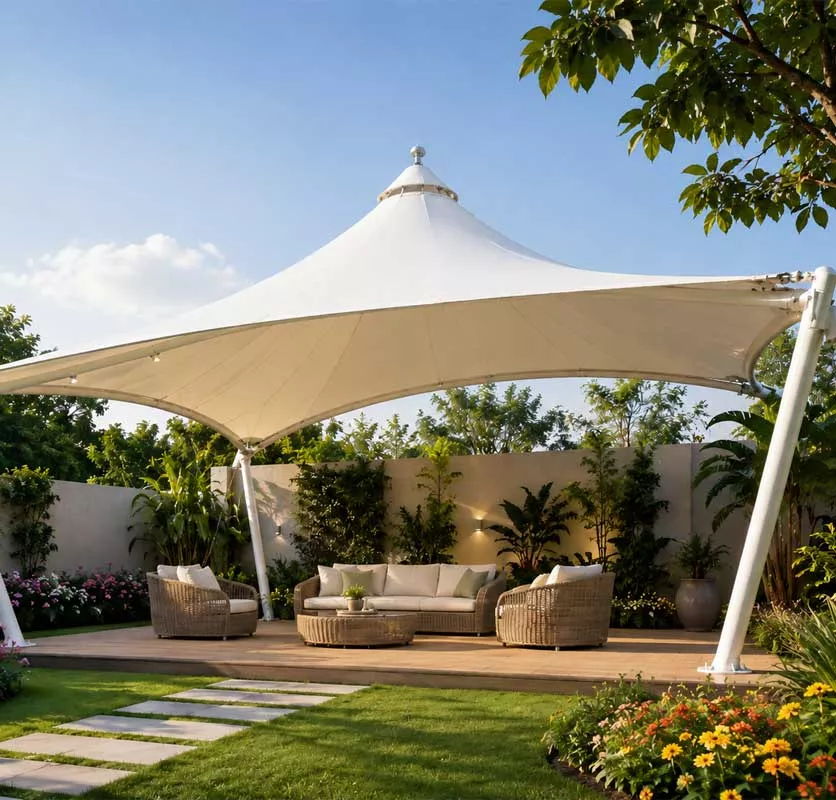
What Is a Garden Tensile Structure?
A garden tensile structure is a fabric-based architectural covering supported by steel or aluminium frames and tensioning cables. Unlike rigid roofing, tensile structures derive their strength from tension — the membrane is pulled tight between anchor points to form a stable, load-bearing canopy.
The main components of a garden tensile structure include:
- High-tensile fabric membrane (HDPE, PVC-coated polyester, or PTFE-coated fibreglass)
- Structural steel or stainless steel columns and masts
- Stainless steel or galvanised tensioning cables and fittings
- Concrete or ground anchor footings
- Edge and corner termination hardware
The working principle is straightforward: pre-stressed tension in the fabric transfers loads to the supporting columns and anchors. This allows large spans to be covered with minimal structural material, making garden tensile structures both material-efficient and visually light.
Types of Garden Tensile Structures
Garden tensile structures come in several configurations. Each suits different site conditions, aesthetic preferences, and coverage requirements.
Hypar (Hyperbolic Paraboloid) Structures
One of the most recognised tensile forms. The opposing curves of the hypar shape give it natural rigidity. It sheds water effectively and fits well in formal garden settings.
Conical or Umbrella Structures
A single central mast supports a cone-shaped canopy. Common in parks, resort gardens, outdoor dining areas, and heritage precincts such as those found near Fatehpur Sikri or Sarnath.
Sail Shade Structures
Triangular or quadrilateral fabric panels attached at three or four points. Versatile and modular. Often used in garden clusters or over walkways.
Barrel Vault Tensile Canopies
Arched fabric roofing supported by curved steel frames. Useful for covering garden pathways, outdoor corridors, and seating areas in hospitality and institutional gardens.
Butterfly / Wavy Membrane Structures
Free-form designs with undulating fabric profiles. Used where visual impact is a priority — luxury resorts, high-end residential developments, and landscape features.
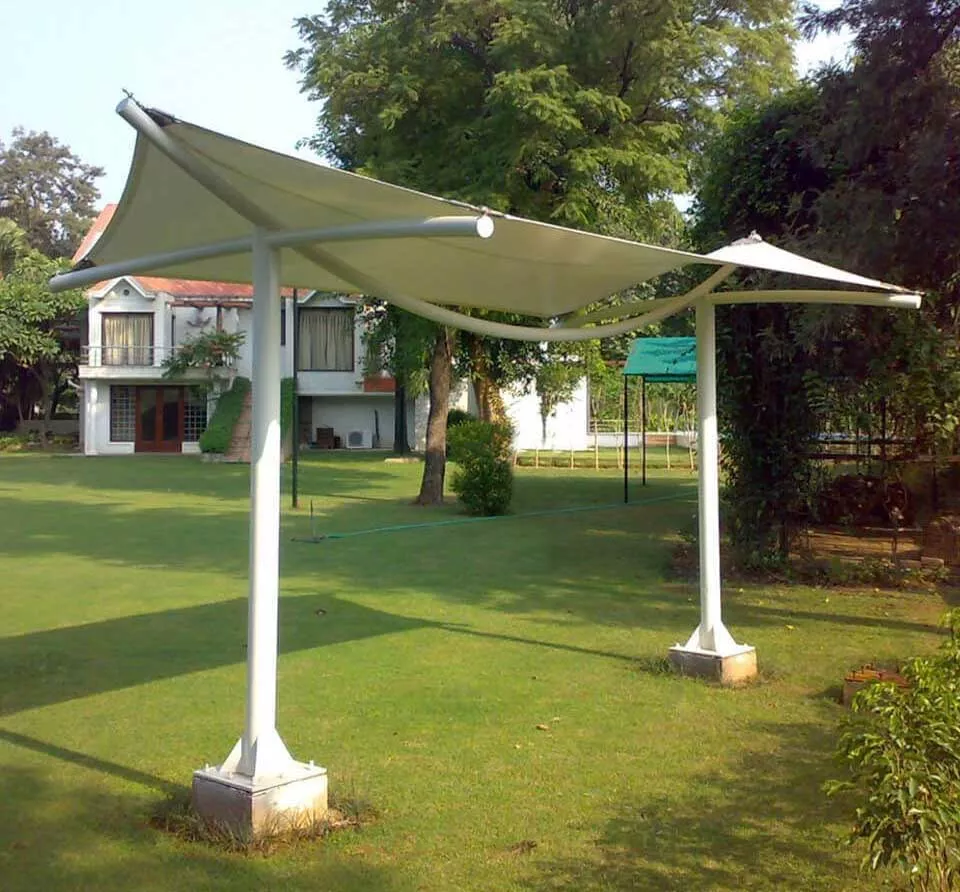
Key Features of Garden Tensile Structures
- UV-stabilised fabric that retains strength and colour despite prolonged sun exposure
- Weather-resistant membranes suited to Indian conditions — heat, monsoon rains, and humidity
- Rust-resistant galvanised or powder-coated steel framework
- Large clear-span coverage without internal columns
- Lightweight compared to concrete or metal sheet roofing
- Modular and expandable — panels can be added or reconfigured
- Low maintenance over the structure's service life
- Custom shapes, sizes, and colours to match project aesthetics
- Service life typically ranging from 10 to 25 years depending on fabric grade and maintenance
Benefits of Choosing Garden Tensile Structure in India
India's climate varies significantly from region to region. A garden tensile structure handles this variation well.
- Effective Shade and Temperature Reduction — High-quality HDPE shade fabric blocks 70–95% of UV radiation. In cities like Agra, Bikaner, Jaisalmer, Mathura, and Jodhpur where summer temperatures regularly exceed 40°C, this makes outdoor spaces usable for longer hours.
- Rain Protection During Monsoon — PVC-coated membranes are waterproof. Structures in coastal areas like Visakhapatnam, Bhubaneswar, Brahmapur, and Kakinada, or in high-rainfall zones in Uttarakhand, Himachal, and Jammu & Kashmir, can be designed to manage rainwater drainage efficiently.
- Fast Site Execution — Compared to brick-and-mortar construction, tensile structures are fabricated off-site and assembled on location. Most garden tensile structure projects are completed in days or weeks, not months.
- Cost-Effective for Large Coverage Areas — When covering large open gardens, tensile structures use less material per square metre than conventional roofing, reducing both material costs and dead loads on foundations.
- Aesthetic Value — Tensile canopies add a contemporary or sculptural quality to garden spaces. They complement both traditional Indian garden layouts and modern landscape designs.
- Energy Efficiency — By reducing direct solar gain in outdoor areas, tensile structures lower the cooling load on adjacent buildings — a practical benefit for resorts, commercial complexes, and hospitals.
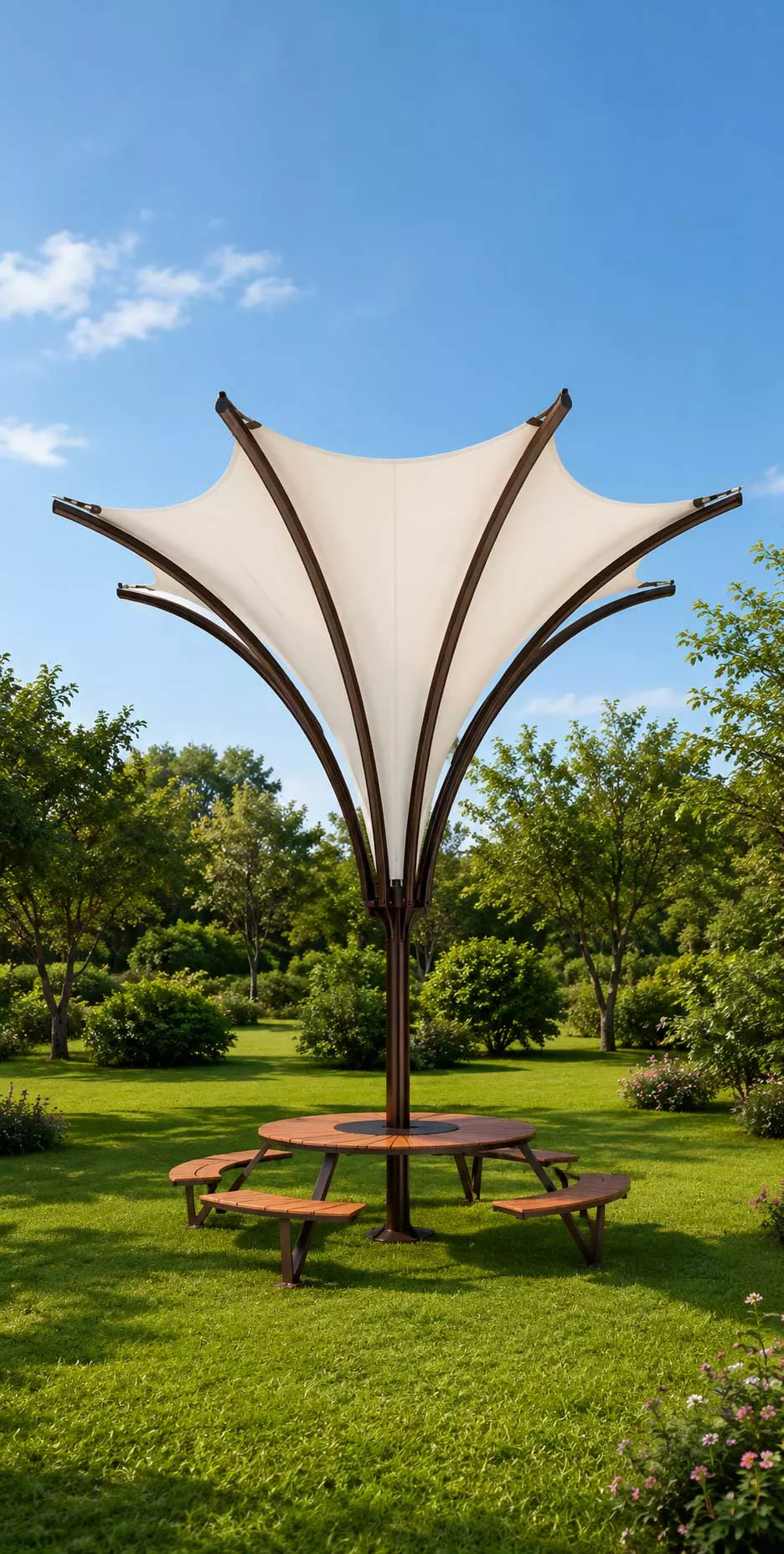
Applications of Garden Tensile Structures Across Different Industries
Garden tensile structures are not limited to residential or decorative use. They serve functional purposes across a wide range of sectors.
- Commercial Complexes and Retail — Garden and entrance forecourt tensile structures enhance customer experience at malls and retail parks. Projects in cities like Noida, Gurgaon, Faridabad, Thane, and Panvel often feature tensile entrance canopies.
- Hotels, Resorts, and Hospitality — Outdoor dining, pool decks, and landscape areas in resorts across Manali, Nainital, Mussoorie, Kasauli, Pahalgam, and Dalhousie use tensile garden structures to create sheltered outdoor spaces without closing off the natural surroundings.
- Public Parks and Heritage Precincts — Government parks, heritage tourism sites, and civic gardens in locations like Kokernag, Rishikesh, Devprayag, Rudraprayag, Ayodhya, Puri, and Haridwar benefit from tensile shade structures that protect visitors without altering the character of the space.
- Educational Institutions — Schools, colleges, and universities use garden tensile structures for campus gardens, outdoor amphitheatres, and walkways. These are practical additions in cities like Dehradun, Roorkee, Kurukshetra, Aligarh, and Varanasi.
- Hospitals and Healthcare Facilities — Outdoor waiting areas, healing gardens, and entry canopies at hospitals in Lucknow, Kanpur, Gwalior, Bhopal, Indore, and Nagpur use tensile structures for weather protection.
- Sports Facilities — Clubhouse gardens, stadium surrounds, and outdoor courts in cities from Vijayawada to Amravati to Rourkela use tensile garden canopies for spectator areas and equipment storage.
- Residential Developments — Luxury housing projects and apartment complexes in Gurgaon, Noida, Greater Noida, Rohini, Dwarka, Panipat, and Sonipat feature garden tensile structures in landscaped podium and terrace gardens.
- Industrial Campuses — Industrial parks and manufacturing campuses in Baddi, Bhiwadi, Nalagarh, Itarsi, Dewas, Morena, and Bhilwara use tensile structures for outdoor recreation spaces and entrance landscaping.
- Religious and Pilgrimage Sites — Pilgrim gathering areas, dharamshalas, and temple gardens in Katra, Pushkar, Sarnath, Tirupati, Mathura, and Haridwar use tensile shading to manage large footfall in open spaces.
Design and Customization Options for Garden Tensile Structures
No two garden projects are identical. RS Tensile offers design and customisation across all structural and fabric parameters.
Fabric Material Options
- HDPE shade cloth – breathable, lightweight, suited for dry-climate and semi-open garden applications
- PVC-coated polyester – waterproof, durable, wide colour range, suited for rain-prone regions
- PTFE-coated fibreglass – high-end, self-cleaning, extremely long service life, suited for landmark projects
Structural Options
- Hot-dip galvanised steel columns and masts
- Stainless steel wire rope and tensioning fittings
- Powder-coated finishes in custom RAL colours
- Aluminium framing for lightweight applications
Shape and Configuration
- Conical, hypar, sail, vault, butterfly, and free-form profiles
- Single-module or multi-bay arrangements
- Column-mounted, wall-mounted, or ground-anchored configurations
Project-Specific Customisation
Fabric colour, opacity level, print patterns, edge finishing, custom height, drainage routing, and integration with garden lighting are all available as project-specific options. Wind load calculations are performed for each site based on IS 875 norms.
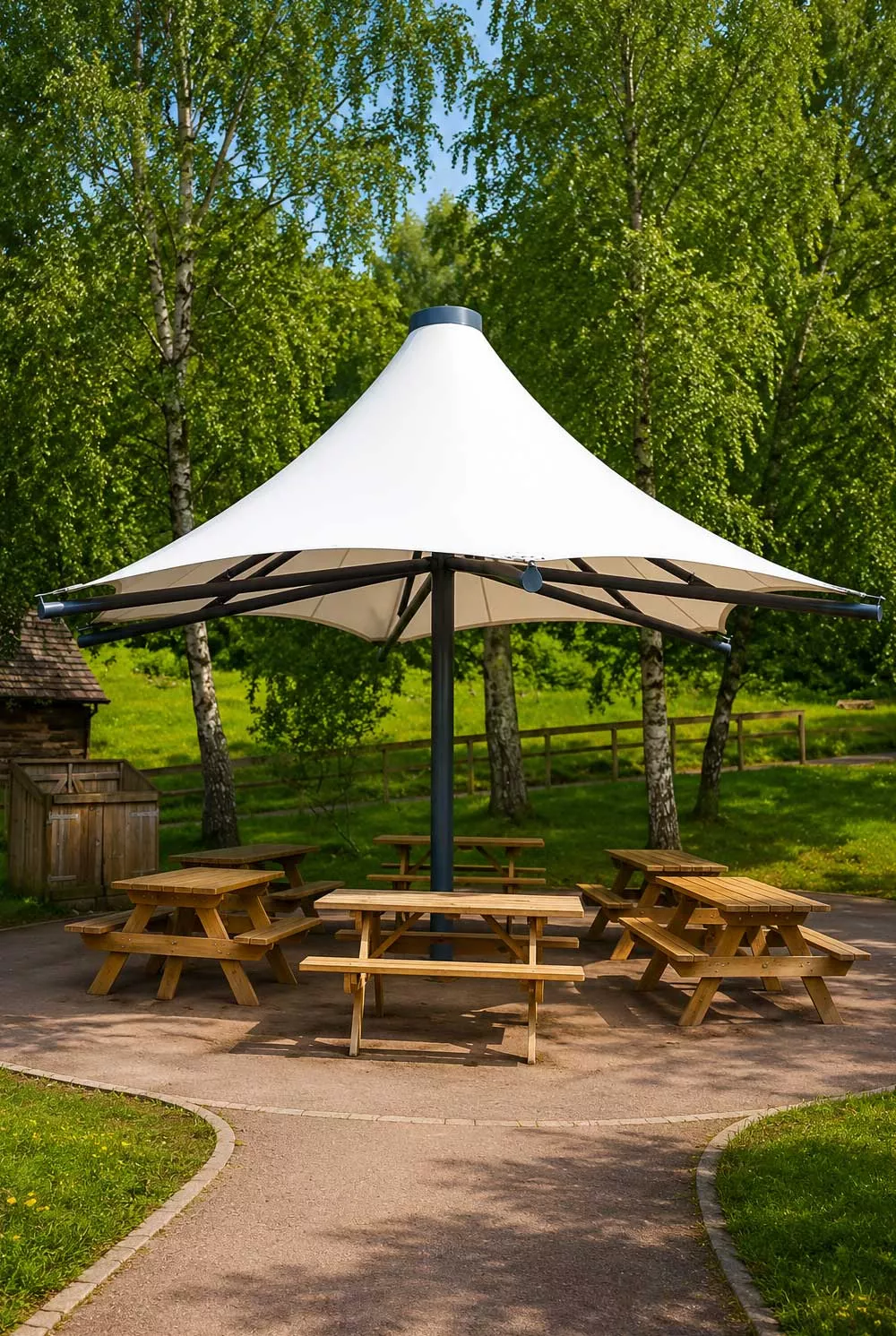
Installation Process for Garden Tensile Structures
RS Tensile follows a structured installation process to ensure structural performance and long-term reliability.
- Site Assessment – Survey of ground conditions, available footprint, existing landscape features, and obstruction clearances. Wind and load analysis based on location (Shimla and Manali face different wind conditions than Varanasi or Guntur).
- Design Planning – Structural and fabric design using engineering software. Compliance with applicable Indian Standards including IS 875 for wind loads and IS 800 for steel structures.
- Fabrication – Steel framework and fabric panels are fabricated at the manufacturing facility. Quality checks on welding, coating, and fabric dimensions are completed before dispatch.
- Foundation Work – Anchor bolts or pile foundations are installed on site as per the structural design. Concrete curing time is allowed before framework erection.
- Framework Erection – Steel columns, masts, and cables are assembled and plumbed. Tensioning cables are pre-positioned.
- Fabric Installation – Fabric panels are attached to the framework and tensioned to specified pre-stress levels. No wrinkles, sagging, or asymmetric tension should remain after installation.
- Final Inspection – Complete structural check, tension verification, hardware tightening, and site cleanup. Client walkthrough and handover documentation provided.
How to Choose a Reliable Garden Tensile Structure Manufacturer in India?
With many suppliers offering tensile structure services, selecting the right one requires looking beyond the price quote.
- Verify Manufacturing Capability – A manufacturer with in-house fabrication — like RS Tensile — controls quality from raw material to finished product. Traders who outsource fabrication have less control over output consistency.
- Check Structural Engineering Support – Every garden tensile structure must be engineered for the specific site's wind zone and load conditions. Ask for load calculations and engineering drawings before committing to any supplier.
- Review Past Project Experience – Ask for project references covering the type of structure and the climatic zone relevant to your location. A supplier who has completed projects in Jaisalmer, Barmer, and Rajasthan has experience with high wind and heat. One who has installed in Rudrapur, Almora, or Pithoragarh understands hill terrain challenges.
- Assess Fabric Quality – Request fabric specifications — GSM rating, UV resistance percentage, tensile strength data, and warranty terms. Low-cost fabric degrades significantly within 3–5 years in Indian outdoor conditions.
- Understand the Warranty and Post-Installation Service – A reliable supplier provides a clear structural warranty and has a service team capable of attending to post-installation issues. Check whether the company serves your location — RS Tensile operates across states including Rajasthan, Haryana, Uttar Pradesh, Uttarakhand, Himachal Pradesh, Jammu & Kashmir, Andhra Pradesh, Maharashtra, Odisha, and Madhya Pradesh.
Why Choose RS Tensile Pvt. Ltd. for Garden Tensile Structure in India?
RS Tensile Pvt. Ltd. is a manufacturer — not an agent or dealer — of tensile fabric structures. This distinction matters because it affects pricing, lead times, quality control, and the ability to deliver custom engineering solutions.
- In-house design, fabrication, and installation team
- Experience across diverse project types — from small residential gardens to large public installations
- Material procurement from established fabric and steel suppliers
- Engineering calculations performed for each project's site conditions
- Active project presence across states: Haryana (Karnal, Kaithal, Jind, Jhajjar, Bhiwani, Fatehabad, Sirsa, Hansi, Narwana, Sonipat, Rewari, Rohtak, Palwal, Ambala, Panchkula, Yamuna Nagar, Bahadurgarh), Rajasthan (Jaipur, Jodhpur, Ajmer, Kota, Udaipur, Bikaner, Alwar, Bharatpur, Sikar, Dausa, Bhilwara, Barmer, Chittorgarh, Dholpur, Hanumangarh, Hindaun, Sri Ganganagar, Kishangarh, Ratlam, Shivpuri, Pratapgarh, Dholpur, Bhind), Uttar Pradesh (Lucknow, Kanpur, Agra, Ghaziabad, Meerut, Varanasi, Prayagraj, Gorakhpur, Jhansi, Aligarh, Moradabad, Saharanpur, Muzaffarnagar, Jaunpur, Faizabad, Amethi, Jalgaon), Uttarakhand (Dehradun, Haridwar, Roorkee, Haldwani, Rudrapur, Mussoorie, Rishikesh, Nainital, Almora, Pithoragarh, Chakrata, Lansdowne, Devprayag, Rudraprayag, Paonta Sahib), Himachal Pradesh (Shimla, Manali, Kullu, Dharamsala, Baddi, Nalagarh, Mandi, Bilaspur, Dalhousie, Chamba, Kasauli, Paonta Sahib), Jammu & Kashmir (Jammu, Srinagar, Katra, Udhampur, Anantnag, Pahalgam, Kokernag, Handwara, Kathua), Haryana, Delhi and NCR (Delhi, Noida, Greater Noida, Gurgaon, Faridabad, Ghaziabad, Rohini, Dwarka, Saket, Mahipalpur, Alipur, Bhiwadi, Samalkha), Maharashtra (Mumbai, Pune, Nashik, Nagpur, Aurangabad, Kolhapur, Thane, Vasai, Virar, Panvel, Bhiwandi, Solapur, Ulhasnagar, Amravati, Jalgaon, Latur), Andhra Pradesh (Vijayawada, Visakhapatnam, Guntur, Nellore, Kurnool, Tirupati, Kakinada, Ongole, Vizianagaram, Chittoor, Rajamahendravaram, Hindupur, Hindupuram), Odisha (Bhubaneswar, Cuttack, Rourkela, Sambalpur, Brahmapur, Puri, Balasore, Dhenkanal, Bargarh, Sundargarh, Nabarangpur, Khordha, Bhawanipatna), Madhya Pradesh (Bhopal, Indore, Gwalior, Jabalpur, Ujjain, Satna, Morena, Dewas, Ratlam, Chhatarpur, Satara), and other states across India.
Conclusion
Garden tensile structures offer a practical, durable, and visually effective solution for outdoor spaces across India. Their ability to cover large areas with minimal structural weight, adapt to varied climatic conditions, and be customised to match any garden aesthetic makes them a preferred choice across residential, commercial, institutional, and public sector projects.
RS Tensile Pvt. Ltd. manufactures and supplies garden tensile structures across India — from metro cities like Delhi, Mumbai, Pune, Hyderabad, and Kolkata to regional cities and smaller towns in states including Rajasthan, Haryana, Uttar Pradesh, Uttarakhand, Himachal Pradesh, Jammu & Kashmir, Andhra Pradesh, Maharashtra, Odisha, and Madhya Pradesh.
If you are planning a garden tensile structure in India for a residential, commercial, institutional, or public project, contact RS Tensile Pvt. Ltd. for project-specific information, design inputs, and a detailed quote. The team can be reached through the contact page on the company website.
FAQs About Garden Tensile Structures
1. What is the average lifespan of a garden tensile structure?
The lifespan depends on fabric grade and maintenance. HDPE shade cloth typically lasts 5–10 years. PVC-coated polyester lasts 10–15 years. PTFE-coated fibreglass can last 25 years or more. Steel frameworks, when properly coated, typically outlast the fabric.
2. Are garden tensile structures suitable for monsoon-heavy regions?
Yes. PVC-coated membranes are fully waterproof. For locations in Odisha, Andhra Pradesh, Uttarakhand, and Himachal Pradesh that receive heavy seasonal rainfall, waterproof fabric combined with properly designed drainage slopes ensures effective rainwater runoff.
3. Can garden tensile structures withstand high wind loads?
Yes, when engineered correctly. Structures are designed to site-specific wind zones as per IS 875 (Part 3). Projects in exposed locations like Jaisalmer, Barmer, coastal Andhra Pradesh, or high-altitude areas in Jammu & Kashmir and Himachal undergo detailed wind load analysis.
4. What fabric colours are available for garden tensile structures?
PVC-coated polyester membranes are available in a wide range of RAL colours. HDPE shade cloth is typically available in greens, beige, cream, charcoal, and custom shades. Colour selection can be matched to project requirements and landscape themes.
5. Can you design a garden tensile structure for an irregular-shaped garden?
Yes. Tensile fabric structures are inherently suited to non-rectangular forms. Hypar, sail, and free-form shapes can be designed around irregular boundaries, existing trees, pathways, and other landscape elements.
6. Do you supply garden tensile structures in tier-2 and tier-3 cities?
RS Tensile supplies and installs across India, including smaller cities and towns such as Jagatsinghpur, Fatehpur Sikri, Kokernag, Yanam, Katra, Nalagarh, Pithoragarh, Itarsi, Hansi, Narwana, Pushkar, Dhenkanal, Dausa, Ongole, Hanumangarh, Kaithal, Bargarh, Khammam, Achalpur, and others.
7. What maintenance is required for a garden tensile structure?
Routine maintenance includes periodic fabric cleaning (mild soap solution, no abrasives), inspection of cables and fittings for corrosion or tension loss, tightening of hardware, and inspection of fabric for tears or UV degradation at seams. Most garden tensile structures require minimal maintenance when correctly installed.
8. How long does installation take?
Small single-canopy garden structures can be installed in 2–5 days. Larger multi-bay installations or complex custom shapes may take 2–4 weeks. Timelines include foundation curing time, which varies by ground conditions.
9. Do you provide structural drawings and engineering calculations?
Yes. Every project comes with structural design drawings and, where required, engineering load calculations in compliance with applicable Indian Standards.
10. Can a garden tensile structure be dismantled and relocated?
Some modular configurations can be dismantled and relocated, though this depends on the foundation type and structural configuration. Ground-anchored systems with permanent concrete footings are generally not designed for relocation.
