Food Court Tensile Structure in India: A Complete Guide

| Product Description | Create a welcoming and stylish environment for diners with a tensile structure that blends modern design and dependable performance. Order your Food Court Tensile Structure today and redefine your outdoor dining experience! |
| Membrane Material | PVC / PTFE / HDPE |
| Fabric Color | White or Customized |
| Shape & Size | Customized |
| Certification | ISO 45001:2018(OHSAS), ISO 45001:2015, ISO 9001:2015 |
| Place of Origin | India |
Order Now
ENQUIRE NOW
Food courts are busy, high-footfall spaces. Whether it is an open-air dining zone, a mall courtyard, or a roadside dhaba cluster, the roof above matters. A food court tensile structure in India has become one of the most practical and visually appealing solutions for covering large outdoor and semi-outdoor dining areas without relying on conventional RCC construction.
RS Tensile Pvt. Ltd. designs, fabricates, and installs tensile structures for food courts and restaurants across the country. From small eatery clusters in Pushkar to large food plazas in Gurgaon, the company has handled projects of varied scale and complexity.
What Is a Food Court Tensile Structure?
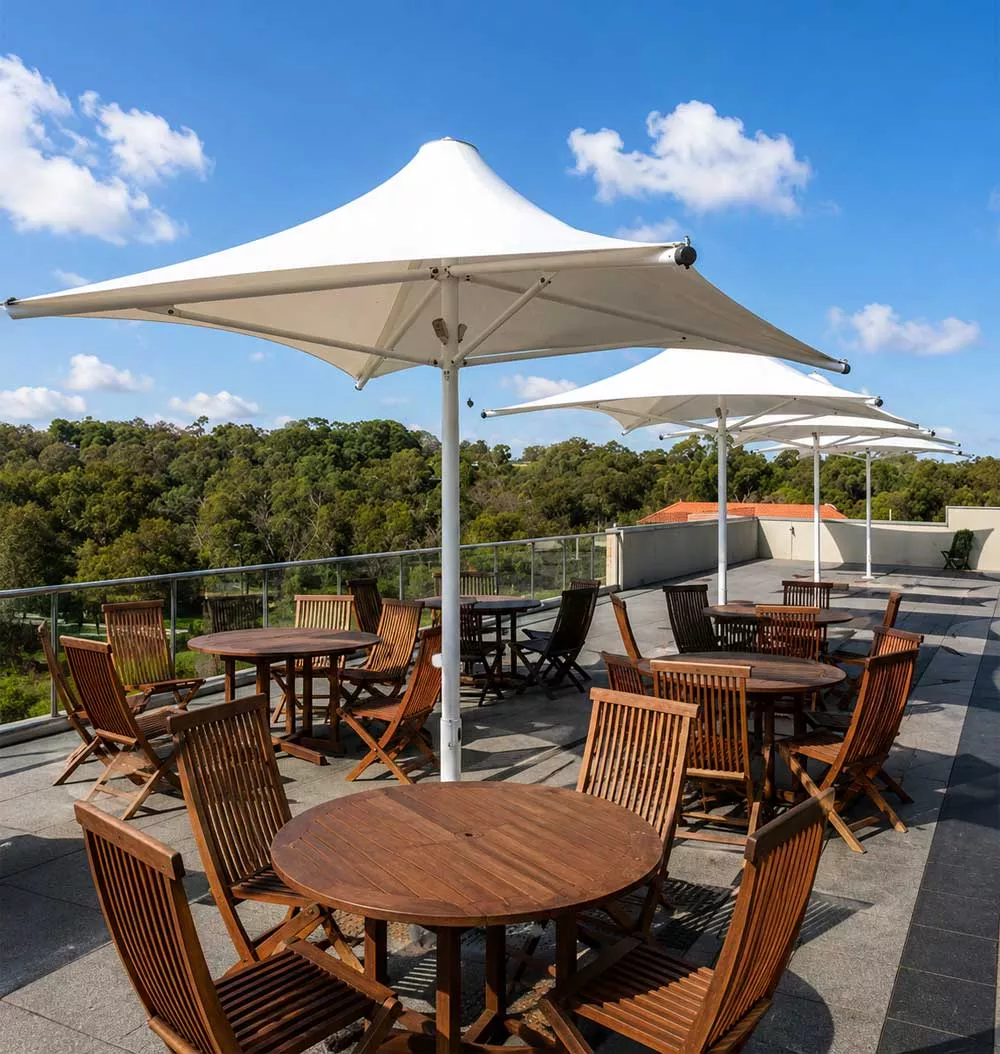
A food court tensile structure is a fabric-based roofing system stretched over a steel frame. Instead of rigid panels or conventional roofing materials, it uses a high-strength membrane — usually PVC or HDPE fabric — pulled tight across anchor points and structural supports to form a stable, load-bearing canopy.
The basic components include:
- Steel or stainless-steel columns — primary load-bearing elements
- Cable or tube framework — transfers tension through the membrane
- High-strength tensile fabric — the main covering material
- Foundation anchors — connect the structure securely to the ground or existing surfaces
- Drainage system — manages rainwater runoff
The structure works on the principle of tension. Unlike a rigid roof that pushes downward through compression, a tensile membrane distributes loads by pulling the fabric in multiple directions simultaneously. This makes the whole system lightweight yet structurally sound.
Types of Food Court Tensile Structures
Several configurations are used depending on the project:
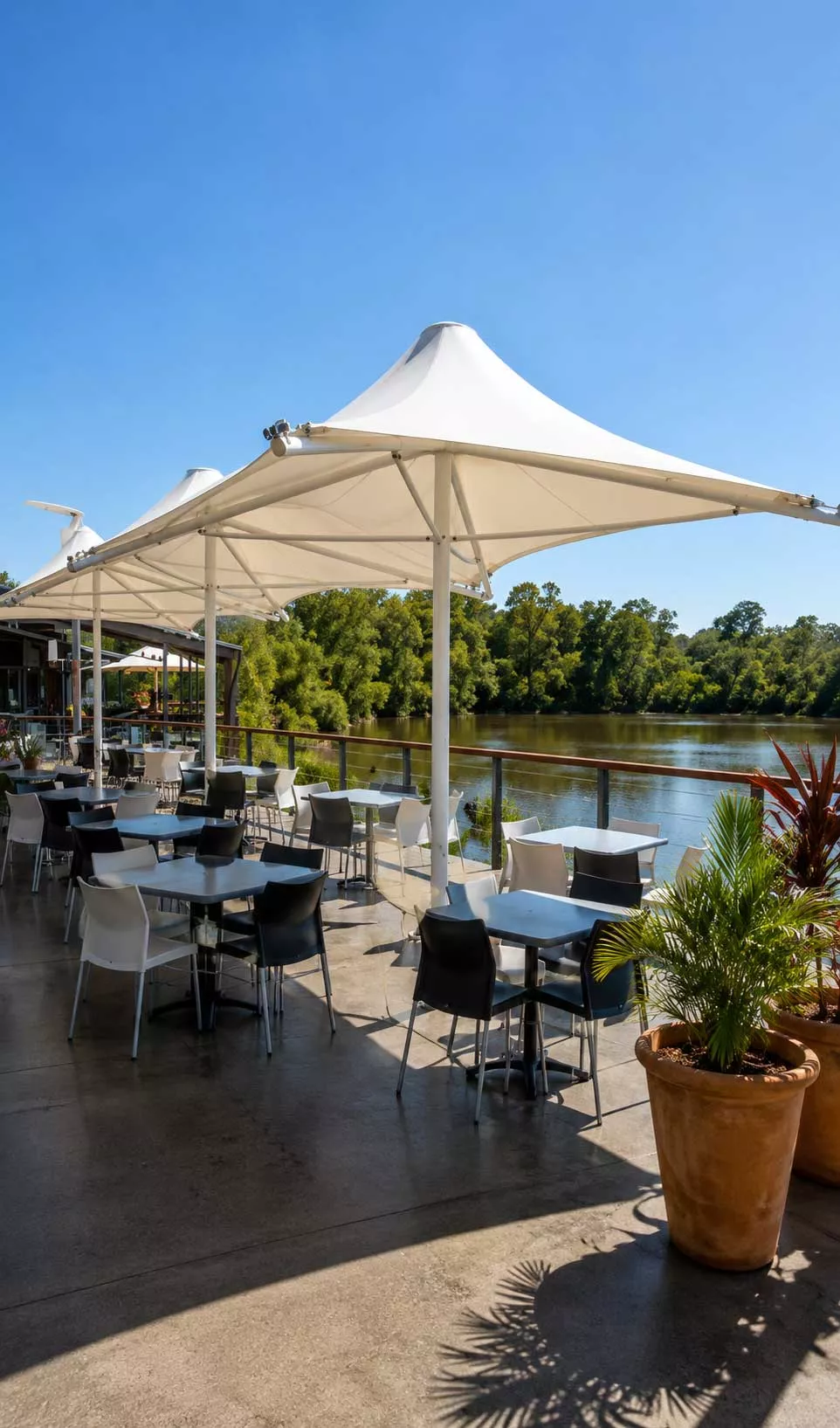
Conical / Mast-Supported Structures
A central mast pushes the fabric upward into a peak. Common in open plazas and food courts in Jaipur, Lucknow, and Kanpur.
Hypar (Hyperbolic Paraboloid) Structures
Saddle-shaped canopies that create an architectural form while managing water runoff effectively. Popular in resort restaurants and premium food courts in Udaipur and Shimla.
Flat / Cantilever Shade Sails
Straightforward flat or slightly angled fabric panels anchored to walls or poles. Used for smaller extensions in areas like Mahipalpur, Rohini, and Dwarka.
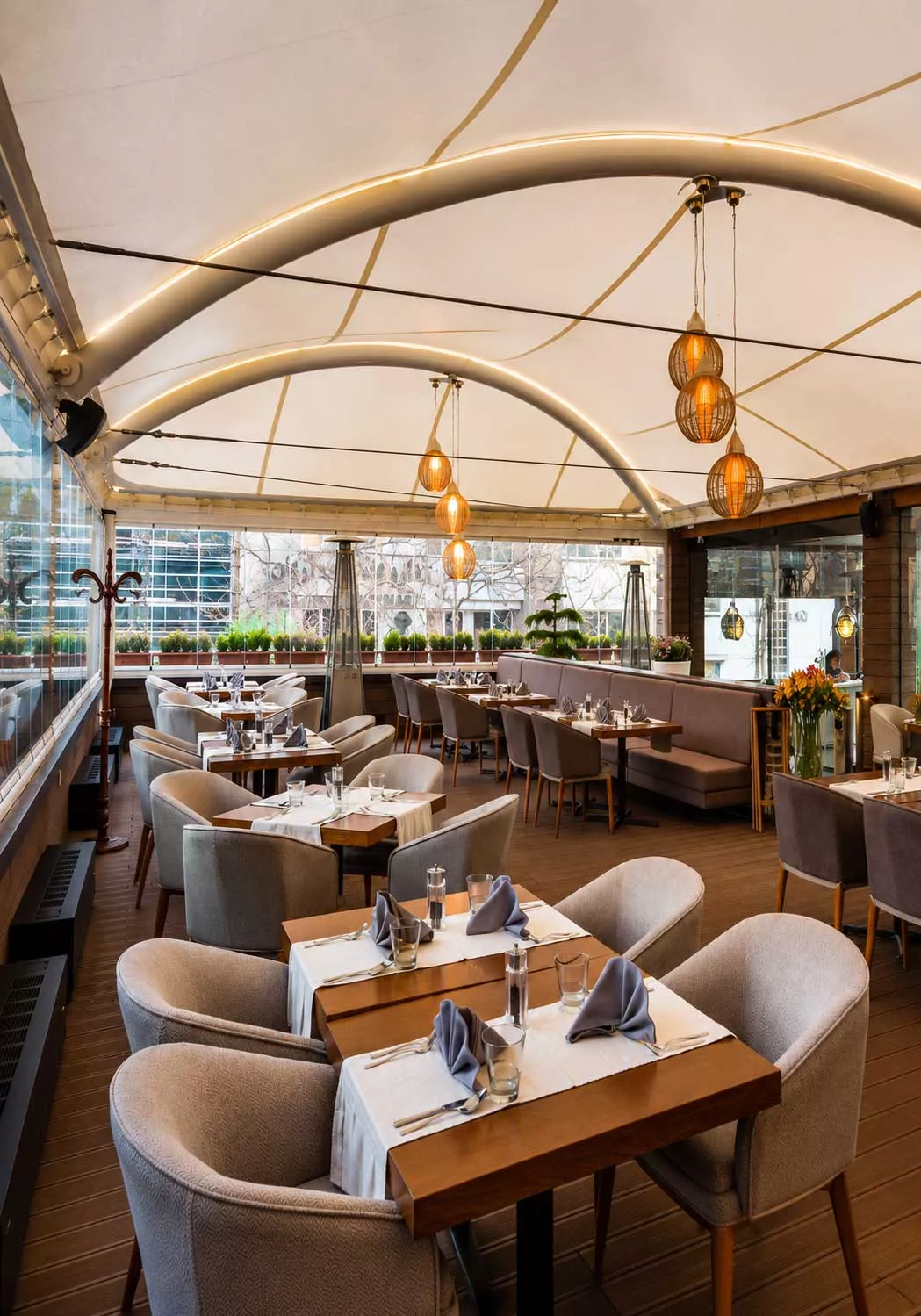
Barrel Vault Structures
Curved arch forms that span over long dining corridors. Often seen covering food lanes in market areas and commercial zones in Indore, Nagpur, and Bhopal.
Frame-Supported Structures
Fabric stretched over a welded steel tube frame. Suitable for permanent installations in areas with high wind loads, such as projects in Manali, Nainital, and Mussoorie.
Key Features of Food Court Tensile Structures
UV and Heat Protection The fabric used in these structures comes with UV-resistant coatings that block harmful radiation. This is especially useful in high-sun states like Rajasthan, where food courts in Bikaner, Jaisalmer, and Barmer require effective heat management throughout summer.
- Weatherproof Performance – A well-fabricated tensile membrane handles both sun and rain. The fabric is tested for water resistance and tensile strength, making it suitable for monsoon-heavy regions like Odisha, where installations in Cuttack, Bhubaneswar, and Puri need to handle heavy seasonal rainfall.
- Lightweight Design – Compared to RCC, tensile structures impose minimal load on the ground or supporting surfaces. This makes them suitable for terraces, retrofitted outdoor spaces, and locations where foundation work is limited.
- Long Service Life – With proper installation and routine maintenance, a food court tensile structure typically lasts 10 to 15 years. High-grade PVC fabric carries manufacturer warranties and retains its structural properties across repeated weather cycles.
- Noise Reduction – Tensile fabric absorbs some ambient noise, which is a practical benefit in busy food court environments where background noise from kitchen areas, crowds, and traffic would otherwise be disruptive.
- Architectural Flexibility – The structure can be formed into curves, peaks, and multi-tiered shapes that are difficult or expensive to achieve with conventional materials. This makes it a good fit for projects where visual identity matters, such as themed restaurants and high-street food plazas.
- Low Maintenance Requirements – The surface of PVC and HDPE tensile fabric is non-porous and resistant to mould and dirt buildup. Periodic cleaning with water and mild detergent is generally sufficient for ongoing upkeep.
Benefits of Choosing a Food Court Tensile Structure in India
Cost Compared to Conventional Construction On a per-square-foot basis, a tensile shade structure costs considerably less than an RCC roof or glass-and-steel canopy when accounting for materials, labour, and foundation requirements. Businesses setting up food courts in Noida, Greater Noida, Faridabad, and Ghaziabad have found tensile roofing to be a faster and more budget-friendly option.
- Quick Installation – Once the design is finalised and fabrication is complete, on-site installation of a tensile structure takes days rather than weeks. This is relevant for food court operators who cannot afford extended shutdowns.
- Large Spans Without Intermediate Columns – Tensile systems can span 15 to 30 metres or more without intermediate supports, keeping the dining area open and unobstructed. This is particularly valued in food courts in Pune, Mumbai, Thane, and Nashik where space layout is a priority.
- Year-Round Usability – Outdoor and semi-outdoor food spaces that would otherwise be unusable during summer or monsoon season become functional throughout the year under a tensile canopy. Operators in Varanasi, Prayagraj, Gorakhpur, and Jaunpur have extended their dining capacity significantly using permanent tensile coverings.
- Improved Customer Experience – Shaded, weather-protected seating attracts more customers and encourages longer stays. A comfortable outdoor food court with an architecturally appealing tensile roof creates an environment that reflects well on the brand.
- Relocatability – Certain tensile structure configurations can be dismantled and reassembled at a different location, which is an advantage for temporary food courts at events, exhibitions, and seasonal venues.
Applications of Food Court Tensile Structures Across Industries
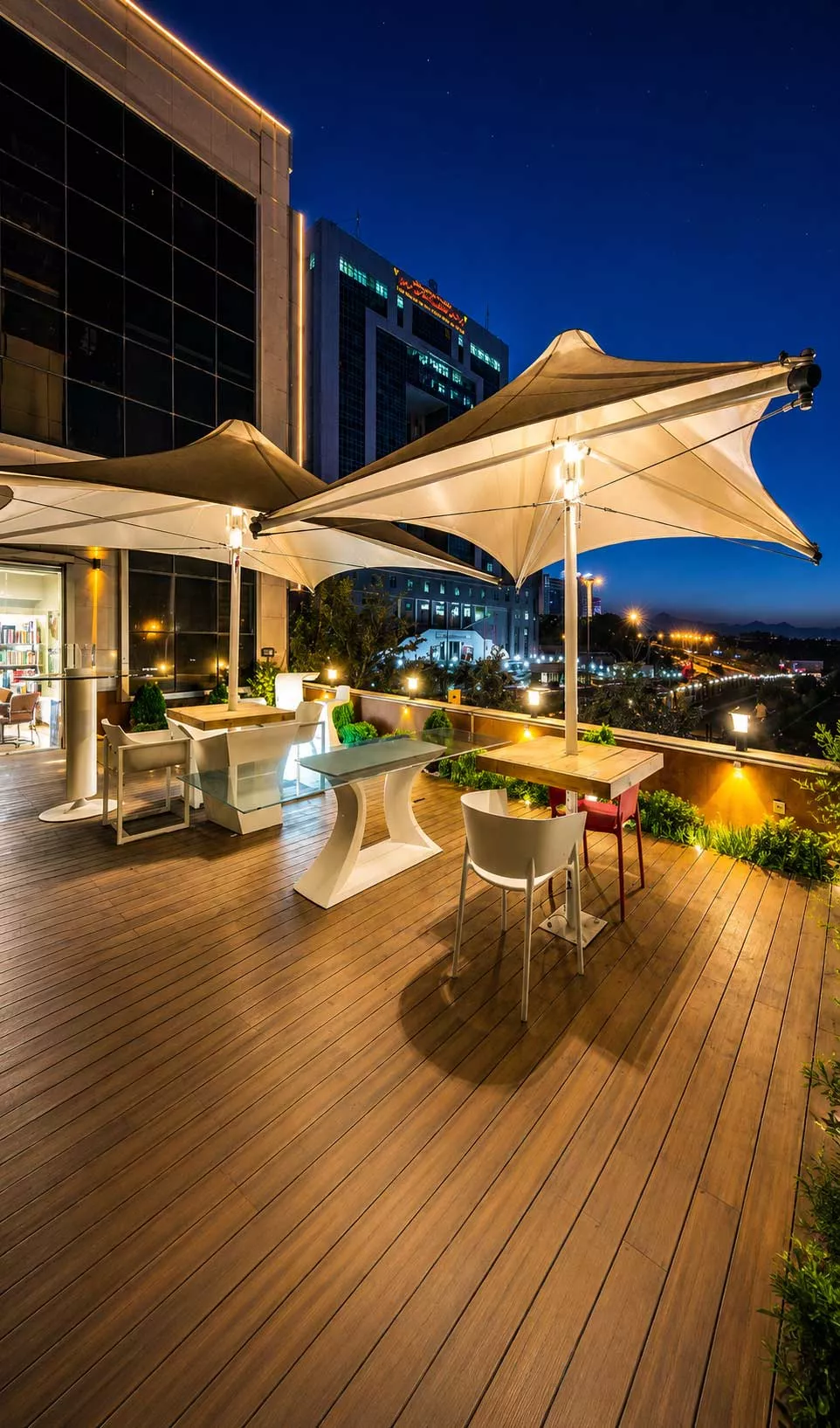
- Commercial Food Courts and Malls – Shopping malls in Delhi, Gurgaon, Rohtak, Panipat, Sonipat, and Karnal use tensile roofing to cover food plazas, courtyards, and open-air dining zones without compromising on the building's existing architecture.
- Hotels and Resorts – Hospitality properties in Rishikesh, Haridwar, Manali, Dalhousie, Kasauli, Dharamsala, and Pahalgam use tensile canopies to extend outdoor restaurant space. The lightweight structure integrates well with hillside and heritage property environments.
- Highway Dhabas and Roadside Eateries – Highway food zones along major corridors connecting Ambala, Karnal, Panipat, and Saharanpur frequently use tensile shade structures for their cost-efficiency and fast setup.
- Pilgrim and Tourism Food Zones – Tourist-heavy locations like Ayodhya, Varanasi, Mathura, Sarnath, Fatehpur Sikri, Katra, Rishikesh, and Haridwar see consistent demand for food court tensile structures near ghats, temples, and tourist routes.
- Industrial Canteen Facilities – Manufacturing plants and industrial estates in Baddi, Nalagarh, Paonta Sahib, Bhiwadi, Samalkha, Rewari, and Bahadurgarh use tensile canopies to shade outdoor canteen areas and employee rest zones.
- Educational Campuses – College and university canteens in Aligarh, Meerut, Agra, Rohtak, Hisar, and Kota have installed tensile structures to expand covered outdoor seating for students.
- Public Infrastructure – Municipal food courts, railway station food zones, and bus terminal eateries in cities like Bhopal, Jabalpur, Indore, Gwalior, and Ujjain use tensile roofing for durable, low-maintenance shade cover.
- Outdoor Events and Temporary Setups – Food festivals, cultural fairs, and seasonal markets in Pushkar, Chittorgarh, Jaisalmer, and Bikaner use tensile canopies for temporary dining enclosures that can be set up and removed efficiently.
Design and Customization Options for Food Court Tensile Structures
RS Tensile Pvt. Ltd. approaches each project individually. There is no single standard configuration — every food court has different dimensions, aesthetic requirements, and structural constraints.
- Fabric Selection – The main fabric options are PVC-coated polyester and HDPE knitted fabric. PVC offers better waterproofing and longevity; HDPE provides good UV protection with higher breathability. The choice depends on local climate, budget, and the intended use.
- Colour and Translucency – Fabrics are available in a range of colours. Clients can also opt for translucent membranes that allow diffused natural light into the covered space while maintaining shade.
- Frame Material – Mild steel frames are standard and cost-effective. Galvanised or powder-coated finishes improve corrosion resistance for coastal or high-humidity locations. Stainless steel is used for premium aesthetics in high-visibility installations.
- Size and Shape – There is no fixed size limit. Projects range from small 100 sq. ft. canopy extensions to large food plazas spanning thousands of square feet. The structural form — conical, flat, barrel, or hypar — is selected based on site conditions and aesthetic direction.
- Modular Configurations – Where a single continuous cover is not feasible, modular tensile units can be installed side by side to cover the full area while allowing for expansion later.
Installation Process for Food Court Tensile Structures
The installation follows a structured sequence to ensure structural integrity and membrane longevity:
- Site Assessment – The team evaluates the site layout, existing structures, soil conditions, wind exposure, and drainage requirements. For locations like hill stations — Nainital, Almora, Chakrata, Lansdowne — wind load calculations are more detailed.
- Design and Engineering – Based on the site data, the structural design is prepared. Load calculations, anchor placements, cable routing, and fabric patterning are finalised using engineering software.
- Fabrication – Steel components are cut, welded, and finished in the workshop. Fabric panels are precision-cut and seam-welded using high-frequency welding equipment to ensure watertight joints.
- Foundation and Anchor Work – Ground anchors, footings, or wall attachment points are installed on-site. This step is critical for long-term structural stability.
- Frame Assembly – Steel columns and supporting structures are erected and positioned as per the design layout.
- Fabric Installation – The pre-cut membrane is attached to the frame and tensioned progressively to achieve the designed geometry. This is a skilled process that requires proper equipment and experienced installation teams.
- Final Inspection – After installation, the structure undergoes a quality check covering fabric tension, anchor integrity, drainage alignment, and overall finish.
How to Choose a Reliable Food Court Tensile Structure Manufacturer in India?
Selecting the right tensile manufacturer is as important as selecting the right design. Here are a few practical considerations:
- Check Portfolio and Project Experience – Ask for photographs or references from past food court installations. A manufacturer with experience across different regions — mountains, plains, coastal zones — understands how weather conditions affect design choices.
- Verify Engineering Capability – Tensile structures must be designed by qualified structural engineers. Ask whether the manufacturer uses engineering software for load analysis and whether drawings are stamped by a certified engineer.
- Assess Fabrication Setup – The quality of steel fabrication and fabric welding directly determines the structure's lifespan. A manufacturer with in-house fabrication equipment gives you more control over quality.
- Understand Warranty Terms – Fabric warranties typically range from 5 to 12 years. Steel warranties vary based on the finishing treatment. Get these in writing before signing any agreement.
- Evaluate After-Sales Support – A manufacturer who provides post-installation maintenance services is preferable to one who does not. Tensile membranes may need periodic re-tensioning or minor repairs over time.
Why Choose RS Tensile Pvt. Ltd. for Food Court Tensile Structures in India?
RS Tensile Pvt. Ltd. is a manufacturer and supplier of tensile structures based in India, led by CEO Radhey Shayam. The company operates from its own fabrication facility and has handled projects across Uttar Pradesh, Haryana, Rajasthan, Madhya Pradesh, Himachal Pradesh, Uttarakhand, Odisha, Maharashtra, Andhra Pradesh, Jammu & Kashmir, and other states.
In-House Manufacturing
The company fabricates steel components and fabric membranes in-house, which keeps quality under direct control and reduces dependency on third-party suppliers.
Engineering-Backed Design
Every project starts with a structural analysis. This approach has allowed the team to handle challenging sites — hillside restaurants in Kullu and Mandi, open-air food courts in coastal Visakhapatnam, and windy high-altitude venues in Pahalgam and Kokernag.
Pan-India Project Reach
RS Tensile serves clients across major metros like Delhi, Mumbai, Pune, Lucknow, Jaipur, Bhopal, Hyderabad, and Kolkata, as well as tier-2 and tier-3 locations including Morena, Bhind, Dewas, Ratlam, Dhenkanal, Bargarh, Nabarangpur, Sundargarh, and Vizianagaram.
Material Transparency
Clients receive clear specifications on the fabric grade, steel quality, and coating standards used in their project. There are no substitutions after the agreement is signed.
Project Coordination
From initial site visit to handover, the team manages timelines, coordinates with site engineers, and ensures the installation does not disrupt the food court's operations longer than necessary.
Conclusion
A food court tensile structure in India is a practical, cost-effective, and architecturally flexible solution for covered outdoor dining. It performs well across India's varied climate zones — from the heat of Rajasthan to the rains of Odisha, from the hills of Himachal to the coastal humidity of Andhra Pradesh.
RS Tensile Pvt. Ltd. provides engineering-backed design, in-house fabrication, and nationwide installation for food court tensile structures. Whether you are planning a new food plaza in Noida or extending an existing restaurant terrace in Pune, the team can assess the site, design the structure, and complete the installation within a defined timeline.
For project enquiries, specifications, or a site visit request, reach out to RS Tensile Pvt. Ltd. directly.
FAQs About Food Court Tensile Structures
1. What is the typical lifespan of a food court tensile structure?
With good-quality PVC fabric and a properly galvanised or powder-coated steel frame, a food court tensile structure lasts 10 to 15 years under normal conditions. Regular maintenance extends this further.
2. Can a food court tensile structure handle heavy rain?
Yes. PVC tensile fabric is waterproof, and the slope of the canopy is designed to direct rainwater toward drainage points. Installations in monsoon-heavy areas like Odisha, Uttarakhand, and Maharashtra are routinely designed for heavy rainfall loads.
3. Is a food court tensile structure suitable for high wind zones?
Yes, but the design must account for the wind load specific to that location. Projects in exposed areas — Jaisalmer, Manali, Pahalgam, Yanam, or coastal Andhra Pradesh — require more robust anchor systems and heavier cable specifications.
4. How much does a food court tensile structure cost in India?
The cost depends on the size, fabric quality, structural configuration, and site conditions. Tensile structure prices in India generally range from Rs. 200 to Rs. 600 per square foot depending on these factors. RS Tensile provides detailed project-specific quotations after a site assessment.
5. Can the design of a food court tensile structure be customised?
Yes. RS Tensile offers full customisation in terms of size, shape, colour, fabric type, and structural form. Projects can be designed to match a restaurant's brand identity or a food court's overall architectural theme.
6. What is the difference between a tensile structure and a polycarbonate roof for food courts?
Both are alternatives to RCC roofing, but they differ in key ways. Tensile fabric offers better heat reduction because it diffuses rather than traps heat. Polycarbonate sheets allow more direct light transmission but can create a greenhouse effect in hot climates. Tensile is generally more suitable for open-air food courts in India's summer conditions.
7. How long does installation of a food court tensile structure take?
For a medium-sized food court canopy, on-site installation usually takes 3 to 7 days after fabrication is complete. Larger or more complex projects may take longer.
8. Does RS Tensile serve smaller towns and tier-2 cities?
Yes. The company supplies and installs food court tensile structures across smaller cities including Hansi, Narwana, Fatehabad, Sirsa, Jhajjar, Una, Hindaun, Dholpur, Kishangarh, Dausa, Hanumangarh, Ongole, Chittoor, Jind, Palwal, Nuh, Bhiwani, Kaithal, Bhind, Satna, Itarsi, Shivpuri, Chhatarpur, and many more.
9. What maintenance is required for a food court tensile structure?
Routine maintenance involves periodic cleaning of the fabric surface with water and mild soap, checking cable tension, inspecting anchor bolts for corrosion, and ensuring drainage outlets are clear. An annual structural inspection is recommended.
10. Does RS Tensile handle both supply and installation?
Yes. RS Tensile is a manufacturer and installer, not just a supplier. The company handles the full project scope — from engineering and fabrication to on-site installation and post-installation support.
