Tensile Structure in Kurnool: Fabric Roofing for Parking, Auditoriums, and Outdoor Spaces

| Product Description | Transform your outdoor spaces in Kurnool with our premium Tensile Structures, crafted to deliver both functional and stylish solutions. The current structures are manufactured with high quality materials such as PVC, PTFE or HDPE that provide high strength and durability, especially in terms of weathering and low maintenance requirements. The tensile structures can be used for residential, commercial or event spaces and blend in nicely, bringing a modern and sophisticated touch to your environment. |
| Membrane Material | PVC / PTFE / HDPE |
| Fabric Color | White or Customized |
| Shape & Size | Customized |
| Certification | ISO 45001:2018(OHSAS), ISO 45001:2015, ISO 9001:2015 |
| Place of Origin | India |
Order Now
Tensile structures in Kurnool are prefabricated fabric-and-steel roofing systems used for car parking sheds, auditorium canopies, walkways, poolside covers, and food court seating areas across commercial and residential sites. They replace RCC slabs and asbestos sheets with a lighter membrane stretched over a steel frame, engineered for faster construction and lower long-term maintenance.
With Kurnool's summer temperatures regularly crossing 42°C between March and June, and an annual rainfall of roughly 700-715 mm concentrated in the June-to-September monsoon, property owners across the district are replacing RCC and asbestos roofing with tensile canopies for faster installation and lower construction cost.
RS Tensile Pvt. Ltd. led by CEO Radhey Shayam, is a manufacturer of tensile membrane structures serving Andhra Pradesh, including Kurnool and the surrounding Rayalaseema industrial belt. If you are comparing vendors for a car parking shed, auditorium roof, or walkway canopy, share your site dimensions with our team for a custom estimate.
ENQUIRE NOW
Types of Tensile Structures Explained for Kurnool
Buyers in Kurnool typically choose from a small set of tensile roof structure formats, each suited to a different footprint and load requirement. Knowing the difference before requesting a quote helps narrow the vendor conversation to the right specification rather than a generic one.
Conic and dome-shaped tensile dome structures work well over central courtyards, entrance lobbies, and small auditoriums where a single high point sheds rainwater efficiently. Hyperbolic paraboloid or 'saddle' forms are more common over car parking bays and walkways, where a wider, flatter span is needed.
A tensile umbrella structure is a single-column, foldable or fixed canopy suited to poolside decks, food court seating, and garden seating clusters where shade is needed over a compact area without perimeter columns blocking movement. A tensile gazebo structure serves a similar purpose at a smaller scale, often used for entrance waiting areas or landscaped garden corners.
A tensile entrance structure — typically a cantilevered or arched canopy — is used at building entry points for hotels, hospitals, and commercial complexes to cover drop-off zones without obstructing vehicle movement. All of these fall under the broader category of tensile fabric architecture, engineered using PVC, PTFE, or HDPE membrane depending on UV exposure and load conditions.
For larger footprints — industrial sheds, exhibition halls, or multi-bay parking lots — a modular tensile lightweight structure with repeated bays is more cost-efficient than a single large span, since it uses standard steel sections and membrane panel sizes that are quicker to fabricate and install.
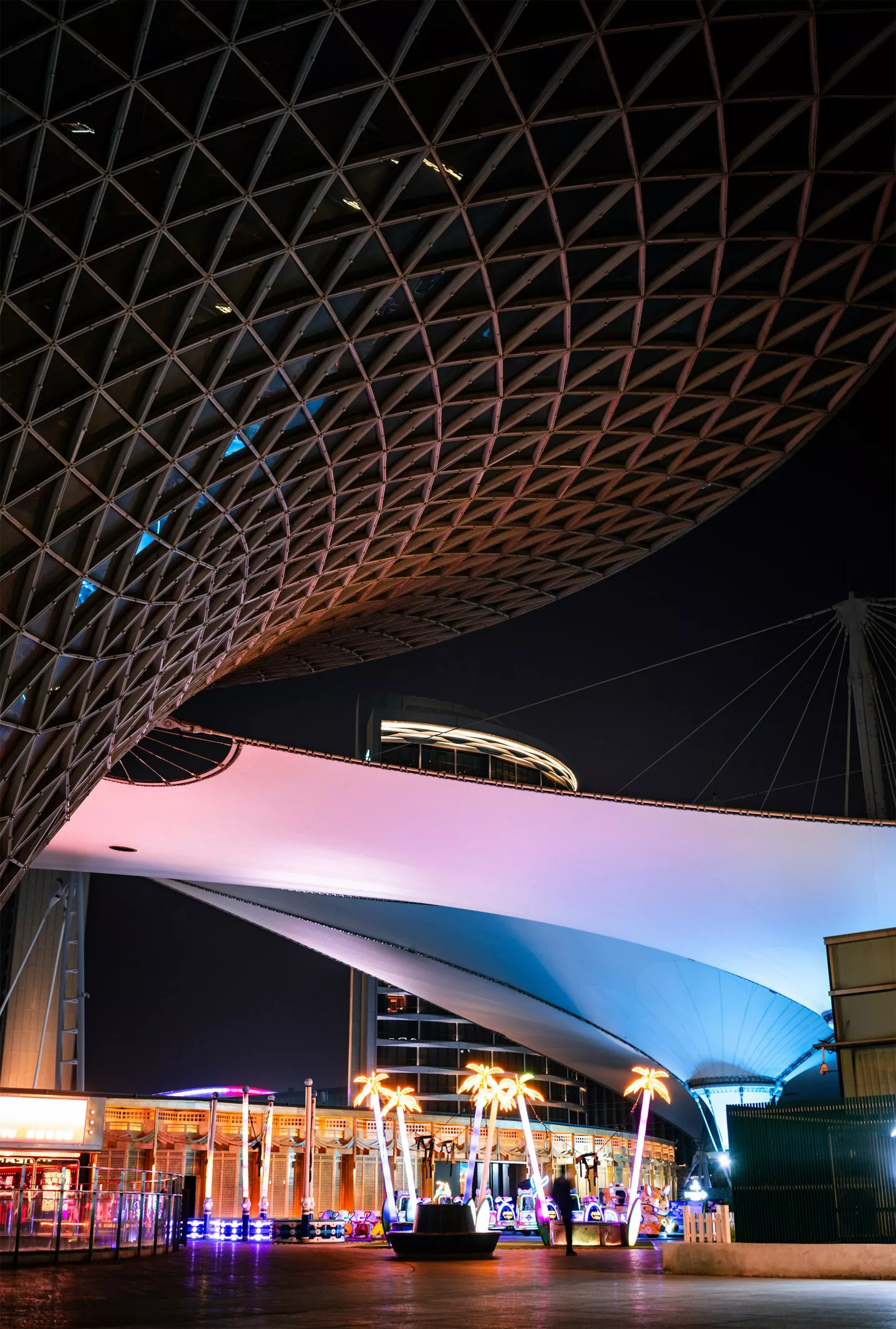
Whichever format fits your site, the underlying tensile roof structure principle is the same: a membrane held under tension by a steel or cable frame, so the fabric itself carries load rather than relying on beams and slabs. This keeps material use, and cost, lower than an equivalent RCC or steel-sheet roof over the same span.
Why Tensile Structures in Kurnool?
Kurnool falls under the BSh semi-arid climate classification, with intense sunshine for most of the year and a short but heavy monsoon window. This combination — high UV load followed by concentrated rainfall — is exactly the condition tensile architecture design in Kurnool is built to handle: PTFE and PVC membranes reflect heat while shedding water quickly along their tensioned curves.
Kurnool district is also going through a documented industrial expansion. The state government has been developing the Orvakal and Kopparthy industrial nodes, and in October 2025 the Prime Minister inaugurated infrastructure projects worth over Rs 134 billion in the district, spanning roads, power, and connectivity. A 765/400 kV power grid substation at Orvakal alone is expected to support an additional 10,000 acres of upcoming industrial development.
That scale of industrial and commercial construction creates real, near-term demand for large-span roofing — vehicle parking for factory workforces, worker canopies, loading bay covers, and staff amenity areas — where tensile roof structures in Kurnool are typically faster to deploy than RCC sheds, since fabrication happens off-site while foundation work proceeds in parallel.
For property owners not tied to industrial projects — schools, hospitals, hotels, and residential societies — the same climate logic applies at a smaller scale: shaded parking, covered walkways, and pool canopies reduce surface heat gain and cut down on maintenance linked to sun-damaged asphalt sheeting or rusted GI roofing.
How to Choose a Reliable Tensile Structure Manufacturer in Kurnool?
Before signing off on a vendor, ask for the membrane material grade being quoted — PVC, PTFE, or HDPE — since each carries a different UV rating, lifespan, and price point. A manufacturer should be able to explain this trade-off in plain terms rather than quoting a single generic 'fabric' line item.
Check the wind load and dead load rating the design is engineered for, particularly for larger spans such as auditorium or car parking canopies. Kurnool sees strong pre-monsoon winds, and a structure engineered without a documented wind rating is a warranty risk later.
Ask what the warranty actually covers — membrane fabric, steel frame, and welding/fabrication separately — and get the terms in writing before advance payment. A reliable manufacturer will also confirm whether the work is turnkey execution (design, fabrication, and installation under one contract) or split across subcontractors, which affects both accountability and total cost.
Finally, ask for a list of prior installations in or near Kurnool and Rayalaseema, and if possible, site details such as soil type and wind exposure that were factored into those designs. A manufacturer with regional installation experience will already know how local soil and dust conditions affect anchoring and membrane cleaning cycles.
About RS Tensile Pvt. Ltd. for Kurnool
RS Tensile Pvt. Ltd. is a manufacturer of tensile fabric structures, under the leadership of CEO Radhey Shayam, producing car parking sheds, auditorium roofs, walkway canopies, dome structures, and garden and food court canopies for clients across Andhra Pradesh and neighbouring states.
As a manufacturer rather than a reselling contractor, RS Tensile Pvt. Ltd. controls membrane fabrication, steel frame cutting, and welding in-house, which is what allows for a defined installation timeline once a site survey and design are approved for a Kurnool project.
For Kurnool clients, this means a single point of contact from initial site measurement through final erection, without the handoffs between design, fabrication, and installation teams that typically extend timelines and blur warranty responsibility.
Local Infrastructure Growth in Kurnool
Kurnool district's industrial base is expanding around the Orvakal and Kopparthy nodes, with the state positioning the region as an emerging hub for drone manufacturing and semiconductor investment alongside its existing agro-processing and logistics activity.
This industrial pipeline, combined with new road and power connectivity announced in late 2025, is a practical driver for tensile roofing demand: new factories, warehouses, and logistics parks need parking and loading-bay canopies quickly, often before permanent RCC construction on the rest of the site is complete.
For a Kurnool-specific quote on an industrial or commercial site, share your plot size and expected vehicle or footfall count with our team so the design brief matches the actual load, not a generic template.
Tensile Applications in Kurnool
The applications below cover the most requested project types for tensile structures in Kurnool, from factory parking to residential society amenities.
Car Parking Structures in Kurnool
A Tensile car parking shed in Kurnool is typically the fastest-payback structure a commercial property can add, since it protects vehicles from both peak summer heat and monsoon downpours without the column density of an RCC parking structure. Malls, hospitals, IT parks, and residential societies are the most common buyers.
For a tensile structure for car parking in Kurnool, span and bay count are the two numbers that determine cost most directly — a single continuous canopy over 40-50 cars costs differently per square foot than several smaller modular bays, so it helps to share your parking layout early in the enquiry.
Walkways in Kurnool
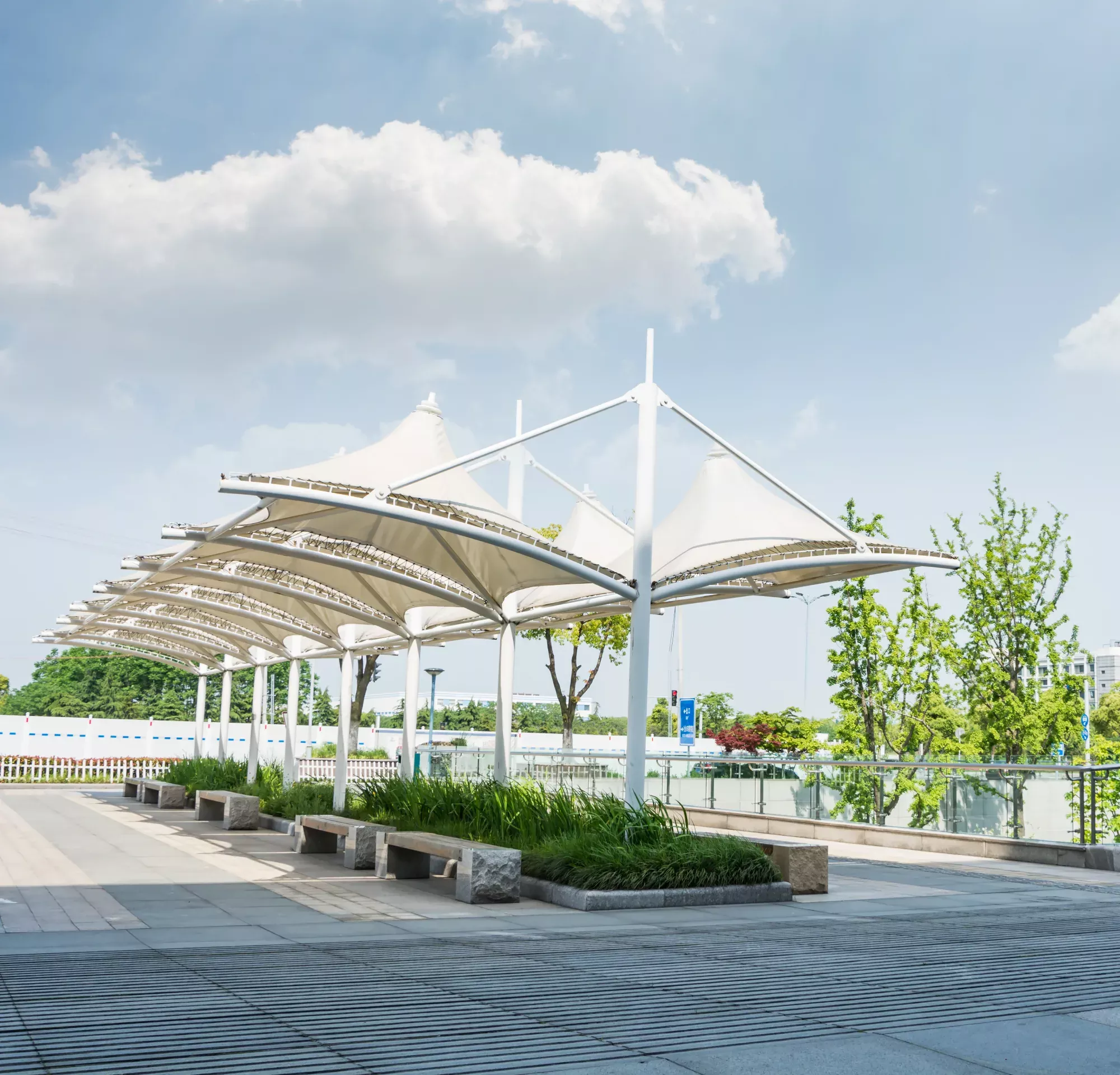
A Tensile walkway structure connects buildings, parking areas, or entrance gates without exposing pedestrians to direct sun or rain — a practical requirement for hospitals, schools, and hotel campuses in Kurnool where covered movement between blocks is expected by visitors and staff.
Walkway canopies are usually a lower-cost entry point into tensile architecture design for Kurnool clients still evaluating the material and comparing it against a simple GI sheet roof.
Swimming Pool Structures in Kurnool
A Swimming pool tensile structurein Kurnool reduces water evaporation and surface heating during peak summer months while still allowing filtered daylight through translucent PVC or PTFE membrane — relevant for hotels, clubs, and residential societies operating pools through Kurnool's hot, dry season.
Auditorium Structures in Kurnool
An Auditorium tensile structure in Kurnool is generally specified for schools, colleges, and community halls needing a column-free covered space for assemblies and events. Dome or barrel-vault membrane forms are common here, sized to the seating capacity and stage layout required.
Beyond these four core categories, we also produce a garden tensile structure for Kurnool residential societies and public parks, and a food court tensile structure for commercial complexes needing shaded, ventilated seating without a fully enclosed roof.
Materials Used for Tensile in Kurnool
PVC-coated polyester is the most commonly quoted membrane for Kurnool projects on a budget, offering a reasonable UV lifespan at a lower cost per square metre, suited to walkways and smaller parking canopies.
PTFE (Teflon-coated fibreglass) membrane is recommended for structures with longer intended lifespans or higher UV exposure — auditorium roofs and larger car parking canopies — since it resists Kurnool's intense pre-monsoon sun without significant yellowing or fabric fatigue over the years.
HDPE shade-net membrane is a lower-cost option used for garden structures and secondary shading needs where full waterproofing is not the primary requirement. Steel framing across all three membrane types uses hot-dip galvanized sections rated for local wind conditions.
Tensile Structure Installation Steps/Process in Kurnool
A site survey for a Kurnool project is typically scheduled within 48 hours of enquiry, covering ground conditions, access for machinery, and existing structures the canopy needs to tie into or clear.
Once dimensions and material grade are confirmed, structural drawings and a wind/load calculation are prepared and shared for sign-off before fabrication begins — this is also when a firm quote and payment schedule are finalised.
Steel members are fabricated and membrane panels are cut and welded off-site in parallel, which is what keeps total installation time for a mid-size Kurnool car parking or walkway project to roughly 3-6 weeks from approved drawing to handover, depending on span and bay count.
On-site work involves foundation and column erection, followed by steel frame assembly and membrane tensioning — the stage most sensitive to wind conditions, which is why erection crews plan around Kurnool's calmer early-morning hours during the pre-monsoon months.
Property Value Advantages at Kurnool
A tensile canopy is generally viewed by valuers and buyers as a maintained amenity rather than a temporary structure, particularly for parking and auditorium installations that carry a manufacturer warranty and visible engineering documentation.
For rental or lease properties in Kurnool — commercial complexes, hotels, and IT parks — covered parking and shaded outdoor seating are increasingly listed as tenant draws, since they reduce vehicle heat damage and extend usable hours for outdoor food court or garden areas during summer months.
Schools and hospitals in Kurnool also factor tensile canopies into compliance and comfort planning — a covered walkway or entrance structure reduces heat-related complaints during peak summer admissions or exam seasons, which administrators increasingly note when comparing older campuses against newer ones with covered infrastructure.
Tensile Manufacturing Process at Kurnool
RS Tensile Pvt. Ltd. fabricates steel sections and cuts membrane panels according to the approved structural drawing for each Kurnool project, using CAD-based patterning so panel seams align with the design's load paths rather than being cut and welded on an ad hoc basis.
Quality checks at the fabrication stage cover weld integrity on steel joints and seam strength on membrane panels, since both are the most common failure points in poorly manufactured tensile structures exposed to Kurnool's wind and heat cycles over several years.
Because fabrication happens at our facility rather than being outsourced panel-by-panel, a Kurnool client gets one point of accountability if a weld or seam needs rework — rather than a dispute between a designer, a fabricator, and an installation crew from three separate firms.
How Tensile Structures Withstand Kurnool Weather?
Kurnool's dry season brings sustained high UV exposure, which is why PTFE and UV-stabilised PVC membranes are specified over uncoated fabric alternatives — both resist the fading and brittleness that shorten the working life of lower-grade sheeting under intense sun.
During the June-September monsoon, the tensioned, curved geometry of a properly engineered tensile roof structure sheds rainwater quickly rather than allowing it to pool, which is a common failure mode in flat GI or asbestos roofing across the district.
Pre-monsoon winds are factored into the structural load calculation at the design stage, with anchor points and steel bracing sized to the specific span rather than a standard template, so the same design approved for a small walkway is not simply scaled up for a large parking canopy without re-checking wind load.
Our Service Areas in Kurnool
RS Tensile Pvt. Ltd. installs and services tensile structures across the following areas in and around Kurnool:
North Kurnool
South Kurnool
East Kurnool
West Kurnool
Central Kurnool
Greater Kurnool
Kurnool Metropolitan Area
Kurnool Suburbs
Kurnool Outskirts
Near Kurnool
Why Choose RS Tensile Pvt. Ltd. in Kurnool?
RS Tensile Pvt. Ltd. is a manufacturer, not a reselling intermediary, which means Kurnool clients deal directly with the team fabricating their steel frame and membrane panels rather than a layer of subcontracted pricing.
- In-house fabrication of steel frames and membrane panels for Kurnool projects
- Site survey scheduled within 48 hours of enquiry
- Written warranty terms covering membrane, steel, and fabrication separately
- Wind and load calculations documented per project, not templated across sites
- Experience with Rayalaseema's semi-arid climate and pre-monsoon wind conditions
- Turnkey execution from design through installation under CEO Radhey Shayam's oversight
FAQs
How much does a tensile structure cost in Kurnool?
Cost depends on span, membrane grade (PVC, PTFE, or HDPE), and site conditions. Share your dimensions with our team for a custom estimate rather than relying on a per-square-foot average, since Kurnool sites vary in wind exposure and soil type.
How long does installation take for a tensile structure in Kurnool?
A typical mid-size car parking or walkway project in Kurnool takes roughly 3-6 weeks from approved drawing to handover, with fabrication happening off-site while foundation work proceeds on-site.
Which membrane material is best for Kurnool's climate?
PTFE is generally recommended for structures needing a longer lifespan under Kurnool's high summer UV exposure, while PVC is a cost-effective option for smaller walkway or garden canopies.
Does RS Tensile Pvt. Ltd. provide a warranty for installations in Kurnool?
Yes. Warranty terms are documented separately for membrane fabric, steel frame, and fabrication/welding, and are shared in writing before advance payment on any Kurnool project.
Can tensile structures handle Kurnool's monsoon rainfall and pre-monsoon winds?
Yes, when engineered correctly. The curved, tensioned geometry sheds rainwater quickly, and wind load calculations are done per project based on span and site exposure rather than a generic template.
Request a Tensile Structure Quote in Kurnool
If you are evaluating a car parking shed, auditorium roof, walkway canopy, or pool structure in Kurnool, request a site visit and custom quote from RS Tensile Pvt. Ltd. Share your site dimensions, expected use, and timeline, and our team will schedule a survey and return a design and cost estimate for your Kurnool project.
Important Keywords & Tags for tensile structure in Kurnool
Popular Search Terms: People searching for tensile structure manufacturer in Kurnool also look for these related keywords and services.
