Tensile Structure Manufacturer in Gurgaon
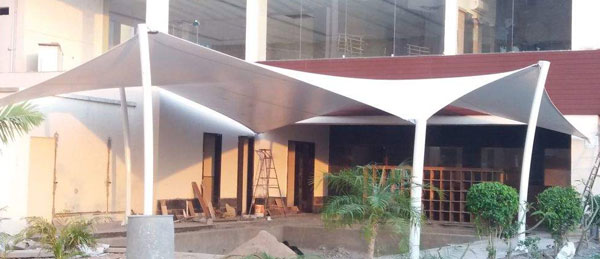
| Product Description | Transform your outdoor spaces in Gurgaon with our premium Tensile Structures, crafted to deliver both functional and stylish solutions. The current structures are manufactured with high quality materials such as PVC, PTFE or HDPE that provide high strength and durability, especially in terms of weathering and low maintenance requirements. The tensile structures can be used for residential, commercial or event spaces and blend in nicely, bringing a modern and sophisticated touch to your environment. |
| Membrane Material | PVC / PTFE / HDPE |
| Fabric Color | White or Customized |
| Shape & Size | Customized |
| Certification | ISO 45001:2018(OHSAS), ISO 45001:2015, ISO 9001:2015 |
| Place of Origin | India |
Order Now
Introduction
Gurgaon, now officially called Gurugram, has grown from a quiet satellite town into one of North India's busiest corporate and residential centres. Cyber City, Golf Course Road, and the sectors branching off Sohna Road host thousands of offices, malls, and gated communities that need durable outdoor coverage.
These properties often need to cover parking areas, walkways, food courts, and rooftop spaces without adding heavy concrete construction. Tensile structures answer that need. They are lightweight, quick to install, and suited to Gurgaon's mix of high-rise towers, business parks, and low-rise residential enclaves.
RS Tensile Pvt. Ltd., led by CEO Radhey Shayam, manufactures tensile structures for corporate and residential clients across Gurgaon. As a manufacturer, the company handles fabric sourcing, cable tensioning, and steel fabrication in-house rather than outsourcing the work. This page covers tensile architecture design, tensile membrane structure, tensile roof structure, and other applications suited to Gurgaon.
Types of Tensile Structures Explained for Gurgaon
Gurgaon's mixed-use developments call for different tensile shapes depending on the site. Here is how the common types apply locally.
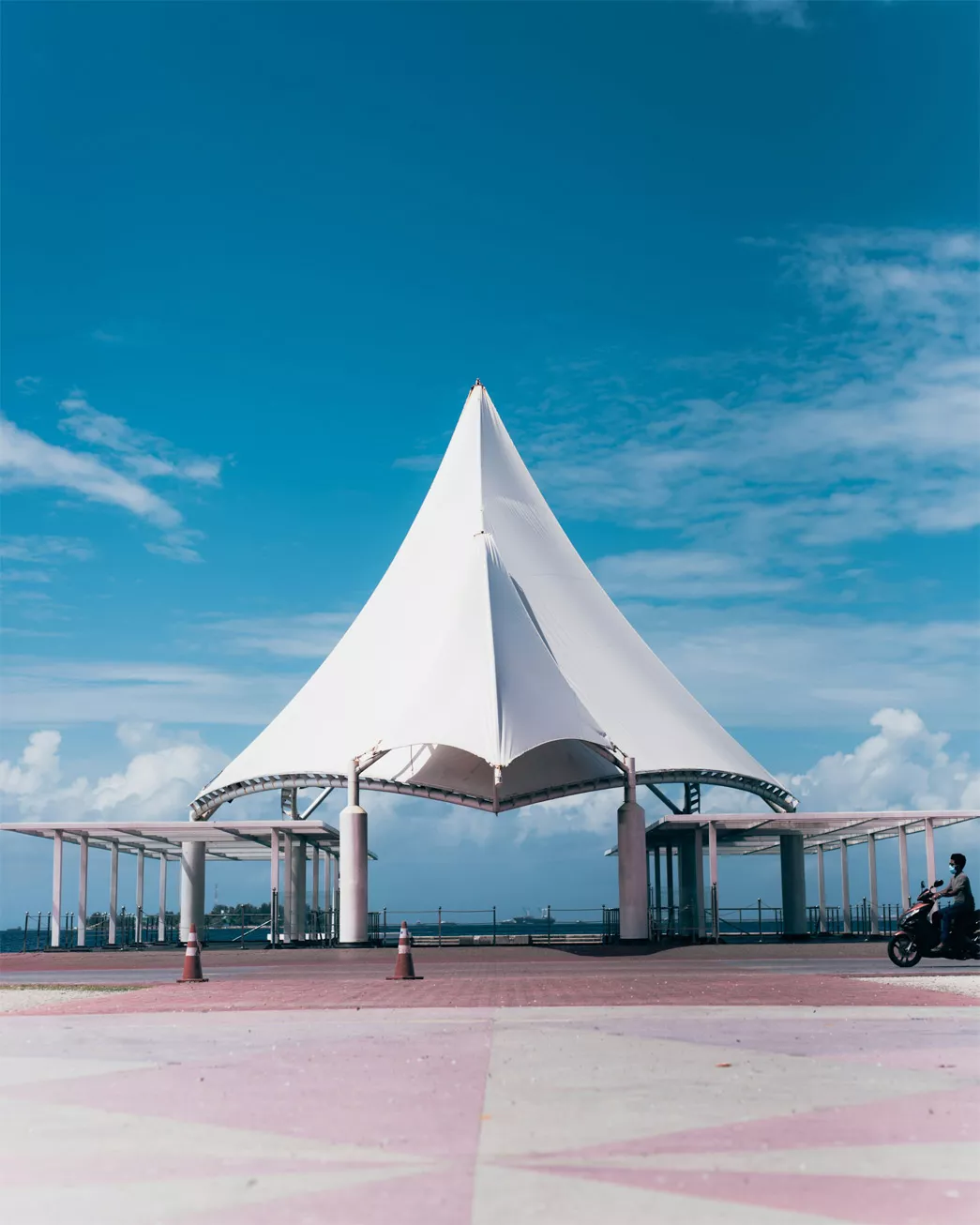
- Conical Structures Conical structures work well at entrance points of business parks and residential societies in Gurgaon. Their pointed shape sheds monsoon rainfall quickly and creates a recognisable marker at gate areas, something many DLF and M3M developments look for at their main entrances.
- Hyperbolic Paraboloid (Saddle) Structures Saddle-shaped tensile structures suit food courts and open dining areas in Gurgaon malls and office campuses. The double-curved fabric handles wind uplift better during pre-monsoon storms, which Gurgaon experiences most years between May and June.
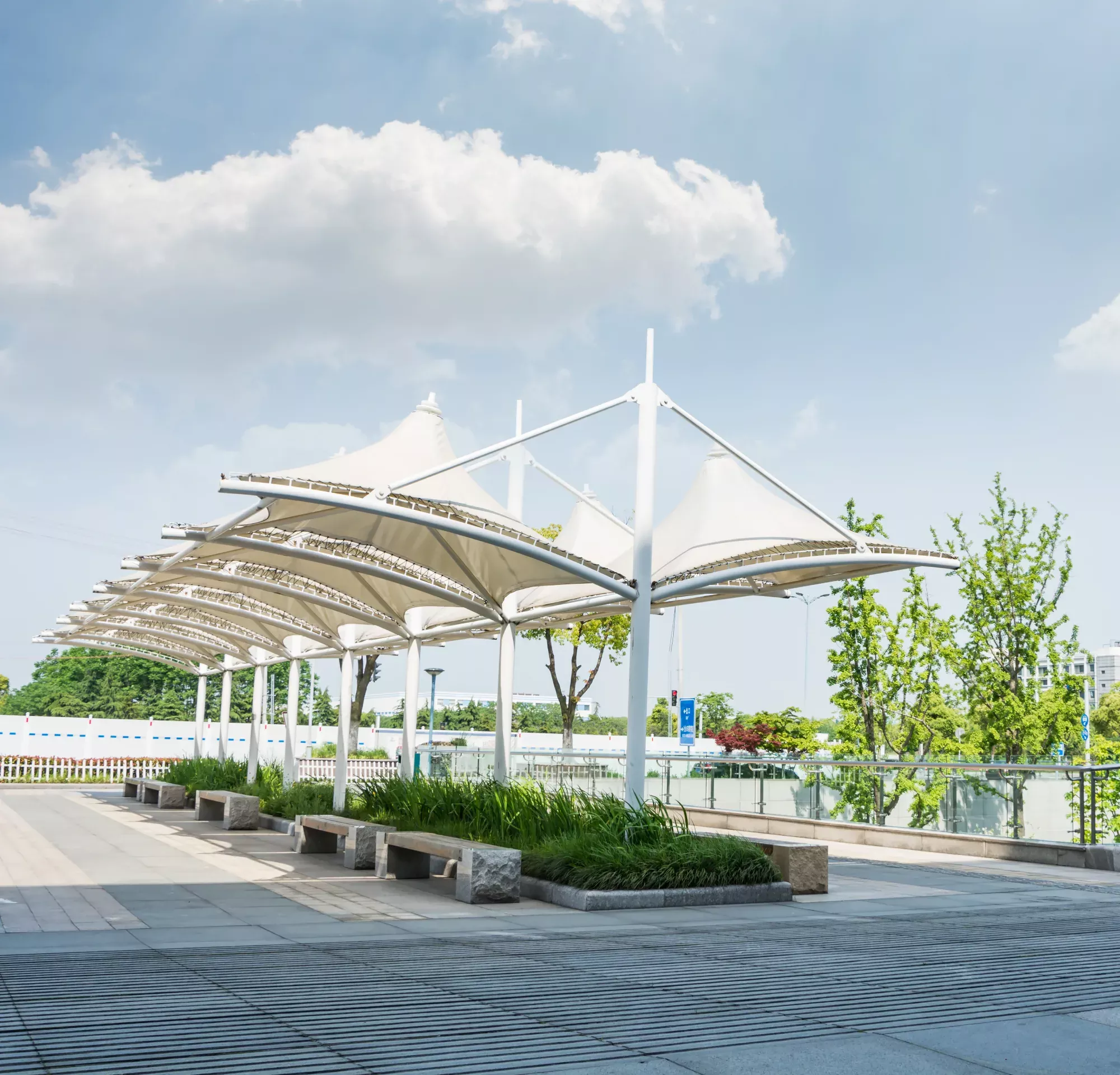
- Barrel Vault Structures Barrel vaults are used for walkways connecting parking areas to office towers in Cyber City and Udyog Vihar. Their long, curved shape covers extended stretches without needing multiple support columns, which matters where footpath width is limited.
- Cable Net Structures Cable net tensile structures span larger open areas such as auditorium courtyards or assembly seating in schools and corporate campuses in sectors like 44 and 49. They cover wide spans while keeping the visual profile low.
- Umbrella Structures Standalone tensile umbrella structures are common in residential society common areas, rooftop cafes, and farmhouse gardens in South Gurgaon. They can be placed individually or in clusters around a pool deck or seating zone.
ENQUIRE NOW
Why Tensile Structures in Gurgaon?
Gurgaon summers regularly cross 42 to 45 degrees Celsius between April and June, with strong sun exposure through most of the day. Open parking areas, walkways, and outdoor seating zones become difficult to use without shade. Tensile fabric roofing blocks direct UV exposure while allowing some natural light through, which keeps these spaces usable.
The city also gets heavy pre-monsoon dust from ongoing construction across corridors like Dwarka Expressway and New Gurgaon. Tensile fabric can be cleaned more easily than painted metal sheds, and PVC-coated material resists dust buildup better than exposed concrete finishes.
Monsoon rainfall in Gurgaon, though shorter than in coastal cities, arrives in intense bursts that can waterlog surface parking within minutes. A properly tensioned fabric roof sheds this water quickly through its sloped design, protecting vehicles and walkways underneath without pooling.
Many Gurgaon developments, especially newer sectors on Dwarka Expressway and Golf Course Extension Road, are built where every square metre of open space matters. Tensile structures need minimal ground-level footing compared to RCC sheds, which suits builders and RWAs working with tight open-space allowances.
How to Choose a Reliable Tensile Structure Manufacturer in Gurgaon?
Gurgaon has both manufacturers and traders offering tensile work, and the difference matters for long-term performance. A manufacturer controls fabric quality, cable specification, and welding standards directly, while a trader depends on a third party for fabrication and may have limited visibility into material grade.
Ask whether the company can show its own manufacturing unit and fabrication process, not just installation photos. For corporate clients in Cyber City or business parks along NH-48, request references from similar commercial projects rather than only residential examples.
Check the fabric specification being offered. PVC-coated polyester suits most Gurgaon applications, while PTFE is used for larger spans or where a longer service life is needed. A reliable manufacturer will explain this trade-off instead of offering a single option for every site.
Site survey quality also matters in Gurgaon, where wind patterns near high-rise clusters can differ from open plots in New Gurgaon sectors. A manufacturer who visits the site before finalising wind-load specifications is better placed to deliver a structure that performs over years, not just at handover.
How to Choose a Reliable Tensile Structure Manufacturer in Gurgaon?
Gurgaon has both manufacturers and traders offering tensile work, and the difference matters for long-term performance. A manufacturer controls fabric quality, cable specification, and welding standards directly, while a trader depends on a third party for fabrication and may have limited visibility into material grade.
Ask whether the company can show its own manufacturing unit and fabrication process, not just installation photos. For corporate clients in Cyber City or business parks along NH-48, request references from similar commercial projects rather than only residential examples.
Check the fabric specification being offered. PVC-coated polyester suits most Gurgaon applications, while PTFE is used for larger spans or where a longer service life is needed. A reliable manufacturer will explain this trade-off instead of offering a single option for every site.
Site survey quality also matters in Gurgaon, where wind patterns near high-rise clusters can differ from open plots in New Gurgaon sectors. A manufacturer who visits the site before finalising wind-load specifications is better placed to deliver a structure that performs over years, not just at handover.
Why Tensile Structures in Gurgaon?
RS Tensile Pvt. Ltd. is a manufacturer of tensile structures, led by CEO Radhey Shayam. The company designs and fabricates tensile roof structures, tensile membrane structures, and tensile architecture design work for corporate, residential, and institutional clients, including projects across Gurgaon's business districts and residential sectors.
Because RS Tensile manufactures its own fabric assemblies and steel framework, project teams in Gurgaon can get design changes, cable tension adjustments, and material substitutions handled without routing requests through a separate factory. This is useful for corporate clients working on fixed handover timelines tied to office fit-outs or event dates.
The company has worked on car parking sheds, walkway canopies, food court roofing, and garden structures suited to Gurgaon's climate and space constraints, adapting each design to the specific plot, wind exposure, and usage pattern of the site.
Local Infrastructure Growth in Gurgaon
Gurgaon's infrastructure has expanded steadily along the Dwarka Expressway corridor, where new residential sectors between 102 and 115 are adding thousands of housing units. These societies are being built with shared amenities such as parking courts, walkways, and pool decks that need weather-resistant covering from the outset.
The Southern Peripheral Road and Golf Course Extension Road have also seen a rise in business parks and commercial complexes, adding office space that competes for tenants partly on the quality of shared outdoor areas such as entrance canopies and food court seating.
Older business hubs like Udyog Vihar and Cyber City continue to see renovation work, where property owners add tensile canopies over existing parking areas to improve tenant experience without undertaking full structural changes to ageing buildings.
IMT Manesar and the industrial belt on the city's outskirts have also generated demand for tensile roofing over loading docks and worker rest areas, where quick installation matters more than architectural styling.
Tensile Applications in Gurgaon
The following applications are common across Gurgaon's corporate parks, residential societies, and institutional campuses.
Car Parking Structures Gurgaon
Corporate parking lots at business parks along NH-48 and Golf Course Road often need tensile car parking shed coverage for both employee and visitor vehicles. A tensile car parking structure protects cars from Gurgaon's summer heat and monsoon downpours while keeping the parking area open on the sides for airflow.
Residential societies use a similar tensile structure for car parking to cover basement ramp entries and surface visitor parking, reducing paint damage and interior heat buildup that owners in Gurgaon commonly report during summer months.
Walkways Gurgaon
Business parks in Cyber City and Udyog Vihar use a tensile walkway structure to connect parking blocks with office towers, letting employees move between buildings without carrying umbrellas during the monsoon or facing direct sun in peak summer. Residential societies apply the same approach between tower entrances and clubhouse or parking zones, a detail increasingly expected in newer Gurgaon developments marketed on amenity quality.
Swimming Pool Structures Gurgaon
Farmhouses in South Gurgaon and premium residential societies with pool decks use a swimming pool tensile structure to reduce water evaporation and shade swimmers from direct UV exposure during peak afternoon hours. The fabric roofing also limits dust settling into the pool from nearby construction activity, a recurring concern in fast-developing sectors.
Auditorium Structures Gurgaon
Schools, corporate campuses, and event venues use an auditorium tensile structure for assembly halls, townhall spaces, and outdoor event seating. Corporate clients in Gurgaon's business parks sometimes commission temporary or semi-permanent tensile auditoriums for annual events, product launches, or large internal gatherings where a conventional hall is not available on short notice.
Materials Used Gurgaon
PVC-coated polyester fabric is the material used most often for tensile structures in Gurgaon because it balances cost, UV resistance, and durability against dust exposure from ongoing construction across the city.
PTFE fabric is used for larger commercial spans, such as auditorium roofs or wide parking areas in business parks, where a longer service life offsets the higher material cost. It also resists dust adhesion better over extended periods.
Cable specification depends on span and wind exposure. High-rise clusters in sectors like DLF Phase 5 or Golf Course Road can create localised wind funnelling effects, so cable tension calculations account for this rather than using a standard specification across every site.
Steel framework is typically galvanized to resist corrosion, which matters during Gurgaon's monsoon months when humidity rises sharply for short periods even though the city is not coastal.
Manufacturing Process Gurgaon
Fabric panels are cut to the design specification using computer-guided cutting to match the exact curvature required for the site, whether it is a conical entrance canopy or a saddle-shaped food court roof.
Panels are then welded using heat-sealing methods appropriate to the fabric type, PVC-coated polyester or PTFE, to create a continuous membrane without weak seams that could fail under Gurgaon's wind loads.
Steel components are fabricated and galvanized separately, then checked against the design drawings before being packed for transport to the Gurgaon site along with the finished fabric assembly.
A quality check reviews cable tension hardware, fabric seam strength, and steel joint welding before dispatch, since correcting issues at the factory is faster than addressing them after installation at a live Gurgaon site.
How Tensile Structures Withstand Gurgaon Weather?
Gurgaon summers bring sustained temperatures above 40 degrees Celsius for weeks at a time. UV-stabilised fabric coatings prevent the material from degrading or discolouring under this exposure faster than untreated alternatives would.
Pre-monsoon dust storms, common in May and early June, are handled through fabric surfaces that shed dust with light rain or occasional washing, rather than trapping it in grooves the way corrugated metal roofing does.
Monsoon rainfall arrives in short, intense spells in Gurgaon. The tensioned, curved geometry of the fabric roof allows water to run off quickly toward drainage points instead of pooling, which reduces the load on the structure during a single downpour.
Wind loads are calculated for each site rather than applied generically, since high-rise clusters in sectors like Golf Course Road can create wind conditions different from open plots in New Gurgaon, and the cable tensioning is set accordingly during design.
Why Choose RS Tensile Pvt. Ltd. Gurgaon?
RS Tensile Pvt. Ltd. manufactures its own tensile structures rather than outsourcing fabrication, which gives CEO Radhey Shayam and the technical team direct oversight of material quality for every project delivered in Gurgaon.
The company has handled tensile architecture design for corporate parking, walkways, food courts, and auditorium spaces across Gurgaon's business parks and residential sectors, adapting each design to the site's climate exposure and space constraints rather than reusing a single template.
Proximity to Delhi NCR allows the company to manage site visits, design revisions, and after-installation support for Gurgaon clients without long turnaround delays that can occur when manufacturers are based further away.
If you are planning a tensile structure for a property in Gurgaon, whether it is a parking shed, walkway, pool deck, or auditorium space, RS Tensile Pvt. Ltd. can review your site and share a design suited to the location. Contact the team to discuss requirements and timelines for your Gurgaon project.
FAQs
1. What does a tensile structure cost in Gurgaon?
Cost depends on span, fabric type, and site complexity. A small tensile car parking shed for a residential society will cost less than a large auditorium tensile structure for a corporate campus, so RS Tensile provides a quote after reviewing the specific Gurgaon site.
2. How long does it take to install a tensile parking shed in Gurgaon?
Most tensile parking structures in Gurgaon are installed within two to four weeks after design approval, depending on span size and whether fabrication is already complete for standard sizes.
3. Can tensile structures withstand Gurgaon's monsoon rainfall?
Yes. Tensile roofs are designed with a sloped, tensioned fabric surface that sheds rainwater quickly, which suits Gurgaon's short but intense monsoon bursts between July and September.
4. Which fabric is best for tensile structures in Gurgaon's climate?
PVC-coated polyester works well for most residential and commercial applications in Gurgaon. PTFE is recommended for larger spans such as auditorium roofs where a longer service life is needed.
5. Do RWAs need to approve tensile structures in Gurgaon residential societies?
Most residential societies in Gurgaon require RWA or builder approval before installing shared structures such as parking sheds or walkway canopies, and RS Tensile can provide design drawings to support this approval process.
6. Can tensile structures be installed on rooftops of high-rise buildings in Gurgaon?
Yes, tensile structures are lightweight enough for rooftop installation on high-rise buildings common in sectors like DLF Phase 5 and Golf Course Road, subject to a structural load assessment of the existing rooftop.
7. What is the lifespan of a tensile structure in Gurgaon?
A well-maintained tensile structure in Gurgaon typically lasts fifteen to twenty years, depending on fabric grade and exposure to UV and dust over that period.
8. Does RS Tensile provide maintenance services in Gurgaon?
Yes, RS Tensile offers periodic inspection and cleaning services for tensile structures installed in Gurgaon to maintain cable tension and fabric condition over the structure's lifespan.
9. Can tensile structures be customised for corporate branding in Gurgaon offices?
Yes, fabric panels can be printed or coloured to match corporate branding for entrance canopies and walkway structures at Gurgaon office campuses.
10. Are tensile structures suitable for schools and hospitals in Gurgaon?
Yes, schools and hospitals in Gurgaon use tensile structures for covered walkways, assembly areas, and waiting zones, since the lightweight design allows installation without disrupting ongoing operations.
Important Keywords & Tags for tensile structure in Gurgaon
Popular Search Terms: People searching for tensile structure manufacturer in Gurgaon also look for these related keywords and services.
