Tensile Structure Manufacturer in Panipat - Custom Fabric Roofing for Parking, Auditoriums & Commercial Spaces

| Product Description | Transform your outdoor spaces in Panipat with our premium Tensile Structures, crafted to deliver both functional and stylish solutions. The current structures are manufactured with high quality materials such as PVC, PTFE or HDPE that provide high strength and durability, especially in terms of weathering and low maintenance requirements. The tensile structures can be used for residential, commercial or event spaces and blend in nicely, bringing a modern and sophisticated touch to your environment. |
| Membrane Material | PVC / PTFE / HDPE |
| Fabric Color | White or Customized |
| Shape & Size | Customized |
| Certification | ISO 45001:2018(OHSAS), ISO 45001:2015, ISO 9001:2015 |
| Place of Origin | India |
Order Now
Introduction
Tensile structures in Panipat are prefabricated fabric-and-steel roofing systems used for car parking sheds, auditoriums, food courts, walkways, and outdoor commercial spaces where conventional RCC or asbestos roofing is too slow or too costly to install. They combine a tensioned PVC, PTFE, or HDPE membrane with a steel or cable support frame to span large open areas without internal columns.
With Panipat's summer temperatures regularly crossing 42-45°C and monsoon rainfall concentrated in July and August, property owners across the city are replacing traditional roofing with tensile membrane structure Panipat installations for faster turnaround, lower material cost, and better heat and water management. RS Tensile Pvt. Ltd., a Delhi-based manufacturer, supplies and installs custom tensile architecture design Panipat projects for residential societies, industrial units, and commercial buildings. For a Panipat-specific quote, share your site dimensions and location with our team to get a custom estimate within 48 hours.
ENQUIRE NOW
Types of Tensile Structures Explained for Panipat
Tensile roof structure Panipat options are generally grouped by shape and application, and the right type depends on span, load, and how the space is used.
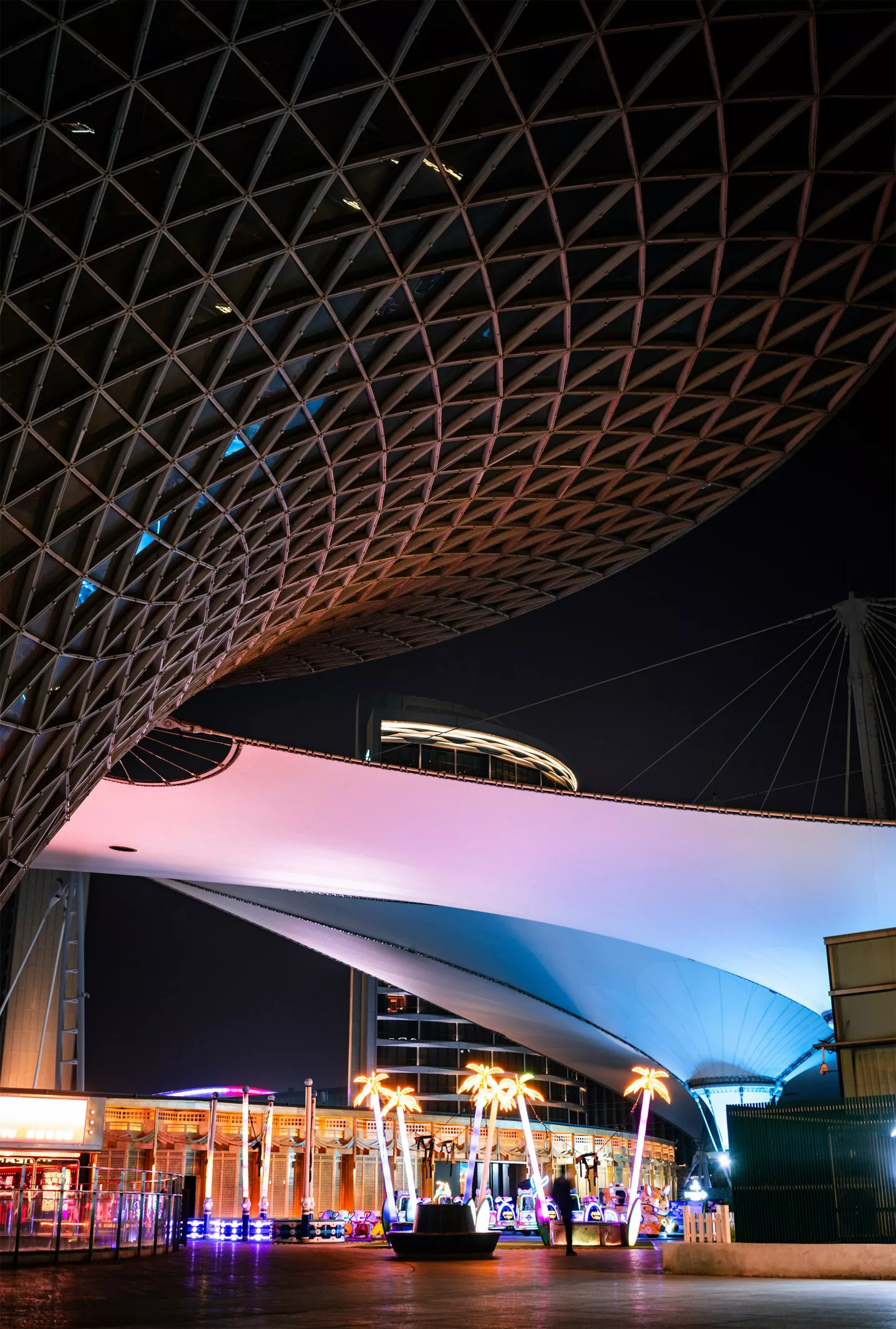
Conical and hyperbolic structures work well for entrance canopies and tensile gazebo structure Panipat installations where a distinct visual form is needed alongside coverage. Barrel vault structures suit walkways and linear spaces such as building corridors or parking lanes. Cable-net and tensile dome structure Panipat designs are used for auditoriums and larger public gathering spaces that need clear-span coverage without support columns breaking up the floor area.
Smaller-format options include tensile umbrella structure Panipat units for standalone seating or vendor areas, and lightweight modular canopies for gardens and food courts where full enclosure isn't needed. A tensile lightweight structure Panipat option is often chosen over a fixed roof specifically because it can be relocated or resized if the site layout changes later.
Each structure type is engineered around local wind load and fabric tension requirements before fabrication begins, not adapted from a standard template. Pricing depends on span, fabric grade, and structural complexity — our team calculates this after a site assessment rather than quoting a flat rate. For a car parking tensile structure Panipat or a tensile structure for car parking Panipat project specifically, span and vehicle count are the two factors that most affect the final quote.
Why Tensile Structures in Panipat?
Panipat's climate and land-use pattern create specific, recurring reasons why property owners choose tensile roofing over RCC or GI sheet sheds.
Summer daytime temperatures reach 42°C and above between April and June, with the region receiving 700-780 mm of annual rainfall concentrated mostly in July and August. PVC and PTFE membranes handle both extremes: they reflect a large share of solar heat while resisting water pooling and fabric sag during heavy monsoon spells, which is a common complaint with flat GI sheet roofing in this belt.
Panipat is also expanding fast. The city's textile hub, warehousing clusters along the NH44 Panipat-Karnal corridor, and residential sectors such as Sector 36 and 37 are all adding covered outdoor infrastructure — parking sheds for factory staff, canopies for warehouse loading bays, and amenity structures for new townships. This is functional demand driving tensile structure Panipat adoption, not a general trend.
How to Choose a Reliable Tensile Structure Manufacturer in Panipat?
Before signing off with any vendor, a few checks help avoid delays and disputes later.Confirm the fabric grade being quoted — PVC, PTFE, or HDPE — since each has a different lifespan, UV resistance, and price point, and vendors sometimes downgrade material without flagging it clearly. Ask for the wind and load rating certificate for your specific span, not a generic brochure figure.
Check whether the manufacturer fabricates in-house or outsources to a third party, since outsourced fabrication usually means longer lead times and less accountability on defects. Ask about warranty terms in writing, and confirm whether site survey, design, fabrication, and installation are handled by one team or split across subcontractors — a single-point turnkey execution model is generally faster to resolve issues.
It also helps to ask for reference sites near Panipat that use a similar span or structure type, since fabric performance and wind behaviour vary with local terrain. A manufacturer familiar with Panipat's flat, open plots and NH44-corridor wind exposure can flag load considerations that a generic quote from an out-of-region vendor may miss entirely.
About RS Tensile Pvt. Ltd. for Panipat
RS Tensile Pvt. Ltd. is a New Delhi-based tensile structure manufacturer, incorporated in 2017 (CIN: U45309DL2017PTC316646), led by Radhey Shyam, who brings a personal background in structural fabrication and fabric engineering into the company's project execution. The company is ISO 9001:2015, ISO 14001:2015, and ISO 45001:2018 certified, IEC-recognized, and registered under Udyam.
For Panipat clients, RS Tensile handles design, fabrication, and on-site installation directly, without third-party subcontracting for the structural work. Site visits to Panipat are scheduled within 48 hours of enquiry, and every project is engineered to the specific wind load and span requirements of the site rather than built to a standard size and adjusted afterward.
Radhey Shyam's background in structural fabrication informs how project timelines and material recommendations are set for each Panipat enquiry, particularly for sites near the city's industrial and textile clusters where dust exposure and higher structural loads are common considerations. Enquiries from property owners, architects, and facility managers in Panipat are handled by the same in-house team from initial site survey through to final handover.
Local Infrastructure Growth in Panipat
Panipat sits on the NH44 corridor roughly 90 km from Delhi and is positioned along both the Delhi-Mumbai Industrial Corridor (DMIC) and Amritsar-Delhi-Kolkata Industrial Corridor (ADKIC) alignment, which is drawing warehousing, logistics, and light manufacturing investment into the region.
New industrial parks along the Panipat-Karnal stretch and residential townships in Sector 36-37 are adding organised outdoor infrastructure — parking areas, loading bays, and amenity spaces — as part of their base design. This directly increases demand for tensile car parking structure Panipat and tensile walkway structure Panipat installations tied to new construction, rather than retrofit-only demand.
ing clusters are also pushing developers to finalise outdoor infrastructure earlier in the project timeline, since covered parking and walkway coverage are increasingly treated as standard rather than optional in new commercial and residential layouts. This means enquiries from architects and facility managers are often tied to a fixed construction schedule, which is why an early site survey and quote request helps avoid delays closer to handover.
Tensile Applications in Panipat
Car Parking Structures in Panipat
Tensile car parking shed Panipat installations are used across factory premises, residential societies, and commercial complexes to protect vehicles from direct summer heat and monsoon rain without the cost of a concrete structure. Spans are engineered per row width, and installation for a standard multi-bay tensile structure for car parking Panipat project typically takes 3-5 weeks from design approval.
Walkways in Panipat
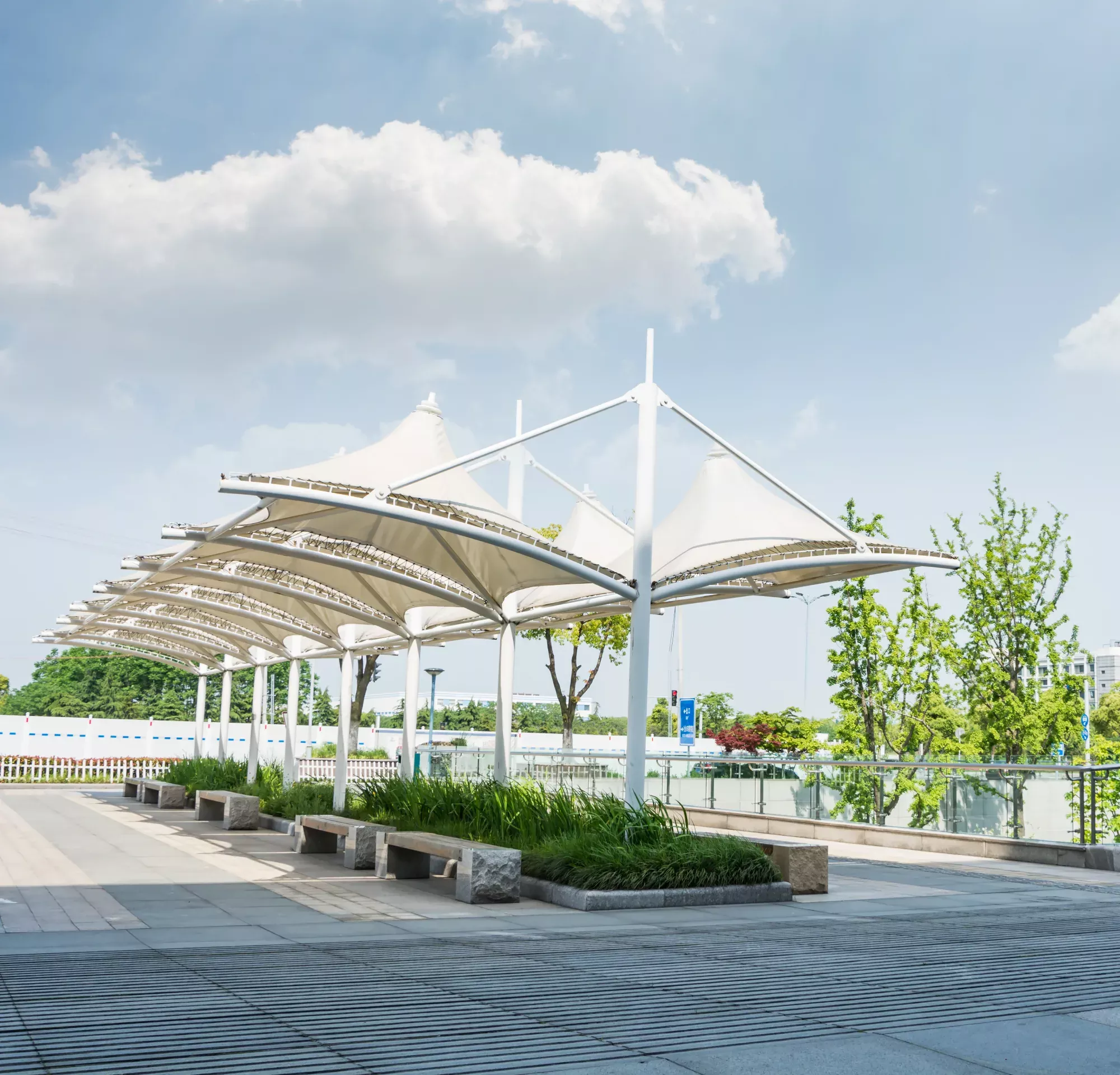
A Covered walkways connect buildings within industrial campuses, hospitals, and schools, protecting foot traffic during Panipat's peak summer heat and July-August monsoon rainfall. These are usually barrel-vault or flat-canopy designs sized to the corridor width and anchored to existing structures.
Swimming Pool Structures in Panipat
A Swimming pool tensile structurePanipat installations shade pool decks in residential societies and hotels, reducing water evaporation and surface heating during the hot months while allowing UV-treated PTFE fabric to let filtered daylight through.
Auditorium Structures in Panipat
Auditorium tensile structure Panipat projects use cable-net or dome-based designs for schools, community halls, and event venues that need column-free coverage for large gatherings. These require higher-grade fabric and more detailed load engineering than smaller canopy structures, which is factored into the quote.
Food Court and Garden Structures in Panipat
Food court tensile structure Panipat installations are used at markets, industrial cafeterias, and mixed-use commercial developments to cover seating areas while keeping ventilation open, which HDPE mesh or lightweight PVC canopies handle well. Garden tensile structure Panipat projects follow a similar approach for residential society lawns, park seating areas, and hotel outdoor spaces, where a tensile umbrella structure Panipat unit or a small conical canopy is often enough to shade a seating cluster without enclosing it.
Materials Used for Tensile in Panipat
Material selection for a tensile fabric architecture Panipat project depends on exposure and budget. PVC-coated polyester is the standard choice for car parking sheds and walkways — cost-effective, with a typical lifespan of 10-15 years. PTFE (Teflon-coated fiberglass) is used where UV exposure and self-cleaning performance matter more, such as auditorium roofs and long-span public structures, with a lifespan extending to 25+ years. HDPE mesh fabric is used for shade-only applications like garden and food court canopies where partial ventilation is preferred over full water tightness.
All three materials are available with UV-stabilised coatings suited to Panipat's summer sun exposure, and the frame structure — whether mild steel or galvanised steel — is selected based on the corrosive potential of the surrounding environment, which is a more relevant factor near industrial zones than for standalone residential installations. Material grade, along with span and fabric area, is confirmed in the quote before fabrication begins.
Installation Steps/Process of Tensile Structure in Panipat
The process begins with a site survey — scheduled within 48 hours of enquiry — to record span, ground conditions, and anchor points. This is followed by structural design and wind-load calculation specific to the site, then fabric and frame fabrication at our facility.
On-site installation follows, including foundation work, steel frame erection, and fabric tensioning. For a standard car parking or walkway structure, turnkey execution from survey to handover typically takes 3-5 weeks; larger auditorium or dome structures can take longer depending on span and fabric grade.
Property Value Advantages for Panipat
Covered parking and outdoor amenity structures are increasingly expected in new residential and commercial developments across Panipat's growing sectors, and their presence can support resale and lease value for both residential societies and commercial properties. A tensile entrance structure Panipat installation also gives commercial buildings and showrooms a defined, weatherproofed frontage without the cost and time of a permanent RCC canopy.
For industrial and warehousing occupiers along the NH44 corridor, a covered loading bay or staff parking structure reduces vehicle and material damage from monsoon rainfall and cuts down cooling load compared with an uncovered yard, which factors into long-term operating cost even though the upfront comparison is often made purely on construction budget. Facility managers evaluating multiple sites frequently list covered outdoor infrastructure as a differentiator during tenant negotiations.
Residential societies in newer sectors also use tensile canopies over amenity areas — gardens, pool decks, and clubhouse entrances — as a visible upgrade during resale marketing, since prospective buyers can assess the coverage directly rather than relying on a brochure description of planned infrastructure.
Tensile Structure Manufacturing Process at Panipat
Fabrication for Panipat projects takes place at RS Tensile's facility, where fabric panels are cut and welded to engineered dimensions and steel components are fabricated to the calculated load specifications. Quality checks on seam strength, fabric tension, and frame alignment are carried out before dispatch, and each structure is assembled on-site rather than delivered as a generic pre-cut kit.
Steel components are treated for corrosion resistance before assembly, which matters for Panipat sites near textile processing units and industrial zones where airborne dust and chemical exposure can accelerate wear on untreated frames. Fabric panels are seam-welded rather than stitched, since welded joints hold tension more reliably across the temperature swings typical of Panipat's summer-to-winter range.
How Tensile Structures Withstand Panipat Weather?
Panipat's summer heat, ranging up to 45°C, and monsoon rainfall concentrated in July and August place specific demands on roofing material. PVC and PTFE membranes are treated for UV resistance to limit fabric degradation from prolonged summer sun exposure, while the tensioned design sheds rainwater quickly, preventing the pooling that causes GI sheet corrosion and RCC waterproofing failure over time.
Wind load engineering also accounts for Panipat's open, flat terrain, which can produce higher sustained wind speeds across large uncovered sites such as industrial yards and parking lots.
Winter fog is common across the region in December and January, and while it doesn't affect structural performance, it does add moisture load to fabric surfaces overnight. Membrane materials used in our Panipat installations are selected with this in mind, so surface moisture sheds cleanly rather than pooling or staining the fabric over repeated winter cycles. High monsoon humidity, which can reach close to 80% in August, is a similar consideration factored into fabric coating selection for long-span structures.
Our Service Areas in Panipat
RS Tensile Pvt. Ltd. provides tensile structure design, fabrication, and installation across the following areas:
North Panipat
South Panipat
East Panipat
West Panipat
Central Panipat
Greater Panipat
Panipat Metropolitan Area
Panipat Suburbs
Panipat Outskirts
Near Panipat
For a site visit anywhere in this coverage area, share your location and structure requirements with our team to schedule a survey.
Why Choose RS Tensile Pvt. Ltd. in Panipat?
RS Tensile Pvt. Ltd. handles design, fabrication, and installation directly for Panipat projects, without routing structural work through third-party subcontractors. The company holds ISO 9001:2015, ISO 14001:2015, and ISO 45001:2018 certification, is IEC-recognized, and is registered under Udyam.
Site surveys for Panipat enquiries are scheduled within 48 hours, and every structure is engineered to the specific span and wind-load requirements of the site rather than resized from a standard template. Warranty terms and material grade are confirmed in writing before project sign-off.
FAQs
What is the cost of a tensile structure in Panipat?
Cost depends on span, fabric grade (PVC, PTFE, or HDPE), and structural complexity. Share your site dimensions with our team for a custom estimate.
How long does tensile structure installation take in Panipat?
A standard car parking or walkway structure typically takes 3-5 weeks from design approval to handover; larger auditorium or dome structures can take longer.
Which fabric is best suited to Panipat's climate?
PTFE offers stronger UV resistance for long-term outdoor use in Panipat's summer heat, while PVC is a cost-effective option for car parking sheds and walkways with a 10-15 year lifespan.
Does RS Tensile handle site surveys in Panipat directly?
Yes, site visits across Panipat are scheduled within 48 hours of enquiry and carried out by RS Tensile's own team.
What warranty does RS Tensile offer on tensile structures in Panipat?
Warranty terms depend on the fabric grade and structure type used and are confirmed in writing as part of the project quote.
Can tensile structures in Panipat handle monsoon rainfall?
Yes, the tensioned membrane design is engineered to shed water quickly and avoid the pooling that causes damage to flat GI sheet or RCC roofing during Panipat's July-August monsoon period.
Get a Custom Tensile Structure Quote in Panipat
If you're planning a tensile car parking structure, walkway, auditorium roof, or food court canopy in Panipat, share your site dimensions and location with RS Tensile Pvt. Ltd. for a custom estimate. Site surveys across Panipat are scheduled within 48 hours of enquiry — request a quote to get started.
Important Keywords & Tags for tensile structure in Panipat
Popular Search Terms: People searching for tensile structure manufacturer in Panipat also look for these related keywords and services.
